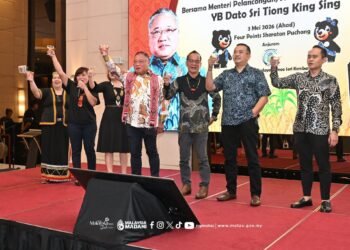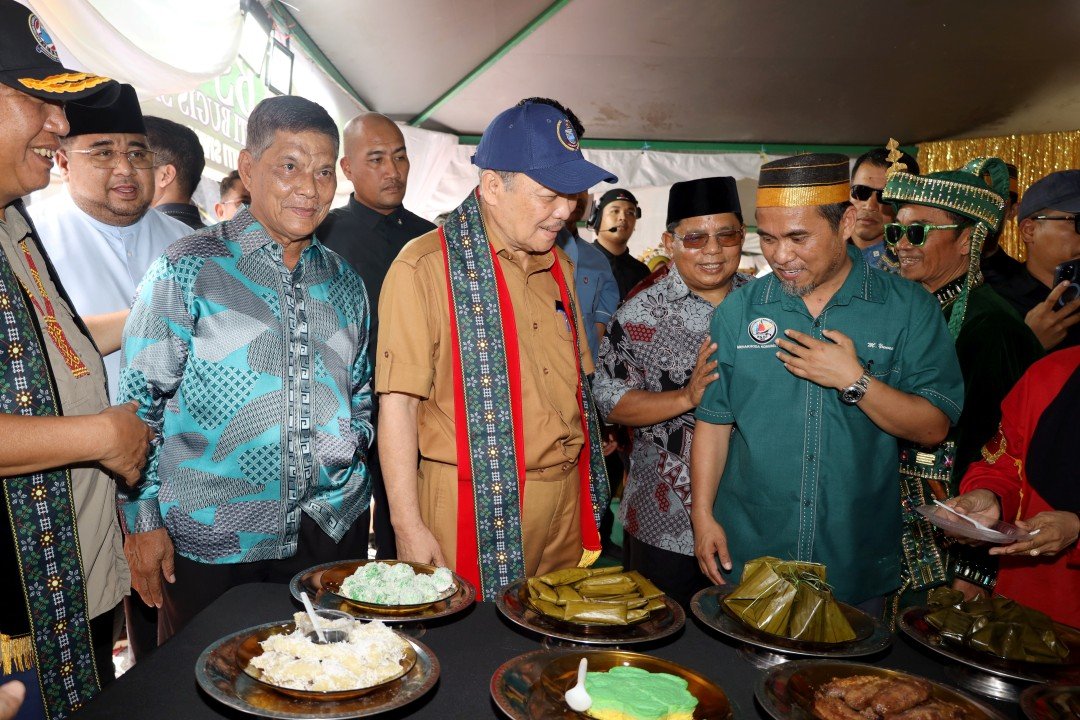

Hajiji (front, second right) makes a stop at an ethnic cultural booth during the event.
LAHAD DATU (May 6): Efforts to strengthen security in the Eastern Sabah Safety Zone (ESSZone) will continue to be driven by advanced technology, including artificial intelligence (AI), to ensure stability as the foundation of the Sabah’s economic growth, said Chief Minister Datuk Seri Panglima Hajiji Noor.
He said the state government is committed to enhancing security capabilities through the modernisation of assets and the use of drones, radar and big data analytics for more comprehensive monitoring and faster response to threats.
“In line with the Hala Tuju Sabah Maju Jaya (SMJ) 2.0 framework, we want security agencies to strengthen the use of AI so that our system is not only physically strong, but also digitally resilient,” he said during the SMJ Roadshow Programme held in conjunction with his security inspection visit to the ESSZone here.
Hajiji stressed that security and economic development are closely linked, describing safety as a key prerequisite for investor confidence in Sabah.
“Without strong security guarantees, investor confidence will be affected, economic activities will be hampered, and the well-being of the people will also suffer,” he said.
He added that development in ESSZone areas will be implemented holistically, balancing security requirements with economic and social progress.
The maritime sector and Blue Economy have been identified as new growth drivers under SMJ 2.0, including modern fisheries, marine tourism, and the development of coastal and border towns.
However, Hajiji said these potentials can only be fully realised if Sabah’s waters remain securely protected.
“Sabah holds a strategic coastline stretching over 1,400 kilometres and serves as the nation’s frontline in Borneo and the Sulu Sea,” he said, adding that stronger security would also unlock opportunities for border town development as new economic gateways.
On Lahad Datu, Hajiji said the district has significant potential in plantations, fisheries, tourism and downstream industries, but stressed that investor confidence depends on a safe and stable environment.
He also reminded that security is a shared responsibility involving security forces and local communities, urging residents to remain vigilant and report suspicious activities.
“The role of the community is very important as a strategic partner to the security forces in ensuring peace and security are preserved,” he said.
Hajiji further assured that the welfare of security personnel will continue to be prioritised through cooperation between the state and federal governments, including improvements in facilities, housing and logistics.
He said the inspection visit programme serves as a platform to assess existing strengths and weaknesses in order to refine future security strategies for the ESSZone.