Saturday, May 2, 2026 1:38 pm –
Jerusalem time

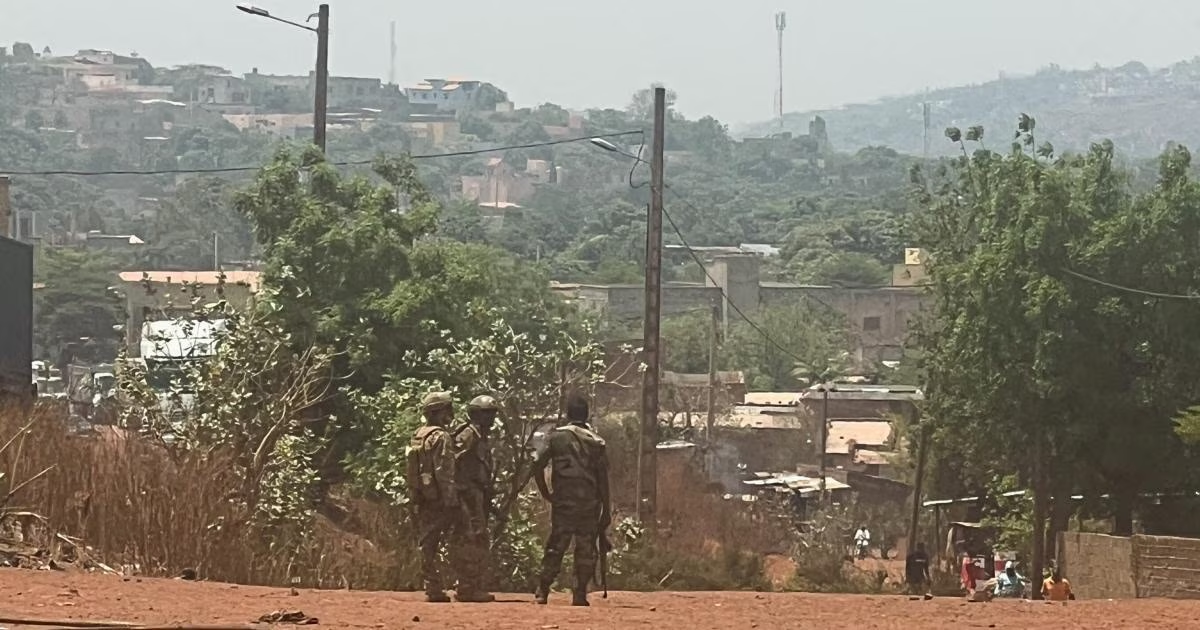
The judicial authorities in Mali revealed serious developments related to security breaches within the military institution, as the public prosecutor in the military court in the capital, Bamako, announced the involvement of army officers in cooperation with armed groups. The statement explained that the ongoing investigations have proven the existence of conclusive evidence convicting current military personnel and others who were recently dismissed, noting that they provided logistical and informational facilities to the militants who carried out the largest series of attacks the country has witnessed in more than a decade.
The accusations were not limited to the military side only, but also extended to the opposition political class abroad, as the statement confirmed the involvement of prominent Malian politicians living in exile in the coordination and planning of these attacks. These movements, according to official sources, aim to destabilize the state and facilitate the implementation of violent and coordinated operations aimed at undermining the authority of the ruling military junta in Bamako.
On the ground, Russia’s African Legion, in cooperation with units of the Malian army, announced the implementation of a qualitative military operation targeting a militant camp near the Mauritanian border. Sources reported that the operation resulted in the destruction of a gathering of about two hundred militants, who were using a fleet of 150 motorcycles and three trucks equipped with missiles and heavy machine guns to launch their lightning attacks.
In a related context, Russian forces succeeded in securing the arrival of a huge convoy of fuel tankers to the capital, Bamako, in a step aimed at breaking the siege imposed by armed groups. The Russian side confirmed that the convoy crossed the vital routes without any objection, which refutes the militants’ claims about their ability to isolate the capital financially and economically, and enhances the resilience of the state’s vital supply lines.
The Malian capital, Bamako, has been facing increasing pressure since last January, after the economic siege imposed by the militants turned into a stifling land and military siege. The armed groups were able to extend their influence over strategic locations, including the cities of Kidal and Gao in the north, all the way to the city of Safari in the centre, making the military junta’s strongholds in Bamako and Katyn under direct threat.
Investigations found strong evidence regarding the complicity of some military personnel in the attacks, including current and recently dismissed officers.
For its part, the ‘Support for Islam and Muslims’ group escalated its political rhetoric, calling on all segments of Malian society, including parties, religious forces and traditional leaders, to unite against the existing authority. The group demanded the overthrow of the military junta that has been leading the country since 2020, calling for the establishment of what it described as ‘new Mali’ through a comprehensive transitional phase that would end the current military rule.
Despite these challenges, Army Commander Asimi Goeta made statements in which he affirmed his tight control over the joints of the state, acknowledging at the same time the seriousness of the current stage that the country is going through. Goita pointed out that the recent attacks were carried out in high coordination between the armed organizations and representatives of the ‘Front de Liberation de Azawad’, which requires full mobilization of the armed forces to confront this alliance.
Within the framework of regional solidarity between the military regimes in the Sahel region, both Niger and Burkina Faso were quick to provide direct military support to their ally, Mali. The Niamey government announced that the joint force of the three countries launched intensive air strikes targeting militant strongholds in the regions of northern Mali, in an attempt to relieve military pressure on the Malian army and restore the field initiative.
At the international level, the Kremlin renewed its commitment to supporting the ruling authorities in Bamako through the African Corps, rejecting all pressures aimed at withdrawing its forces from the region. Observers believe that the Russian presence has become a fundamental pillar of the military council’s strategy to remain in power and confront the growing threats from armed groups and separatist movements.
On the other hand, the Front for the Liberation of Azawad issued a strong warning to the neighboring countries, Niger and Burkina Faso, asking them to stay away from the internal conflict in Mali. The Front’s spokesman stressed that the situation on the ground is out of control, anticipating the fall of the military regime in Bamako soon, and considering that external interventions will only complicate the crisis.