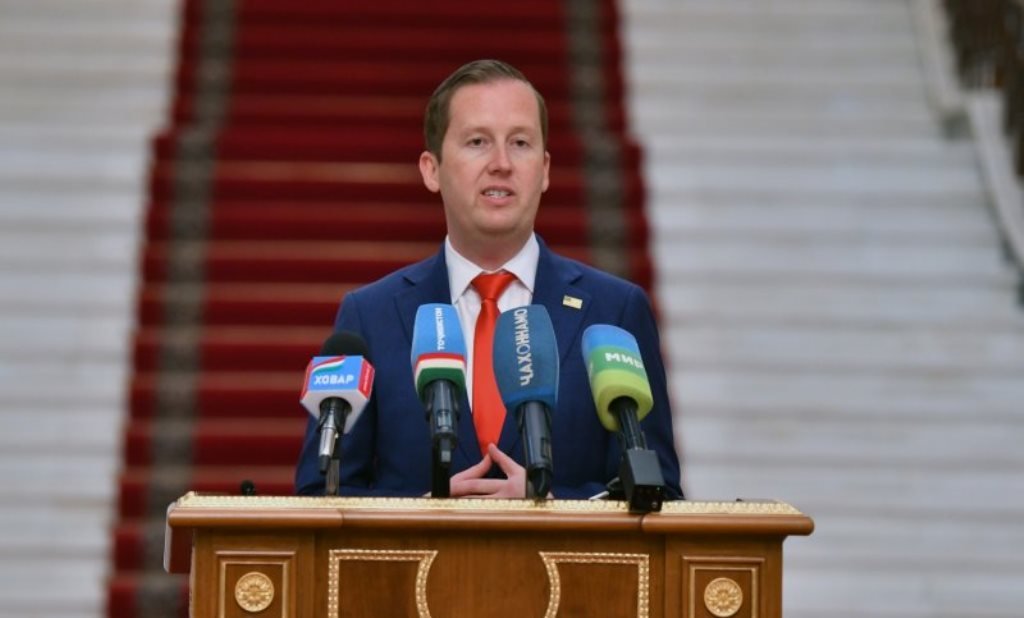
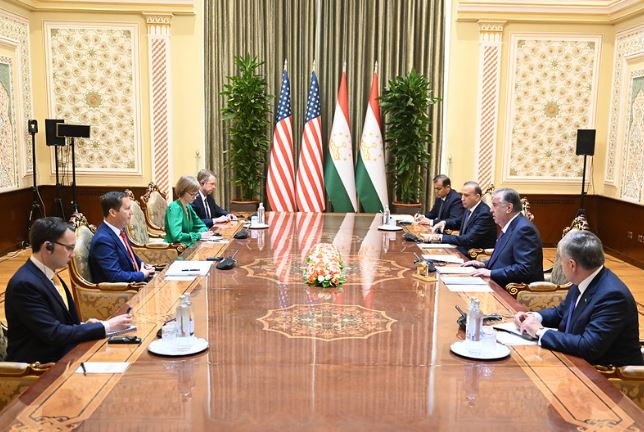
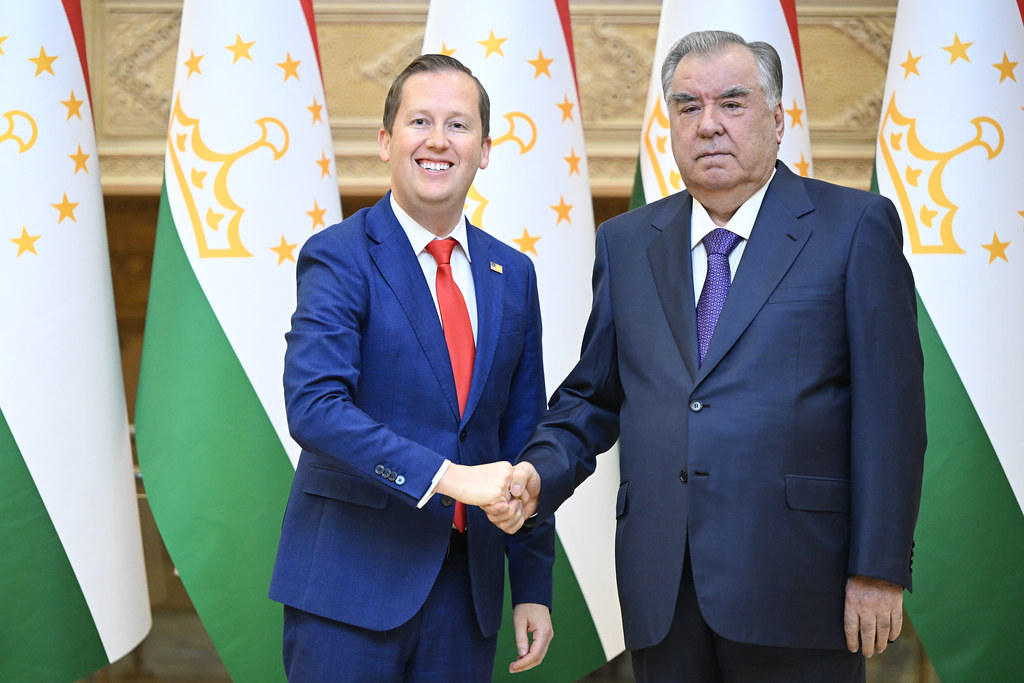
On April 28–29, the US Special Presidential Envoy for South and Central Asia, Sergio Gore, visited Tajikistan for a two-day visit. During the trip, he held meetings with the country’s leadership and President Emomali Rahmon, completing a tour of Central Asian states that began last fall.
During the meeting with the head of state, special attention was paid to the implementation of the agreements reached within the framework of the Central Asia – USA Summit held in November last year. Issues related to the current state and prospects for the development of bilateral relations in the areas of economics, trade, investment and security were also discussed.
Emomali Rahmon noted the need to use the potential of the Trade and Investment Framework Agreement (TIFA), as well as mutually beneficial cooperation in the fields of hydropower, mining and processing of minerals, light, food, chemical and pharmaceutical industries, the development of artificial intelligence, digital infrastructure and digitalization of the economy, the creation of joint ventures for the processing of agricultural products for export and attracting investments on this basis.
He recalled that the United States is one of the five leading investment partners of Tajikistan.
Below we will try to understand in detail the significance of this visit and determine the prospects for Tajik-American relations within its framework.
Central Asia in Washington’s spotlight
The visit of the US Presidential Special Envoy to Tajikistan must be viewed in a broader context related to the strategy of the current White House administration in Central Asia.
This strategy has a number of goals: containing China and Russia in Eurasia, developing new supply chains in the field of critical minerals and Eurasian transport and logistics routes, and seeking support for American leadership initiatives (like the Abraham Accords and the Peace Council) and investments designed to strengthen the confidence of US citizens in President Trump.
But for now, the biggest priority is perhaps containing and isolating China, especially in the context of crises in the Middle East and the Afghanistan-Pakistan border that are isolating Beijing in global markets.
Central Asia, in the event of prolonged tension in these directions, will acquire critical importance for the PRC. Another important factor is dominance China in the global market for critical minerals, which it uses as leverage.
In such conditions, the United States seeks to reduce dependence on Beijing shaping rare earth alliances where are they trying integrate Central Asian countries with large potential these resources. Let us recall that during the “Central Asia – USA” summit the topic of critical minerals and transactions in this areabecame key.
Purpose of visit
Sergio Gore’s visit to Central Asia could mean that the United States is seriously considering strengthening its position in the region. Washington intends to move into practice the implementation of the agreements reached during last year’s summit.
Despite the fact that the United States singles out Kazakhstan and Uzbekistan as its main partners in the region, a visit to countries such as Tajikistan, considered the least attractive country, reflects the complex regional nature of American activity in Central Asia.
A feature of the current US strategy in Central Asia is attempts to expand its trade and economic presence, and the mission of an American official is most likely to study and prepare the necessary basis for American business to enter the region.
As mentioned above, during the meeting between Gore and the President of Tajikistan, trade and economic areas were identified as priority areas of cooperation.
Let us also recall that in November last year there were signed multibillion-dollar trade and investment agreements, the implementation of which was focused on during the meeting of the special envoy with the head of state.
What value can Tajikistan provide to the United States?
If we talk about the practical value of Tajikistan for American policy, first of all we can highlight the possibility of comprehensive containment of China, which is pursuing an in-depth strategy in Central Asia covering all five countries and almost all sectors of the economy.
Tajikistan has large reserves of natural resources. The country is rich in gold, silver, lead, zinc, copper, antimony, mercury and other minerals. Only the cost of minerals and metals (mainly gold, silver, zinc, antimony and lead) at the Uchkado deposit can, according to preliminary calculations, amount to billions of dollars.
RT is taking a leadership position in the global markets for critical resources. For example, according to the US Geological Survey, in 2023 Tajikistan took second place in antimony production (21 thousand tons or about a quarter of world production). According to the country’s customs service, in 2023 Tajikistan exported antimony worth $107 million, and in six months of 2025 exports made up $286.5 million.
Tajik antimony may acquire a strategic character for the United States in the context of attempts to introduce export controls from the PRC, which accounts for about half of the world’s antimony production. American investment in this sector of the economy can also serve as a deterrent to China, which has a significant presence in the mining of this metal.
In this context, investment agreements of the type concluded last November between Tajikistan and the US-based Transparent Earth to provide technical assistance and remote sensing capabilities to the mining and agricultural industries worth $32.5 million are of particular value.
Challenges and opportunities for Tajik-American relations
A number of opportunities are opening up for Tajik-American relations today. This is, first of all, as noted above, the growing attention of the United States to Central Asia, as well as concrete and practical steps to expand its presence in the region, which do not exclude any country.
An opportunity, no matter how cynical it may sound, can also be considered to be increased competition between the United States and China, especially in the field of critical minerals. In this context, the positions of the United States and Tajikistan, as shown in the above example, may converge.
Another positive point in the relationship between the parties may be the priorities of the current White House administration, which relies primarily on the trade and economic expansion of its presence in the region. The Central Asian countries perceive this step very positively, which can increase their trust in the Americans.
Despite the positive factors, Tajik-American relations may face challenges that could weaken the prospects for the development of bilateral relations.
The first challenge can be considered a possible change in American foreign policy with the replacement of the current US administration. It should be noted here that American policy may be inconsistent in certain vectors in the event of a change of administrations in the White House. Peripheral regions for the United States such as Central Asia may become particularly vulnerable to this prospect.
Another challenge may be the declarative nature, sluggish implementation or complete non-realization of the intended vectors of cooperation. This is a fairly widespread practice in international relations, which is especially noteworthy for the interaction of parties like the United States and the Republic of Tajikistan.
Another challenge is the lack of sufficient knowledge and understanding of the parties about each other, the remoteness of political and economic cultures and the lack of constant contacts of high rank and in extended groups.
What can you offer?
For the further development of relations between the United States and Tajikistan, three generalized recommendations could be proposed (due to the limited scope and nature of the material).
Deepen knowledge about each other
Despite the existence of political contacts, relations in the economic sphere, as well as culture and education, in the author’s opinion, the parties do not have sufficient knowledge and ideas about each other.
For example, American business does not have sufficient knowledge about the Tajik market, about the country’s business culture and ideas about how to behave in the atmosphere of our market. The Tajik establishment, in turn, does not fully understand American culture and has a certain level of distrust of Americans.
To reduce the influence of these factors, it is necessary to establish a set of relationships that should more or less bring the parties’ ideas about each other closer to reality. These could be steps such as increasing the number of contacts between representatives of the political classes, business and scientific and expert communities. It may be important to study the experience of interaction with other countries, for example, Tajik-Chinese relations.
Pay due attention and don’t be afraid
American business, due to the remote location of Tajikistan, the small size of the Tajik economy, possible risks associated with investment guarantees, the economic presence of China and Russia, and established, not entirely correct ideas about possible destabilizing factors, is afraid to invest in the country.
In this context, American business, as already mentioned, needs to study the country in more depth, give it due attention and not be overly cautious.
Returning to the experience of China, it would be possible to achieve certain legal guarantees like agreements on the promotion and mutual protection of investments.
Sequence and implementation of given vectors
Further development of relations will require consistency of course and implementation of the planned vectors of cooperation. Since Tajikistan needs close relations with the United States, it will be interested in and adhere to the consistency of its American vector of foreign policy.
Washington is more vulnerable in its consistency in relations with Dushanbe. The implementation of the planned areas of cooperation also depends on the presence of a consistent policy.
The United States needs to maintain increased attention to Tajikistan regardless of the change of administrations in the White House.