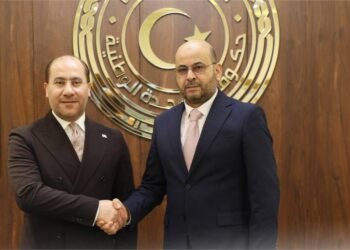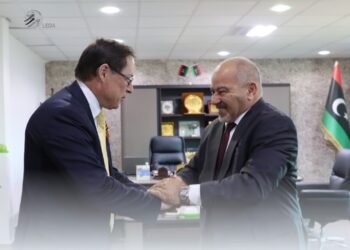
The Chairman of the Libyan Investment Authority (LIA), Ali Mahmoud, met yesterday with the Deputy Permanent Representative of the Federal Republic of Germany to the United Nations.
The LIA said the meeting addressed the status of the LIA’s assets invested in Germany and the mechanisms for their reinvestment and management within the framework of recent Security Council resolutions.
The two sides also discussed ways the German mission could support the LIA in facilitating the licensing procedures the LIA has submitted to the relevant German authorities. These procedures pertain to reinvesting its cash reserves held in German banks, in accordance with the provisions of relevant international resolutions.
The LIA emphasized that it is not requesting the lifting of the asset freeze imposed by sanctions. Rather, it seeks to manage and invest the uninvested cash reserves within the framework of the asset freeze measures, in a manner that achieves sustainable returns and safeguards the rights and interests of the Libyan people.
The LIA noted that, along with its long-term investment portfolio, it has previously managed to reinvest a portion of its cash reserves in German markets and financial institutions, while maintaining the asset freeze. It also added that is it had a diversified investment portfolio managed in Germany, which includes the energy sector, bank deposits and equity investments in companies, thus supporting the preservation of asset value in the long term.
A contrarian view
However, a March 2026 report by the American non-profit The Sentry Organisation noted that there were numerous examples of the LIA making more profit through frozen assets than through assets it was free to reinvest.
The report says the 2020 Deloitte assessment of the LIA assets value them at $62.85 billion. The Sentry calculates that around two thirds of these assets ($40-43 billion) are frozen, leaving one third (around $20-23 billion) not subject to any freeze.
It adds that the LIA also has the ability to actively manage at least $9.5 billion of those frozen assets via licenses obtained from sanctioning authorities. This means that—when combined with the approximately one third of the LIA’s assets that are not subject to sanctions—the LIA remains able to actively manage around half of its total assets, or $30-33 billion.
The report says these should be delivering a return on investment. Instead, the total value of the LIA’s assets has in fact fallen since 2011, and the assessed value of the assets that were not frozen or for which licenses were obtained – has not increased.
It says the LIA has campaigned in recent years for the freeze to be partially lifted, claiming that it has been undertaking a transformative process to improve accountability and transparency., But as the LIA paints a public picture of positive strides, it has failed to come to grips with the flaws in its sprawling organization.
By examining the LIA’s activities in the United Kingdom (UK), South Africa, Liberia, and elsewhere on the African continent, The Sentry has identified ongoing issues that have led to the mismanagement of billions of dollars of assets that are not subject to any asset freeze and the failure to effectively navigate sanctions designations where assets have been frozen—calling into question the LIA’s public narrative. The LIA did not respond to The Sentry’s request for comments concerning its findings in this report.
Together, these findings expose a very different picture than the one the LIA is presenting to the UN Sanctions Committee, revealing insights into the systemic problems the LIA faces.
Key recommendations
The Sentry report has made several recommendations:
- The UNSC should not ease current restrictions on the LIA until Libya achieves more thorough and transparent governance standards for its sovereign wealth fund. Providing access to frozen funds—even under oversight from the Security Council—would remove the LIA’s incentive to better manage the assets.
- The UNSC should therefore condition further sanctions relief upon benchmarks for improved LIA governance and transparency. By more clearly seeking to extract improvements as a precondition for further access to frozen assets, the UNSC will also help those in the LIA who are committed to better stewardship of Libya’s sovereign wealth push back against the political and coercive pressures that they face from vested interests. Without such efforts, Libya’s frozen billions will simply slide into the pockets of politically exposed persons (PEPs) and be lost to the Libyan public.
- The LIA should publicly release a copy of its audit, asset valuation, and consolidation of accounts, acknowledging shortcomings. This should include a statement recognizing where assets may need to be written off if they have been lost or mothballed.
- The LIA should publish an annual report detailing its financial performance, including the returns its assets are generating and progress towards compliance with the Santiago Principles.
- In keeping with the repeated findings of the Libyan Audit Bureau, the LIA board should urgently conduct an audit of those holding positions within the LIA’s ecosystem to address repeated conflicts of interest in the management of its subsidiaries. This should also include an assessment of the PEPs contracted by the LIA.
- If the LIA does not agree to these conditions, the UNSC should insist upon a forensic audit of the LIA’s assets and accounts to definitively clarify the status of its governance and guide further decisions.