The Colombian artist Beatriz González, who died on January 9, 2026, was one of the most relevant figures in contemporary Colombian art. One of her facets, less known to some, was that of researcher and historian of Colombian art.
For 14 years of her life she worked at the National Museum of Colombia as curator of art and history, a position in which she presented several exhibitions and in which she was responsible, among other things, for researching the museum’s art and history collections and a curatorial renovation of the rooms, inaugurated in 2001.
READ ALSO
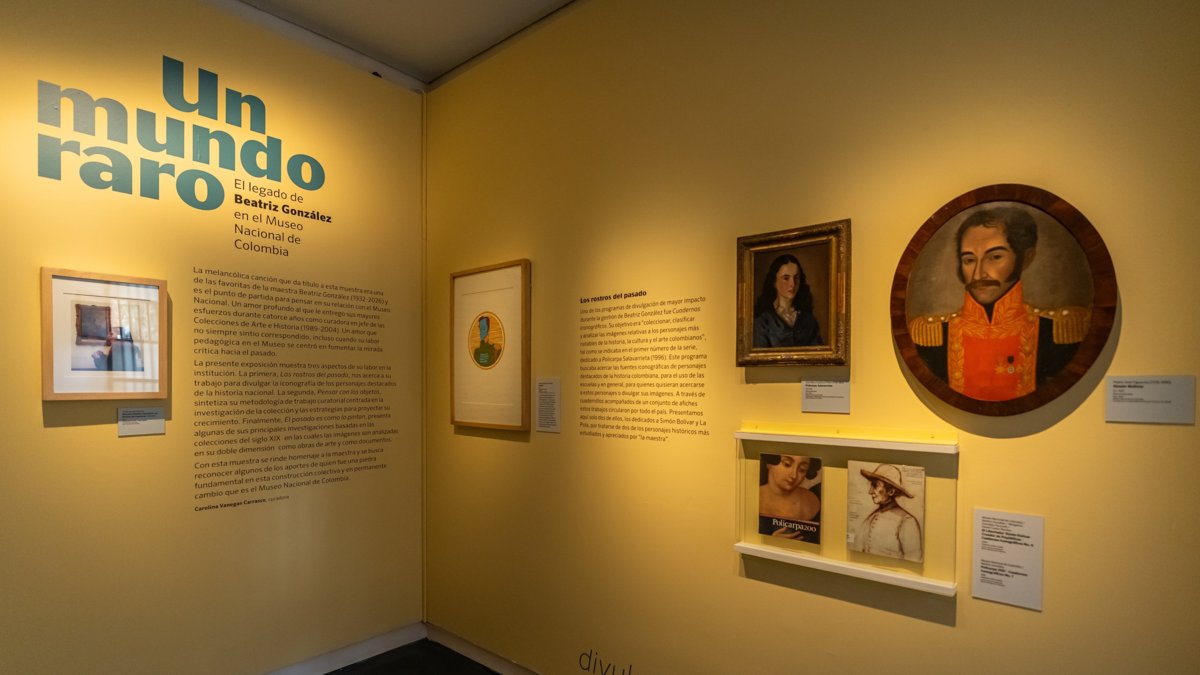
These days, the National Museum presents a temporary exhibition to recognize and honor those legacies that González left in the institution. Titled ‘A strange world: the legacy of Beatriz González in the National Museum’, the exhibition does not focus on her work, but on her research, her work as a curator and on some of the artists she researched.
The curator of the exhibition, Carolina Vanegas Carrasco, an art historian who worked with her at the museum, spoke with EL TIEMPO to understand more about this exhibition, which can be visited on the second floor of the National Museum until July 15, 2026.
Beatriz González died on January 9, 2026. Photo:National Museum of Colombia Archive
When did you meet teacher Beatriz González?
In the year 2000, I studied Fine Arts at the National University and came to the National Museum to volunteer in the art and history curatorship, which she directed. There we began to work on the exhibitions that were being organized at that time and on research into the museum’s collection.
Why was the teacher’s time at the National Museum so important?
She was curator between 1989 and 2004, and during those years she not only made many exhibitions, but also researched the museum’s collection, a work that, added to that of the teams that succeeded her, can currently be seen in the Colecciones Colombianas database. Furthermore, he laid out the curatorial script for the permanent rooms for the renovation project that the museum carried out during those years and, once that project was inaugurated, in 2001, his idea was to continue investigating the collection to feed those scripts. The teacher worked with teams from different disciplines, had many advisors and constantly communicated with other areas of the museum. A very important area for her, for example, was the Educational division. In conjunction with this, the Ernesto Restrepo Tirado History Chairs were held, with the idea of incorporating recent research from the academy and other institutions into the museum to jointly think about how to complement and enrich the museum’s permanent rooms.
And how did the idea of honoring and talking about that legacy in an exhibition come about?
We know that Beatriz González is an internationally recognized artist, but that her role as a researcher and curator is less known. For this reason, when she died, on January 9 of this year, the National Museum of Colombia wanted the exhibition in tribute to her to be focused on that legacy for the museum and for the history of Colombian art.
You say in the introductory text to the exhibition that the deep love that the teacher felt for the National Museum was not always felt reciprocated. When did this happen and why?
Beatriz González was a person who always generated controversy, both in her work and in her research, because she was a woman with strong opinions. Once she left the National Museum, and although the institution continued to do research, they no longer did exactly what she would have done. Since he did not mince words, he criticized and said what he did not think, which of course generated very interesting public debates. And although the exhibition appeals in part to the affection of those of us who were trained with her and the way in which she transformed research in Colombia based on heritage, it does not want to show her as someone infallible, on the contrary. What seems most interesting to me is that she did not expect one to be obedient, but instead encouraged having a critical vision of history and always debating.
Beatriz González in a photo taken at the museum and which is part of the exhibition. Photo:National Museum of Colombia
The title of the exhibition comes from there, right?
‘A strange world’ is a song by José Alfredo Jiménez that she really liked, and it is a song about reciprocated and unrequited love. It is a metaphor to talk about Beatriz González as a person who generated strong passions and controversy. Furthermore, it allows us to talk about how she broke those boundaries between ‘elitist culture’ and ‘popular culture’ – which was another of her great contributions to the museum – because, just as she listened to symphonic music to paint, she also liked popular music, such as that of José Alfredo Jiménez.
How did you manage to account for the entire legacy of Beatriz González in a limited space?
This is a cabinet exhibition, which means that it is developed in a small format, assuming the challenge of making a synthesis that, as an example, highlights three aspects of the work of teacher Beatriz González in the museum.
The first part focuses on dissemination and a program that she worked together with the Educational area, called Iconographic Notebooks, with the idea of bringing to all Colombians, and beyond the borders of the museum, the images of relevant figures in the history of Colombia that are protected by both the museum and other institutions.
The second is called ‘Thinking with objects’ and alludes to Beatriz González’s work methodology: thinking about what things could be told from what she was collecting, but also her idea that only by investigating the collection could one think about what was missing and through what objects the stories that were not told in the museum’s script could be told.
The third, more focused on publications, focuses on her research on the history of Colombian art in the 19th century, one of the periods that she studied the most. Here we show a little of what she worked on in the museum, but also in other public collections in the country, and we focus on three artists from that time who were endearing to her.
Who are these artists?
There is Peregrino Rivera Arce, an artist trained at the National School of Fine Arts who went to war in 1899 with his drawing materials and made some of the banknotes that circulated during the Thousand Day War. Also José Gabriel Tatis, who made the drawings of the Congress of New Granada in 1853 and whom she said had inspired her to paint the work on the constituents of 1991. And the third was her great love of the 19th century, José María Espinosa, who in addition to being one of the main portraitists and caricaturists of the early 19th century, was Antonio Nariño’s standard bearer in the Southern Campaign. And I think they were endearing to her because they were artists who, like her, had a great commitment to the country.
Is there a relationship between these artists, these investigations and their work?
Yes, for example, she dedicated a lot of time of her life to José María Espinosa. She said that Espinosa had taught her that caricature was also art. From there arose an investigation that began in the 80s and culminated in the last book she published: ‘History of caricature in Colombia’, the three volumes published by Villegas Editores in 2020. That is the investigation of a lifetime, but it also tells us a lot about Beatriz González in the sense of how important humor was for her in her work, that idea of how art can say things that a history or journalism text cannot express, and, in general, the importance of visual culture in the formation of national identity.
Carolina Vanegas, the curator of the exhibition ‘A Strange World’. Photo:National Museum of Colombia
Why do you think Beatriz González is still relevant today?
Her fundamental trait in all the roles she held was her passion for generating spaces for exchange and commitment to the country, whether as an artist, as a curator, as a researcher or as a museum pedagogue. Furthermore, for those of us who work in museums, this exhibition reminds us of the responsibility of our actions and decisions in the public appropriation of our heritage.
JOSÉ VICENTE GUZMÁN- for EL TIEMPO
READ ALSO