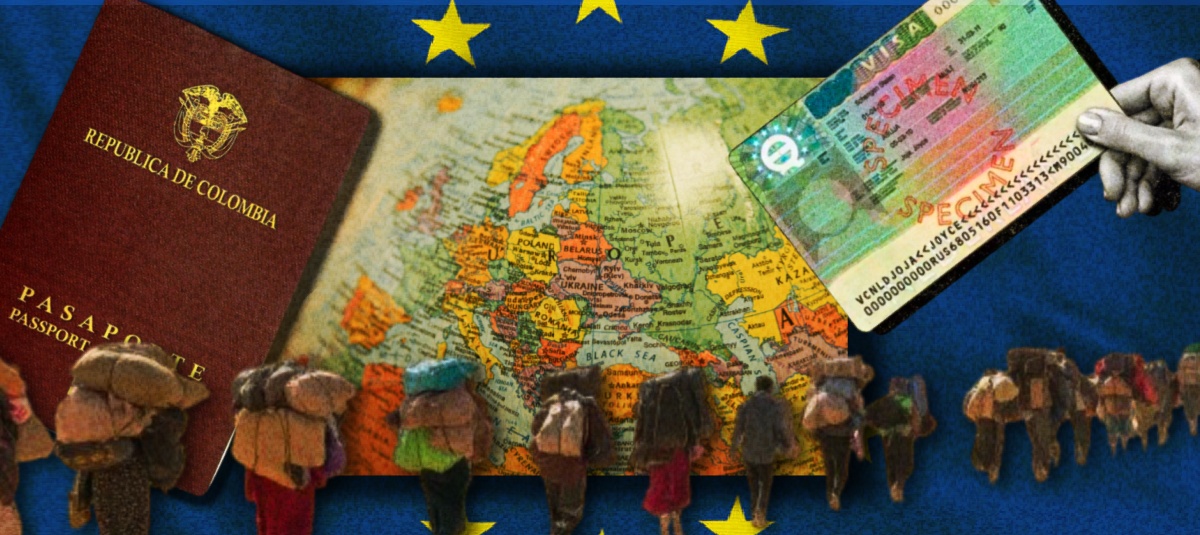
In recent years, the main migratory destinations have adjusted its entry and stay policieswhether for attract specific profiles or to restrict certain flows. These changes have resulted in new visas, program reforms and, in some cases, in the closure of roads that were previously used by many migrants, including Colombians.
It is the case of freezing the issuance of immigrant visas in the United States for Colombians and 70 other nationalities, which put the legal measures to emigrate to this country.
However, these adjustments do not affect everyone equally. Conditions vary depending on the profile: while some countries have strengthened schemes for qualified professionals or students, others have tightened mechanisms such as asylum or limited work options for unskilled profiles.
For this reason, EL TIEMPO collects some of the main programs, visas and recent changes in different destinations, organized according to the type of migrant, to identify what real options exist.
Regularization in Spain Photo:
1. Skilled labor migrant
For a Colombian skilled labor migrant, there are options in countries that have designed specific systems to attract talent. Canada and Australia They stand out for their point-based models, such as Express Entry (Federal Skilled Worker Program)in Canada, or work visas for Australia(classes 189, 190, 489, 481 and 482)where factors such as education, work experience and language directly determine the possibility of obtaining residency, and even applicants must take skills tests.
In Europe there are visas linked to employment, such as Blue Cardwhich allows highly qualified professionals in categories such as health, technologies or engineering, live and work in 25 countries of the European Union (except Denmark and Ireland) for the duration of the contract. In these cases, the key requirement is not to accumulate points but to obtain a previous job offer in demanded sectors. This can make the process faster for technical profiles, but also more uncertain if you cannot connect with employers from abroad.
This is how the European Union Blue Card works. Photo:
The United States represents a special case: it offers some of the highest salaries, but with more restricted pathways such as H-1B, which depends on corporate sponsorship and is subject to quotas and lottery. According to data from the State Department analyzed by this newspaper, between January and August of this year, only 501 of these visas were issued for Colombians, a reduction of 11% compared to 2024.
2. Unskilled or technical labor migrant
For unskilled or technical workers, the options are temporary work programs linked to specific sectors. In the United States, they highlight the H-2B visa, for non-agricultural work (construction, tourism, maintenance), and H-2A, focused on agricultural work. The latter has become more relevant after the return of Donald Trump and in light of the lack of workers in the fieldwhich has led to adjustments to facilitate its use by employers.
READ ALSO
In Europe, there are also figures to access work permits for seasonal work, On this page you can find out the requirements and processes for each country. In Poland, for example, Colombians can access by first obtaining an offer, which will allow the employer to start a process for a work permit and a national visa, which is valid for up to 9 months.
In Latin America, countries like Chile and Mexico offer more accessible routes. In Chile, professionals can apply to the Temporary Residence Visafor work that grants stay up to five years to carry out work mainly on a seasonal basis, while in Mexico there is the Temporary Residence with work permit for stays longer than 180 days and no longer than 4 years.
US Student Visa F1. Photo:iStock
3. International student
For international students, there are options such as Canadawhich operates with the Study Permitwhich also allows work part time during the program; Upon graduation, many students can access the Graduate Work Permitwhich allows them to work and then apply for residency. Australia follows a similar logic with the Student Visa (500)which can be linked to the Temporary Graduate Visa (485) to remain in the country after completing studies.
In United States, the main route is the F1 visa, but after the return of Donald Trump they have become more restrictions to access this visa, and they have even revoked more than 6,000 until August 2025, so it is no longer as preferred a category as before.
In Europe, countries like Spain offers a stay for studieswhich allows work partially and, in some cases, change to work residence afterwards. Germanyfor its part, has the student visawith access to low cost universities and the possibility of requesting a work search permit up to 18 months to get a job after graduating.
Long lines of migrants in Barcelona to request mass regularization in person. Photo:EFE
4. Asylum or refuge seeker
Asylum and international protection options for Colombians have been restricted in several of the main destinations. In the United States, the suspension of decisions, along with a significant reduction in refugee quotas from 125,000 to 7,500, increased uncertainty for applicants. Although the system has not disappeared, in practice it is frozen and greatly reduced.
In Europe, the panorama has also changed hard. The European Union advances in reforms to expedite asylum processesincluding the introduction of concept of “safe country of origin”to which Colombia is a part. This is a figure that would allow faster reject requests coming from countries considered without generalized persecution.
READ ALSO
Added to this is the case of the United Kingdom, which has adopted more restrictive asylum policies. Among the measures implemented is that refugee status will be temporary and reviewable every 30 months. Likewise, permanent residence can be requested after 20 years, previously it was after 5.
Colombians will have a harder time requesting asylum in the UK. Photo:
5. For family reunification
For family reunification migration, the landscape has also changed in some key destinations. In USAhe family reunification program was eliminated for Colombians and other countries in December.
In Europe, Spain maintains one of the more accessible schemes through the family reunification in a general regime, which allows legal residents bring spouse, minor children and, in some cases, parentsas long as they meet income and housing requirements. Other European countries, such as Germanyalso contemplate family reunification, but with stricter conditionsespecially in terms of income, living space and, in some cases, basic language knowledge.
In Canadareunification is channeled through the Family Sponsorship Programwhich allows citizens and permanent residents sponsor immediate family members.
6. Entrepreneur or investor
The options are highly conditioned by the capital amount and type of business. In USAone of the best known ways isEB-5 visawhich allows obtaining residence in exchange for investments from approximately $800,000 in projects that generate employment. There is also the famous ‘gold card‘ promoted by the Trump administration, at a cost of one million dollars, although its concrete implementation remains uncertain.
The digital nomad profile has grown in recent years Photo:iStock
In Europe, several countries developed schemes known as “golden visas,” which grant residency in exchange for investment. Spain, for example, allows you to obtain residency through real estate investment (from 500,000 euros), while Portugal and Greece have operated similar programs. In Asia, countries like Singapore run programs such as the Global Investor Programme, with high investment requirements.
7. Digital nomad or remote worker
The profile of digital nomad has grown in recent years, and several countries have created specific visas to attract remote workers.
In Europe, Spain has positioned itself as one of the clearest destinations for this profile with its digital nomad visawhich allows Colombians to live and work legally in the country while maintaining employment with foreign companies or remote income. The program offers work flexibility, tax benefits and an initial residence of up to one renewable year, with the possibility of extending the stay. Among the key requirements is demonstrating stable income of around 200% of the Spanish minimum wage (around 12 million Colombian pesos per month).
READ ALSO
In Asia and the Middle East, cases such as United Arab Emirateswhich offers specific permissions for remote workand countries like Indonesiawhich has developed the E33G visa (KITAS) for digital nomads. This permission allows reside up to one year (renewable) working exclusively for overseas employers, with a requirement of minimum income of around more than 200 million pesos annually.
Santiago Andrés Venera Salazar – INTERNATIONAL – EL TIEMPO