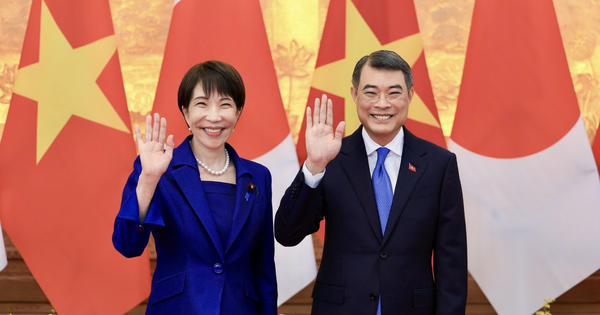
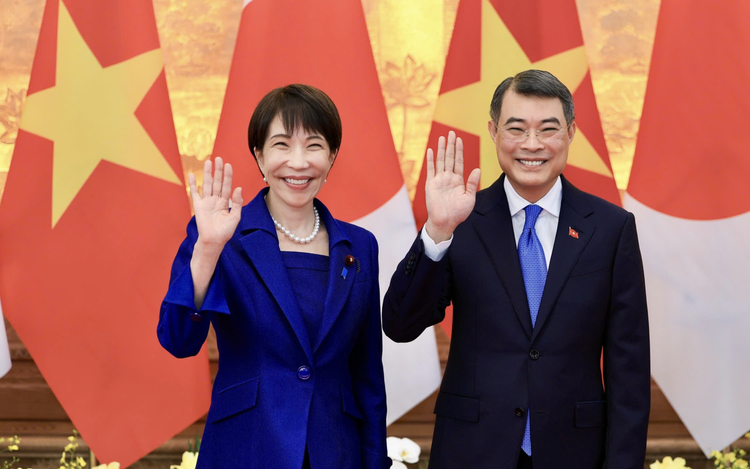
Vietnamese Prime Minister Le Minh Hung (R) and Japanese Prime Minister Takaichi Sanae wave before entering talks in Hanoi, May 2, 2026. Photo: Nguyen Khanh / Tuoi Tre
“Vietnam, true to Hanoi’s former name Thang Long, meaning ‘Rising Dragon,’ is developing at an extremely impressive pace,” Takaichi said at a joint press briefing with Vietnamese Prime Minister Le Minh Hung after talks on Saturday, during her official visit to Vietnam from May 1 to 3.
The remarks reflect Japan’s perception of Vietnam’s increasingly important role in its foreign policy.
Before her visit, Takaichi had already emphasized economic security as a new pillar of bilateral cooperation, a theme that featured throughout her engagements in Hanoi.
Economic security push drives energy, trade, technology cooperation
Talks between Takaichi and Vietnam’s top leadership underscored a gradual shift in bilateral ties toward energy security, supply chain resilience and higher-value economic cooperation.
On April 15, Takaichi convened a virtual summit of the expanded Asia Zero Emission Community (AZEC+), involving 15 countries, focusing on energy autonomy.
At the meeting, she launched the Partnership on Wide Energy and Resources Resilience Asia (POWERR Asia) and proposed upgrading AZEC into AZEC 2.0, expanding its scope beyond decarbonization to include economic and energy resilience.
At a post-talk briefing, Hung said both sides had agreed to accelerate projects under POWERR Asia, a US$10 billion initiative aimed at strengthening energy security across Asia.
Under the framework, Japan will support crude oil supply arrangements for the Nghi Son oil refinery, where Japanese firms hold major stakes and currently supply around 30-40 percent of domestic petroleum products.
PM Takaichi confirmed this would be the first project under the initiative.
The two sides also set targets to raise Japanese investment in Vietnam to $5 billion per year and bilateral trade to $60 billion by 2030, with priority given to high-tech projects linked to technology transfer.
Both countries also agreed to co-fund 15 semiconductor research projects under NEXUS, an initiative of Japan’s science and technology agency meant to expand international research cooperation and strengthen the Japanese technological presence in the region.
Speaking to Tuoi Tre (Youth) newspaper, Professor Stephen Nagy of International Christian University in Japan said Vietnam is well positioned for selective supply chain diversification thanks to its stable political environment, young workforce, and strategic location.
He added that Japan’s direct investment in Vietnam and official development assistance (ODA) cooperation between Japan and Vietnam support the Southeast Asian country’s sustainable development while also strengthening intra-ASEAN economic connectivity, which is aligned with Tokyo’s FOIP vision.
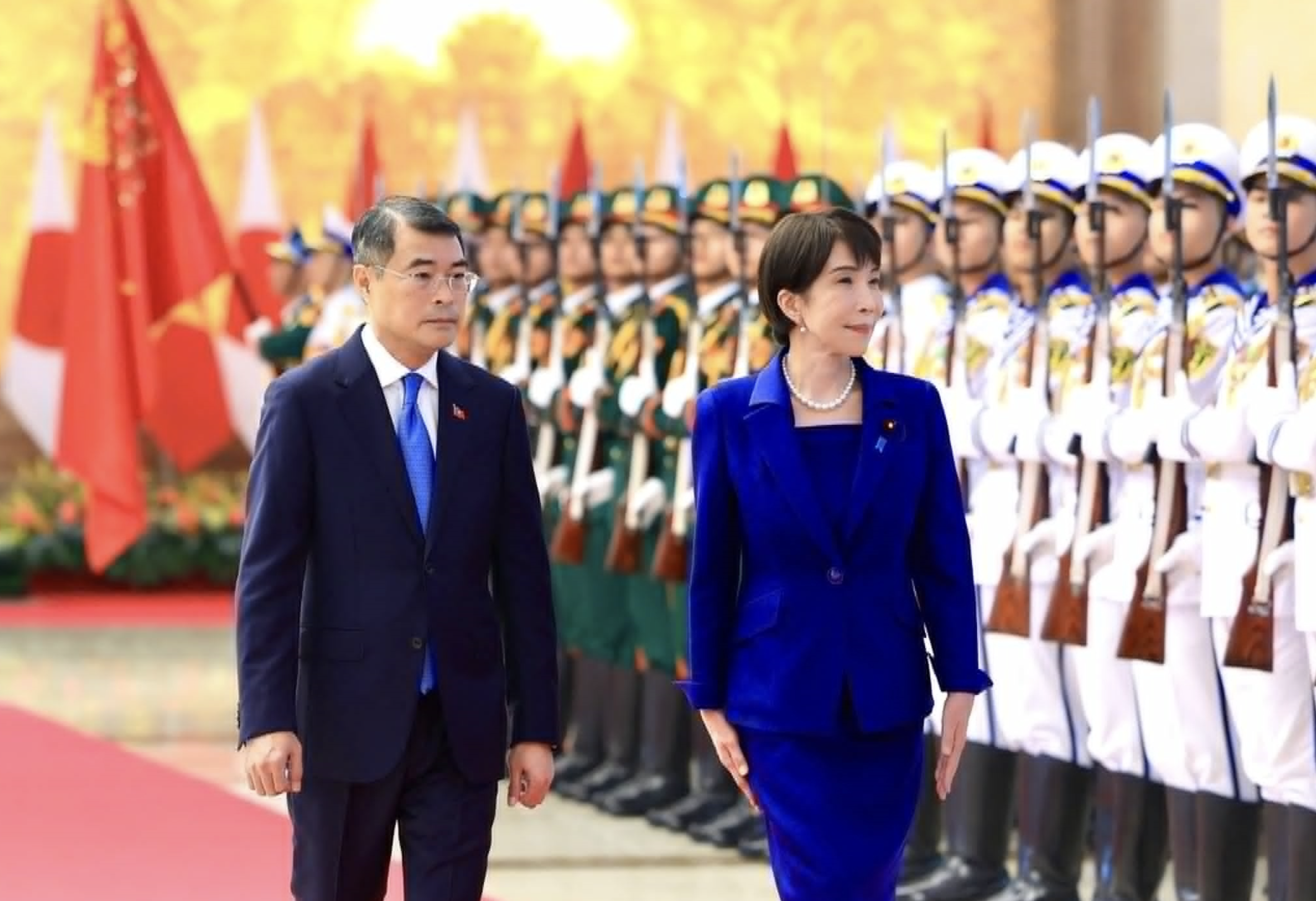
Vietnamese Prime Minister Le Minh Hung (L) and Japanese Prime Minister Takaichi Sanae review the honor guard during the welcome ceremony for Takaichi in Hanoi, May 2, 2026. Photo: Nguyen Khanh / Tuoi Tre
FOIP shift underscores Vietnam’s strategic role
The strategic importance of Vietnam was highlighted by Takaichi during her visit.
She noted that many Japanese companies have already expanded their presence in Vietnam, which is a key node in global supply chains.
Amid an increasingly complex global environment, Vietnam’s emphasis on strategic autonomy and proactive diplomacy made it a fitting venue for her FOIP policy update speech at Vietnam National University-Hanoi.
Launched a decade ago, FOIP has traditionally been framed as a geopolitical initiative centered on the rule of law, freedom of navigation, and high-quality infrastructure connectivity.
Takaichi’s message suggests Japan is now repositioning FOIP toward a more economic and technology-driven framework, with greater emphasis on supply chain resilience and energy security.
Yamada Takio, former Japanese ambassador to Vietnam and now a special adviser to Japan’s foreign minister, said supply chain disruptions could significantly affect Tokyo’s production capacity and wider regional stability.
He noted that Japan is heavily reliant on imported critical supplies across Asia, meaning any breakdown in energy or logistics in the region could have broad economic consequences.
Against this backdrop, initiatives such as POWERR Asia are expected to support the broader re-definition of the FOIP framework.
Takaichi’s visit goes beyond protocol, underscoring not only Vietnam’s position as her first stop in Asia following her re-election in February 2026, but also Japan’s growing priority on Southeast Asia in its long-term strategy, while reaffirming Vietnam’s rising role in the regional order.