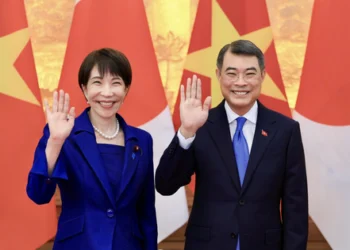
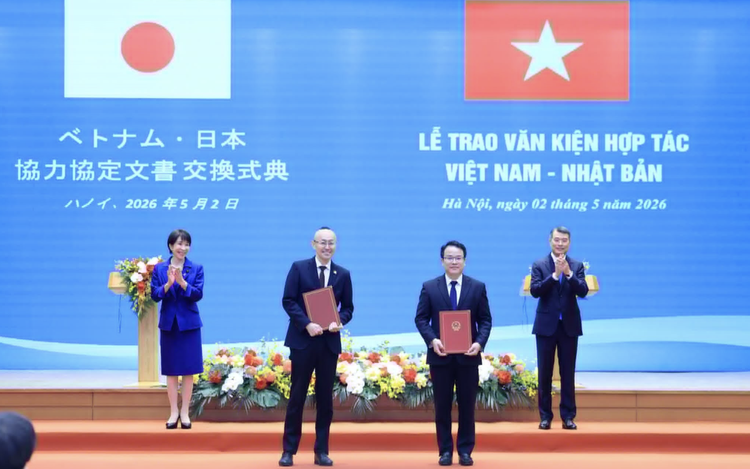
Vietnam’s Prime Minister Le Minh Hung (2nd row, right) and Japanese Prime Minister Takaichi Sanae (2nd row, left) witness the exchange of an MoU between the two nations in Hanoi, May 2, 2026. Photo: Nguyen Khanh / Tuoi Tre
In late April, authorities in Bac Ninh Province, northern Vietnam granted investment certificates to two new Japanese-backed projects, including the Aeon Mall Tan Tien, with total capital of nearly US$150 million, and Sunhill Vietnam factory No. 2, valued at some $3 million.
Both, located in the Hiep Hoa industrial cluster, demonstrated Japan’s expanding footprint in a market it has cultivated for over 30 years.
Persistent investor
In the first quarter of 2026 alone, newly registered Japanese investment in Vietnam reached roughly $191.3 million, accounting for 1.9 percent of the total new foreign investment in the Southeast Asian nation, according to the General Statistics Office of Vietnam.
This figure placed Japan among the top five investors with the largest new investment in Vietnam.
To date, Japan ranks as the third-largest source of foreign investment in the country, with its engagement in around 5,630 projects and total registered capital exceeding $79.4 billion.
Some Japanese brands such as Honda, Toyota, Canon, Panasonic, and Nidec have long been embedded in Vietnamese daily life.
Their presence extends beyond retail shelves to large-scale investments in manufacturing, distribution systems, and supply chains across multiple provinces.
Currently, Japanese enterprises operate in 33 out of Vietnam’s 34 provinces and cities, with investment concentrated in manufacturing and processing (61 percent), electricity production and distribution (15 percent), and real estate (12 percent).
Japanese firms have mainly made their investment in Ho Chi Minh City, Thanh Hoa Province, Hanoi, Hai Phong City, and Dong Nai City.
Vietnam is not only an investment destination but also a profitable one.
A recent survey by the Japan External Trade Organization (JETRO) found that about 67.5 percent of the Japanese firms operating in Vietnam reported profits in 2025, the highest level in 15 years and the third highest in Southeast Asia.
Notably, 35 percent of the Japanese companies in Vietnam, mainly active in electronics and transportation, export their goods to the United States, underscoring Vietnam’s role as a critical manufacturing hub in Japan’s global strategy.
Consumer market emerges as new frontier
Beyond production, Japanese capital is increasingly targeting Vietnam’s domestic consumer market.
According to Japanese market research company B&Company, Japanese investments in 2025 spanned diverse sectors including renewable energy, logistics, services, and infrastructure development.
JETRO data indicated that 60.1 percent of the Japanese firms planning to expand in Vietnam cited rising domestic demand as their primary driver.
This shift highlights Vietnam’s evolution from an export-oriented manufacturing base to a promising consumer market.
The proportion of Japanese companies intending to expand operations in Vietnam within one to two years stands at 56.9 percent, significantly higher than the ASEAN average of 46.8 percent.
Japanese giants are becoming increasingly prominent in Vietnam’s retail market.
AEON Vietnam currently runs a vast network of eight shopping malls, 15 general merchandise stores and supermarkets, 45 mid-sized and small supermarkets, 180 convenience stores, 29 specialty stores, and one health and beauty store nationwide.
The firm plans to pour an additional $1.5 billion into the Vietnamese market, targeting annual revenue growth of around 30 percent and a threefold expansion by 2030.
Meanwhile, department store chain Takashimaya is developing a new shopping center in Hanoi, expected to open in the third quarter of 2027.
Its existing mall in Ho Chi Minh City is also projected to see strong profit growth.
Japanese investment is also making waves through mergers and acquisitions.
In December 2025, stationery brand Kokuyo spent some $185 million acquiring a 65.01-percent stake in Thien Long Group, securing a leading position in Vietnam’s stationery market and enlarging its distribution network across ASEAN.
Moreover, Japanese grain solution company Showa Sangyo, which was the first producer in the world to sell the tempura batter mix, officially put into service a $21-million production facility in Ho Chi Minh City in late March, positioning Vietnam as a key production hub in its ASEAN operation.
Vietnam through Japanese eyes
With one of the fastest GDP growth rates in the region, a population exceeding 100 million, and record-breaking export figures, Vietnam is increasingly viewed as a high-potential market by Japanese investors.
JETRO surveys rank Vietnam among the most attractive destinations for expansion in ASEAN.
This reflects more than 30 years of trust-building and ecosystem development, from early manufacturing plants to today’s nationwide distribution networks.