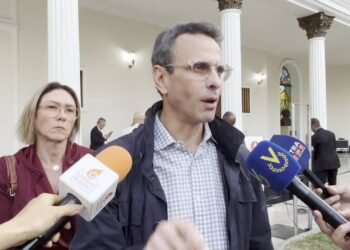
Information that came from Guatemala and that was denied by the State Department, to finally be true, was the replacement of Laura Dogu as charge d’affaires of USA in Venezuela for John Barrettclose to Marco Rubio.
For some political analysts, this situation is indicative of some friction within the administration of donald trumpabout Venezuela: Dogu did not arrive alone to open the North American embassy in Caracas or stay three months, but he had to leave. There was a “change” in policy, it is stated.
Barrett’s profile, with political and economic changes achieved in Panama and Guatemala, where he also served as chargé d’affaires, seems to speak for itself and it is expected that his mission in Venezuela will not be limited to a “normalization” of the interim of Delcy Rodriguez with economic openness.
Analysts consulted by Cocuyo Effect they give him the benefit of the doubt to the member of the US Senior Foreign Service, who has only been in Caracas for a week. As soon as he set foot on national soil, he declared that he is coming to finish implementing the three-phase plan proposed by Rubio for Venezuela: stabilization, recovery and transition.
The benefit of the doubt
“You have to give the benefit of the doubt to John Barrett who shows he is aware that you must implement the three-phase plan. It’s hard to think that he would declare that way if the intention is to normalize. If you name the three phases and then not do so, you are endorsing the failure of the plan for Venezuela that exists and is demarcated,” said political analyst Benigno Alarcón.
He clarifies that the exact reasons for Dogu’s replacement are not known, but he considers that the denial of the State Department and the subsequent arrival of Barret are indicative of a “conflict” or friction over the appointment.
“Laura Dogu did not act like someone who only came to open an embassy. In diplomatic language, a change is not only in face, indicates policy change. Barrett has a higher profile than Dogu and expressly said: I am here to fulfill the three-phase plan and meets with Delcy Rodríguez, he comes with a different line,” Alarcón added.
On April 15, one day after the denial by the State Department spokesperson, Dogu herself announced, through an official statement, that she would return to her position as Foreign Policy Advisor to the Chief of the General Staff Joint and welcomed his successor to the embassy.
For political consultant Erick Obermaier, Washington could have looked for an official with “differential” characteristics for the current state of what is happening in Venezuela and from there he noticed an “acceleration” of the narrative about the changes.
“There has been an acceleration of statements from some State Department actors, speaking again of the three phases, of the transitionincluding partial compliance with the first sentence and the current moment related to phase two (recovery),” he commented.
On April 16, the Undersecretary of State, Michael Kozakconsidered “completed” the first phase (stabilization) of the US plan for Venezuela. More than 100 days after the arrest of former ruler Nicolás Maduro, no acts of violence were generated and economic cooperation between Washington and Miraflores is advancing with the progressive recovery of oil production, increased income and the relaxation of sanctions.
Obermaier evaluates said compliance as partial because the political stabilization component has not met expectations for major changes (release of political prisoners, for example) and economic improvements have not yet permeated the population that demands better salaries. The US prioritizes economic progress over rescuing democracy in Venezuela.
What is expected of John Barrett?
“I am on Venezuelan land to continue implementing the three-phase plan of President Donald Trump and Secretary of State Marco Rubio, and deliver results for the people of our countries. “It is an honor to represent the United States at this historic moment in our relations with Venezuela,” Barrett said upon arrival.
During his time at Guatemala strengthened the bilateral alliance between the US and the Central American country, rejected the interference of organized crime in elections of authorities and promoted security, investment and reduction of illegal migration. In Panama He is also credited with freeing the canal from Chinese influence, protecting Washington’s interests. What are you expected to achieve in Venezuela?
“I have no doubt that the intention of the United States, that it is not a single person who makes the decisions, is to close the process in Venezuela with democratization through free elections. But a hypothesis not applied in other countries is being tested: generating conditions to stabilize a government (interim) and then going to elections, which does not seem to walk in a straight line,” Alarcón warns.
In his opinion, it raises concern that the economic opening, based on cooperation with the United States and greater access to resources by Miraflores, has so far not had a cost in political currency for the so-called rodrigato. That is to say, despite the protection, there were no changes in the Attorney General’s Office nor have all political prisoners been released.
“It is a process that is still underway. Beyond Delcy Rodríguez and the North American tutelage, it also depends on the capacities to achieve pressure, action and agreements of the national politics of the entire opposition group led by María Corina Machado and also on the counterpressures and agreements that imply the resistance of the other actors of Chavismo to the changes,” Obermaier pointed out.
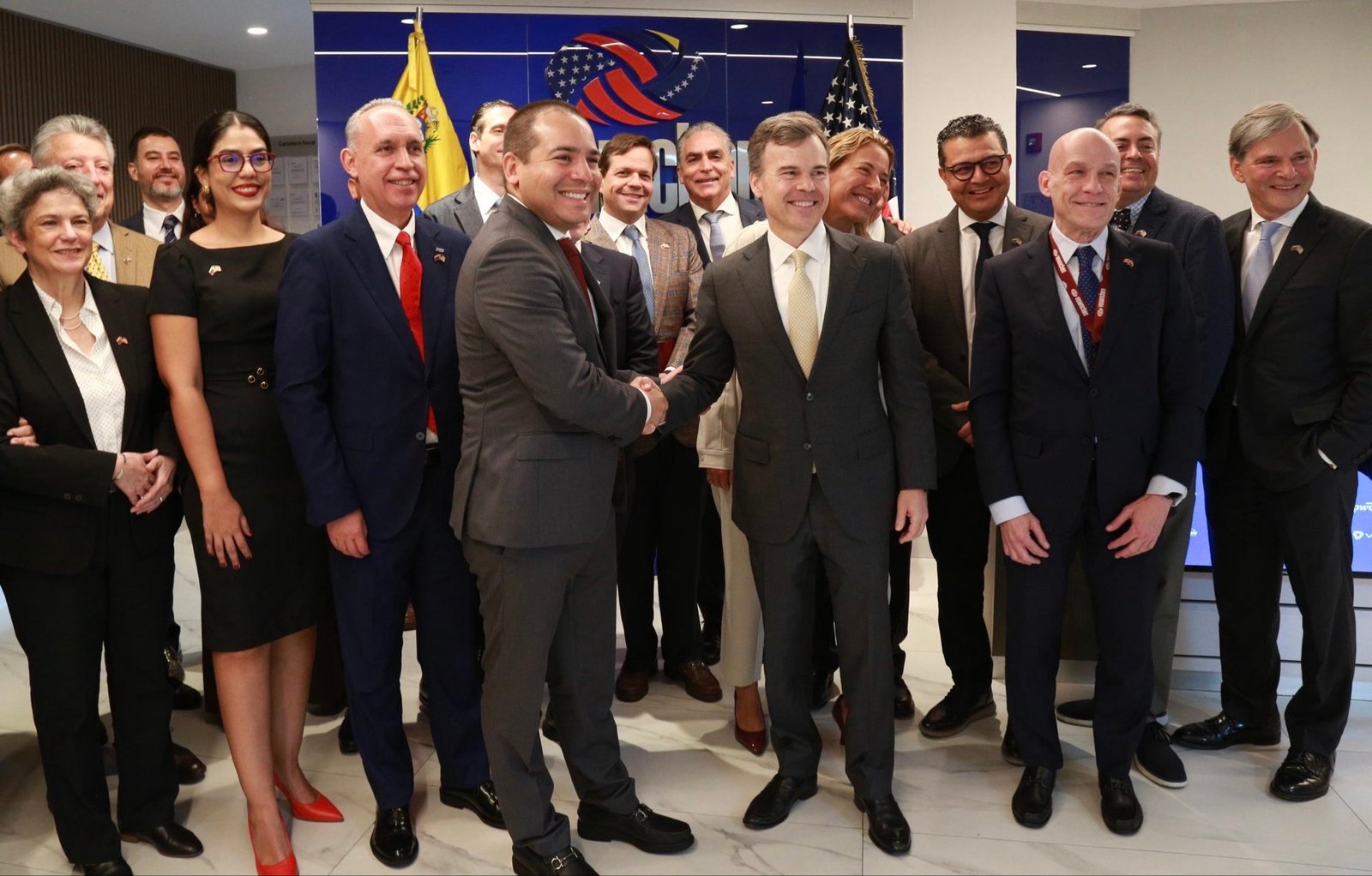
Barrett attended the forum this Monday, April 27 Venezuela Energy 2026where he avoided being approached by the press and urged the oil companies present to take advantage of the “historic opportunity” in Venezuela, in the context of economic cooperation with the White House. On Tuesday he met with representatives of the Venezuelan-American Chamber of Commerce and Industry.
“Investment from the United States is the engine of Venezuela’s transformation into a global energy center, and an essential pillar for stabilization and economic recovery,” said the diplomat during the meeting with businessmen.
Electoral scenario
Both Alarcón and Obermaier They rule out new presidential elections in Venezuela for the remainder of 2026. The opposition, it is emphasized, also seems to have assimilated it with its sights set on early 2027, after creating electoral conditions that start from the renewal of the National Electoral Council (CNE) so that an independent and impartial body is installed.
Alarcón warns that there are real dangers such as the fact that voting is postponed so much that it makes the political transition to democracy impossible.
“There may be institutional changes, but also there must be a change of government,; If not, it is not a transition. The government can change the Supreme Court of Justice, but if it continues to govern it is not a transition, the process can be reversed,” he said.
In that sense, he stressed that the first elections that must be held after the events of January 3 are the presidential because in Venezuela, because it is a presidential system, the Executive Branch prevails over the other Branches. In any case, he added, the Parliament can be elected together with the President of the Republic.
“We already had an opposition AN in 2016 and we saw what happened. Either both elections take place at the same time or the presidential election must be first,” he insisted.
Michael Kozak admitted that they still do not have a date for the Venezuelan elections, but stated that they are “focused on the steps.” Chavismo, for its part, especially in the voice of the Minister of the Interior and Justice, Diosdado Hairdismisses calls for elections as soon as possible because the opposition “breaks” the rules. Machado has said that he plans to return to Venezuela before the end of 2026, promises to tour the country and warned that they want elections to choose “everything.”
“In Venezuela the risk is that of a cosmetic transition instead of a real one. There are some intermediate ones there, such as the agreed transition scenario, in which the first election is not a 100% open election, but one that allows the country to be further democratized. That is, due to the non-participation of some politicians, but an election in which the opposition has the opportunity to win and the current numbers actually give,” is another scenario outlined by Obermaier.
In his opinion, starting a transition that ends in an election or making an election that starts a transition process are possible scenarios. A red flag about the first scenario, he said in agreement with Alarcón, is that the interim is showing signs of rearrangement and adaptationnot real changes that indicate that they will facilitate democratization.
It remains to be seen what the US can push through Barrett.