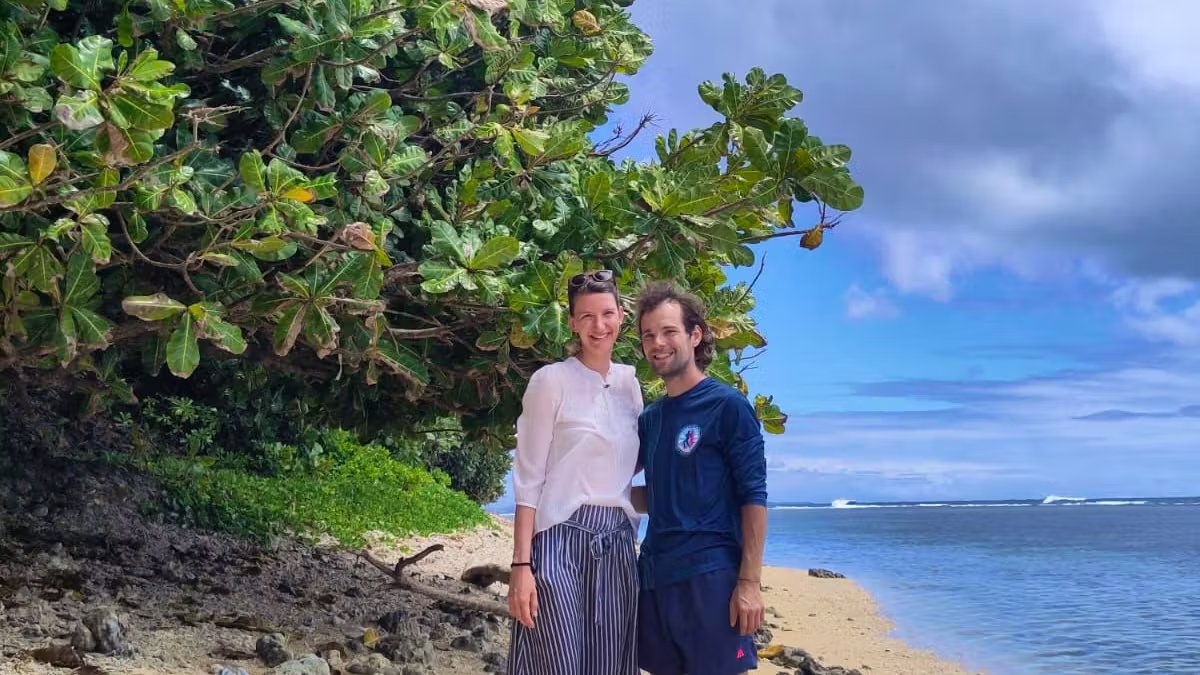
- Sabine and Damian met shortly before they emigrated and initially had a long-distance relationship.
- In South Africa, Sabine works on a project against violence against women, Damian joins in later.
- Your social enterprise supports those affected with training, work and psychological support.
- The need is great because one in three women in South Africa is affected by violence.
- The couple lives on donations without a fixed salary and builds a life together on site.
Four days before Sabine her visa Applied for South Africa, she met Damian. A timing that doesn’t exactly suit Future sounds. And yet, after this first meeting, they stay in the same country for several months, seeing each other, getting to know each other – and becoming one Couple.
When Sabine finally emigrated to South Africa, the relationship had only been official for two months. “We said: Let’s see how it works,” says Damian. He is staying in Switzerland for the time being, is in the middle of his studies and is bound for at least another year. Six months of long-distance relationship followed with lots of phone calls and a lot of uncertainty.
Project in the area of violence against women
Sabine knew early on that she wanted to go abroad. International work, a life outside of Switzerland – that had been her plan for a long time. But one experience has a decisive impact on her path: a woman becomes a woman near her university raped and murdered. There are protests in Cape Town, the act concerns many people – including her.

It becomes clear to Sabine: she wants to be in the area Violence to Women engage. In South Africa she finds exactly this access. She works on site in a project and takes on social work tasks.
A few days become a new life
When Damian visits her in South Africa for the first time, something changes. “It felt extremely good,” he says. Cape Town in winter, hardly any tourists, a country that immediately grabs him. The relationship becomes more intense – and it quickly becomes clear: you want more. The two get engaged.
The uncertainty about their future together remains: “It was like a testing and planning time for us,” says Damian. The Bernese is helping Sabine with the Not I But We project. At first it was only supposed to be short-term, but it quickly becomes more.
Every third woman is affected
The social enterprise supports women who have experienced violence or been victims of human trafficking. The aim is to give them a new perspective – specifically through free sewing training, a secure job and support in the areas of mental health and professional development.
The women make bags, clothing and accessories. But it’s about more than production. “It’s about dignity and economic independence,” says Damian. Nine women are currently working on the project. This year there will be up to 20.
Four new participants are already starting in the next training round. The women come to the project through partner organizations and shelters. As soon as there are free places, applications will be made.
Do you support social projects or are you committed to a good cause?
The need is great: “In South Africa, gender-specific violence is considered a national disaster,” says the 30-year-old. It is estimated that one in three women is affected. At the same time, the country is a central hub for human trafficking.
Between hope and harsh reality
Everyday life in the project is intense. “You never know what to expect,” says Damian. It happens that women show up for work in the morning – and have recently experienced violence. “These aren’t stories, they’re reality,” he says.
The situation is challenging for Damian. As a man in an environment where many women have been traumatized by men, his role is constantly questioned. «I think a lot about what men are capable of. There’s also anger.”
A life without a fixed wage
Financially, the project is not an easy path. Damian and Sabine do not receive any wages. They live off supporters from Switzerland. The project itself is financed about half through the sale of the products and the other half through fundraising, as the 30-year-old explains.
“It was challenging at first,” says Damian. “But it’s been working for two years – and you’ve learned to trust it.”

The employees currently earn around twice the local minimum wage. Nevertheless, it remains a balancing act: “If we pay too much, there is a risk that the women will never move on.”
The goal is clear: the women should stay as long as they need support – and then go their own way.
A step into the unknown – that worked
As the wedding date approaches, the two still don’t know exactly what their future will look like. A lot is open and unclear. “Looking back, it might have been smarter to plan it differently,” says Damian. “But it felt right.” Today they are married and are building a life together in South Africa.

Deborah Gonzalez (dgo) has been working at 20 Minuten since 2021. She is deputy head of the Society & Community department.