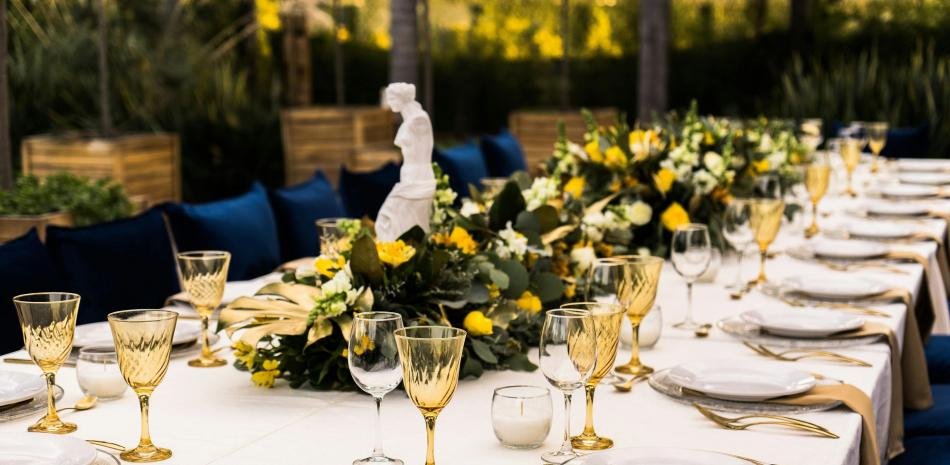
Whenever we organize a meal, whether formal or not so formal, we must remember the phrase of the French politician and gourmet Jean Anthelme Brillat-Savarin: “To invite someone is to take charge of their happiness during the time they remain under our roof.”
Therefore, we must think about our guests, their well-being and put ourselves in their place, that is, we all want to have a good time, enjoy food and drink and a good dance at the end if that is planned.
Expressed like this, it seems very easy because I always said that it is easier to be a guest than to be a host. Putting on a formal meal requires a lot of advance planning.
It all starts once the date, place, and number and level of guests are defined: all of this is determined by the host, always.
What does it take to receive well?
Organization: good planning, calculation: to make purchases, control: of the elements to be used, cutlery, tableware, glassware, courtesy: when inviting, receiving and saying goodbye, style: taking care of every detail, keeping calm on the day of the meal, precision: when giving instructions to the staff, realism: when evaluating the space and the budget and generosity: offering quality in drinks and delicacies
When we talk about the style of the food, we are referring to the harmony that must exist between the room that will be used, the quality of the delicacies and drinks that will be served, and the magnificence that the decoration will have.
A single example will suffice to clarify this issue: if the host decides to have a formal meal, but in a country style, there will be no harmony if the decoration is full of French glassware and chandeliers hanging from the ceilings of the room.
The next thing the host must determine is the menu to be served. Again, there must be coherence between the style of the event and the delicacies chosen to be served or the drinks. Dishes and drinks must be in direct relation to the level of the guests. If we return to the example of formal country-style dining, it would be more coherent to serve grilled meats with various types of salads rather than serving caviar and seafood.
Choosing the menu must be one of the host’s most complex tasks, since he must take into account the level of the guests, their religion and their culture of origin. The only “politically correct” reasons to reject any food are: allergies or illnesses suffered by the guest, the guest’s religion that prohibits him from consuming something, and the guest’s culture that sometimes prevents or prohibits him from eating something because it is not his custom.
Once the aforementioned details have been resolved, it is time to deal with other no less important issues.
What staff do we have for service on the day of the meal?
We are talking about maître or head of the room, waiters or waiters, kitchen assistants, etc. We must check the experience of the service personnel so that their work is guaranteed and they offer us peace of mind that everything will go as planned.
Since we mentioned the waiters or waiters, for a formal lunch or dinner, even if it is country, it is always good to have as much help as possible in serving the table so that the guests are served as soon as possible.
Regarding the dishes that are going to be served, it is preferable that it be excellent in the right measure, rather than mediocre and abundant and above all that no one says “They served the soup cold and the champagne hot.” It is recommended to avoid serving dishes that are very exotic or strange to the guests’ tastes.
Drinks play a fundamental role when serving delicacies. This is what is called “pairing” of food and drink. White wines go with fish, omelettes and crustaceans, the same for rosé wines.
Bordeau wines go with chicken. Burgundy wines go with pasta, lamb, goat, game, pheasants, deer, etc. At a formal table you can serve: water, wine and champagne or water and champagne end to end.
The champagne must be Brut and if it is Spanish, the better. Snails go with red wine. The mussels go with white or red wine if they are accompanied by garlic. When there is garlic, it is usually accompanied with red wine.
White wines are served cold, at 7 to 10 degrees, accompanying soups, consommés, salads and white meats (chicken, fish, pasta). Red wines are served at room temperature, 18 to 20 degrees, accompanying red meat or game.
Champagne is served very cold, 4 to 6 degrees, accompanying desserts. Water is served at room temperature, in glass or crystal jugs.
It is time to determine what type of service we will use to serve? In formal meals, plated service is the most common. In this service system, the dishes come fully served from the kitchen.
It is the most used in restaurants and hotels as well. Let us remember that the dishes are served to the right of the guest and the cutlery and crockery are removed to the left of the diners.
The rolls are refilled on the left and the drinks are served on the guest’s right.
Official photographers or local press photographers always attend every event. We always recommend letting photographers enter once all the guests are seated, before the dishes are served. This is done so that no guest is captured in the act of eating and that the photos are neat, aesthetic and harmonious.
At this point, all the guests then go to adjoining rooms to enjoy some drinks and good music until the end of the evening.
When we decided to leave the party, we only said goodbye to the hosts, we thanked them for having been invited. Let’s remember to be punctual when receiving invitations to lunch or dinner, but also know how to leave on time.