Researchers have deciphered the origin of the Europeans: the nomadic tribes who, 8,500 years ago, unleashed a continental genocide but laid the foundation for all the Indo-European languages spoken today. They are the genetic and linguistic ancestors who definitively reshaped the face of Europe.
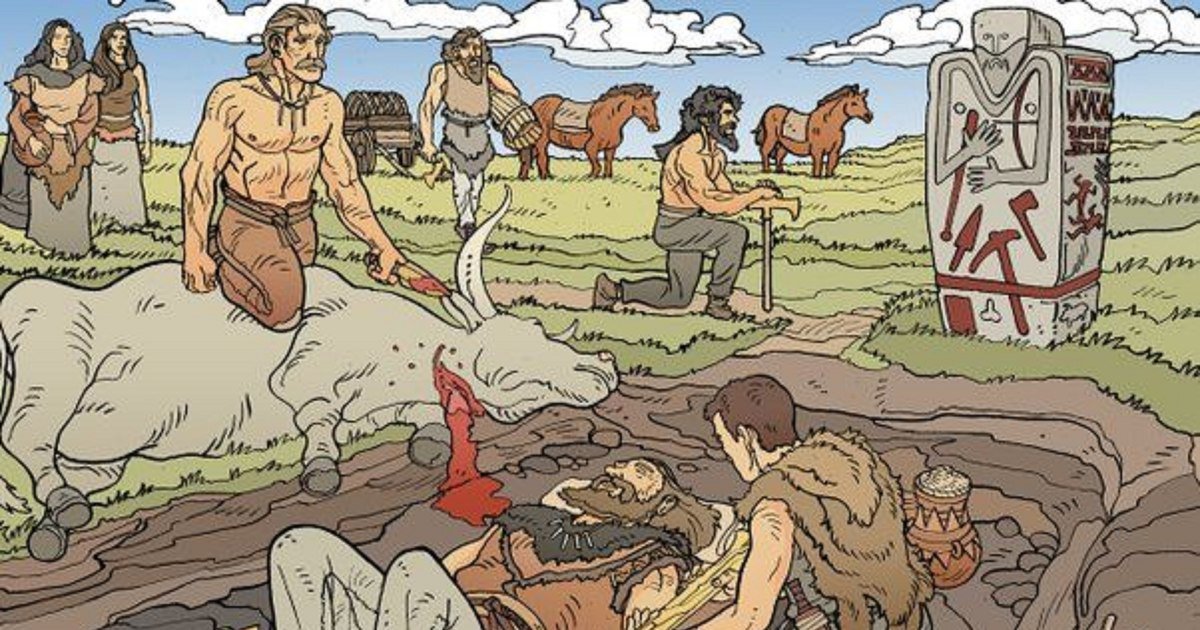
Burial of a Yamnaya chief PHOTO Rome World/facebook
The Indo-European languages represent the largest language family in the world, being spoken by almost half of the global population. At the same time, about 94% of Europeans speak an Indo-European language, mainly from the Romance, Germanic and Slavic branches. For centuries, scholars and, later, modern scientists have tried to find the origin of these languages and the common ancestors of Europeans. All sorts of hypotheses were issued, some logical, others fanciful, but no consensus was ever reached. The new studies, based on advanced analyzes of the DNA of individuals who lived 8,500 years ago, have almost completely solved the enigma and revealed an absolutely surprising conclusion.
Two studies carried out by international teams of researchers, based on DNA, and published in the journal Nature, concluded that the ancestors of Europeans were a population that lived on the territory of present-day Russia, approximately 6,500 years ago. They led to the emergence of a group of nomadic herders who would play an essential role in the spread of Indo-European languages. Furthermore, today’s European nations were born from a terrible genocide that took place several thousand years ago throughout the continent.
A handful of villages in the Russian steppes and a people who changed the history of the world
Research carried out over the past decades has progressively come closer to this amazing discovery, recently published in specialist journals. More precisely, scientists gradually began to identify those who brought Proto-Indo-European to the European continent and, at the same time, those who genetically defined the new peoples of this vast territory. It was about the Yamnaya tribes, pastoral and warrior populations of the North-Pontic steppes who invaded Europe. However, there were a number of syncopes, which the new research has resolved.
More precisely, the population that formed the basis of the formation of the Yamnaya tribes was identified – that is, the original ancestor of Europeans and, at the same time, the people who gave birth to the first Proto-Indo-European language, the one from which all other Indo-European languages and dialects on the Globe developed. One of the supporters of this hypothesis is the geneticist David Reich, from Harvard Medical School and Harvard University. He hypothesized that this ancestral ancestor came from the Caucasus – Lower Volga region. “This is the first time we have a unifying genetic picture for all Indo-European languages“said lead co-author Iosif Lazaridis, associate researcher in human evolutionary biology at Harvard University’s Faculty of Arts and Sciences (FAS), for Harvard Medical School. Subsequently, two landmark studies, published in the journal naturallyidentifies as the initial nucleus this population from the Caucasus – Lower Volga region, considered the source of Proto-Indo-European, the precursor language of all these idioms.
This population lived in the Eurasian steppe, on the territory of present-day Russia, about 6,500 years ago, in the Copper Age (Eneolithic). Its range stretched from the plains along the Lower Volga to the northern foothills of the Caucasus Mountains. According to researchers, members of this group moved westward, where they mixed with local populations, giving rise to the Yamnaya culture — that famous group of nomadic herders who would play an essential role in both the spread of Indo-European languages and the formation of European peoples.
Basically, as studies indicate, the Yamnaya population consisted of only a few thousand individuals living in neighboring villages, about 5,700–5,300 years ago. In a short time, they developed an innovative economy based on mobile herding, which allowed them to exploit the vast territories of the steppes. This adaptation led to rapid demographic expansion; in just a few centuries, their descendants spread over a huge territory, from central Europe to eastern Asia.
The discovery represents an important confirmation of the “steppe hypothesis”, formulated in the 19th century, which places the origin of Indo-European languages in the steppes of Eurasia. Over the past few decades, linguists and archaeologists have noticed similarities between languages such as Latin, Greek and Sanskrit, suggesting the existence of a common ancient language. Now, genetics comes to complete this picture.
In addition to language, the Yamnaya tribes inherited important cultural traditions from this ancient population, including the custom of burying their dead in kurgans (graves covered with earthen mounds). The conclusions were formulated on the basis of two studies: the first, with DNA obtained from 354 individuals from Russia and Southeast Europe, and the second, with 81 samples from Ukraine and the Republic of Moldova. This data was supplemented by existing genetic information from nearly 1,000 ancient individuals.
In conclusion, several thousand individuals of the Copper Age (a period of transition from the Stone Age to the Metal Age), gathered in a few villages in the Russian steppes, migrated westward. It is not known exactly what prompted them to leave, but on the territory of Ukraine and, probably, of today’s Republic of Moldova, they encountered local, Neolithic populations. They mixed with the locals and gave birth to the Yamnaya civilization, a race of warrior shepherds that would completely change the destiny of Europe.
Yamnaya, the “fathers” of Europeans and a prehistoric genocide
These Yamnaya developed a revolutionary lifestyle. They were herders of cattle and sheep and are believed to have been the first population in the world to domesticate the horse and use it for nomadic herding. At the same time, they were the first to learn to use ox-drawn carts. These discoveries turned them into formidable warriors. In addition, they provided them with extraordinary mobility, which shaped their lifestyle. They were nomads who traversed, with their families and belongings loaded into them, the vast steppes, in search of new pastures and new territories to conquer.
“We found that the Yamnaya descended from just a few thousand people living in a few nearby villages 5,700–5,300 years ago. As their descendants, the Yamnaya developed a radically new economy that allowed them to follow their herds into previously inaccessible open steppe areas. This led to a population explosion so that within a few hundred years, Yamnaya descendants numbered tens of thousands of people and were spread from Hungary to eastern China”says Reich for Harvard Medical School.
These warlike pastoral tribes—tall, white-skinned, red- or blond-haired, lactose-tolerant people (European hunter-gatherer populations did not)—camped over the Neolithic and Eneolithic civilizations of the Old World. The people of the Yamnaya culture, as Martin Trautmann shows in his work “First bioanthropological evidence for Yamnaya horsemanship”they knew metallurgy, managing to make bronze weapons in particular.
They rarely practiced agriculture, only on the banks of rivers, when they stayed longer in one place; in those periods they also fortified their settlements. Artisans had a special status in the Yamnaya world, with metal objects being found in large quantities in the tombs of tribal elites. In contrast, the Neolithic populations of Europe in the 7th millennium BC. they were shorter in stature, with darker skin and brown hair. In addition, they did not have a culture of war, nor did they excel in the area of metallurgy, using weapons and tools made of stone. Moreover, European Neolithic civilizations were weakened both by a mysterious epidemic, which many scientists talk about, and by intertribal wars.
In the face of the powerful Yamnaya warriors—better equipped, more physically fortified, faster, and more violent—the agrarian communities of Old Europe were sure victims. More and more specialists blame this devastating invasion for the destruction of most of the large Neolithic settlements, from the Danube area (including our country) to the British Neolithic tribes (those who built Stonehenge). The Yamnaya warriors “swept” the continent from one end to the other, with genetic and archaeological studies revealing a true war of extermination. Indeed, the genes of Neolithic men in Europe have disappeared.
Most likely, the Yamnaya warriors exterminated the men of each community and kept some of the women. The Danish specialists were shocked to discover that nothing remained in the structure of the Danish people, for example, from the genetics of the Neolithic ancestors. Mostly only those of the Yamnaya culture. “It was such a rapid population change, effectively no descendants of the predecessors”said paleocologist Anne Birgitte Nielsen from the University of Lund.
“I’m more and more convinced that it was some kind of genocide”stated the researcher Kristian Kristinsen. In turn, new genetic studies show that indeed more than 80% of Europeans today are Yamnaya descendants. “They have radically changed the population of Europe, with major disruptions in Germany, Spain, Italy and Hungary (…) In Britain, there has been a population replacement of over 90% in just a few decades“, said Reich.
In addition, these steppe warriors also brought the Proto-Indo-European languages, inherited from their ancestors in the Volga area.