Medieval documents indicate that when the Hungarian tribes came to the area of Central Europe, Pannonia was also inhabited by Romanians. We are talking about communities of Wallachian shepherds under the successive rule of the Avars and the Bulgarians. Then under the pressure of the Hungarian invasions they migrated to the south.
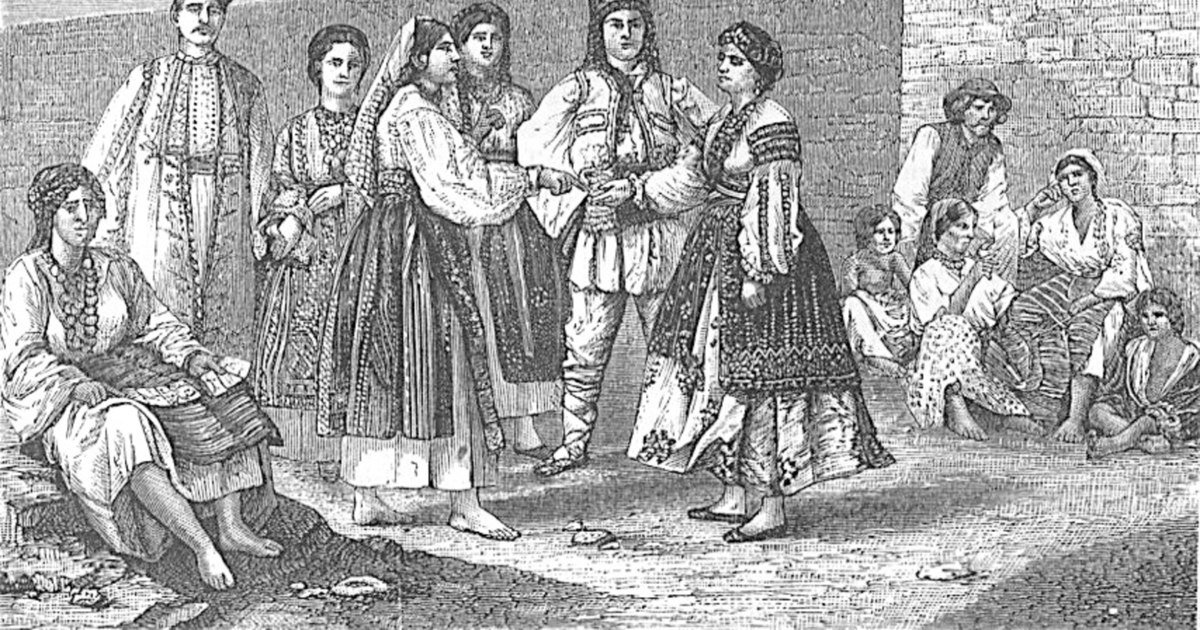
Valahi PHOTO magazine Harpers Magazine 1876
The presence of Romanians in Transylvania before the Hungarian invasion of Europe, in the 9th and 10th centuries AD, was controversial and, in particular, contested by a part of Hungarian historiography, especially in its nationalist period. However, old medieval documents show a much more complex reality from an ethnic and political point of view in the area of Pannonia and Transylvania when the Hungarian tribes arrived. More precisely, not only did the Romanians live in Transylvania in the 9th-10th centuries AD, but they also lived in Pannonia, before the arrival of the Hungarians, alongside other populations. Medieval authors said that they were shepherds and that they were ruled by local chieftains, being forced to migrate south of the Danube because of the Hungarian invasion.
An unprecedented document from almost eight centuries ago
At the beginning of the 20th century, the Polish historian Olgierd Górka found in the National Library in Paris a unique document, unknown to specialists until then. It was a medieval manuscript entitled “Descriptio Europae Orientalis” (no – Description of Eastern Europe), written at the beginning of the 14th century, more precisely in 1308. The author of the work was anonymous, but it is assumed that he was a very influential French monk, experts say. A real erudite, says George Popa-Lisseanu, who took an interest in the history and geography of the Balkan countries he passed through. “He is anonymous and, according to Górka’s researches, he appears to be a Dominican or Franciscan friar, who lived longer as a missionary in the Balkans, namely in Serbia. His sympathies show him to be of French nationality, for he identifies himself with the interests of the Catholic Church and of French policy in the East at that time.”wrote G. Popa-Lisseanu in “Description of Eastern Europe”.
Later opinions tend to indicate that this Franciscan or Dominican monk arrived in Hungary with King Charles Robert of Anjou, himself a Frenchman. The monk lived for a long time in Hungary and came to know very well the geographical and political realities, as well as the history of the place. He also traveled to the Balkans. This monk would have been close to the King of France, being the envoy of Prince Charles de Valois, the brother of the King of France, Philip IV the Fair. This Charles of Valois had come with the army to the Balkans, wishing to occupy the throne of the Byzantine Empire, recently recovered by the Greek emperors from the hands of the Latin crusaders.
The learned monk lived either in Hungary, as I mentioned, as a confidant of Charles Robert of Anjou, or in Serbia, in the Catholic area. He only traveled to a few regions in the Balkans. According to another hypothesis, the anonymous chronicler was Andreas Hungarus, a Hungarian priest who became Archbishop of Bar in Albania in 1307. Whatever the monk’s origin, his work is of undeniable value.
In this manuscript, the realities in the Balkans are clearly presented, including references to the status of the Romanians. The treaty was written for Charles, Count of Valois, who was preparing a crusade against the Byzantine Empire to assert his claim to Constantinople. It is very similar in genre to contemporary treatises on the recovery of the Holy Land, although its subject matter is different. The countries that the monk wrote about in the “Descriptio” are Albania, Bohemia, Bulgaria, Halici (Ruthenia), Hungary, Poland, Serbia (Rașca) and the Byzantine Empire. The geography, politics, culture and economy of these kingdoms are described. It has been claimed that his knowledge of Albania and Hungary was better than that of countries further east, showing that he spent more time in these territories than in the others.
“They were all shepherds of the Romans”
The part that most interested historians was the one devoted to the Vlachs, a population that would have been dispossessed of their lands and expelled not only from Transylvaniabut also from Pannonia, i.e. present-day Hungary. In other words, claimed the Franciscan chronicler from the 14th century, when the Hungarians arrived in Europe, they found the Romanians not only in Transylvania, but also in Pannonia. They were shepherds who spoke a Latin language and were pushed south of the Danube by the Hungarian invasion. “Once they were shepherds of the Romans, and because of the fertile and green land, they used to live in Hungary, where the pastures of the Romans were. But later, being driven out of here by the Hungarians, they fled to those parts (nr – the southern Balkans)”wrote the anonymous monk in “Description of Eastern Europe”.
At the same time, in his presentation to Hungary, the French monk makes clarifications and says that, in fact, the expulsion of the Vlachs was not done peacefully. More precisely, according to the medieval document, the “shepherds of the Romans”, including the Vlachs who lived in Pannonia when the Hungarians arrived, were constituted in a kind of confederation that waged a cruel war with the newly arrived tribes. “They were all shepherds of the Romans, and had at their head ten powerful kings in all Messias and Pannonia. However, weakening the empire of the Romans, the Hungarians came out of Scythia and the great kingdom that is beyond the Maeotid Plains and fought in the open field, which is between Sicambria and Alba Regală, with the named ten kings and took possession of them”stated the anonymous monk. Defeated by the Hungarian horsemen, they left for the southern Balkans.
A pastoral population under the rule of the steppe peoples
There are Romanian specialists who gave credence to this historical source. They say that the Romanian people were formed from both banks of the Danube, but also from both banks of the Tisza. “These shepherds of the Romans, sometimes also called Vlachs or just colonists of the Huns, lived in Pannonia when the Hungarians came, probably not in kingdoms in today’s sense of the word, but having their leaders, who will sometimes be called kings in the etymological sense, or princes, or dukes, or only voivodes or princes”wrote G. Popa-Lisseanu in an introduction to “Description of Eastern Europe”.
Moreover, the presence of the Vlachs in Pannonia before the arrival of the Hungarians is also confirmed by other historical sources, including the Hungarian ones. Anonymus, the famous author of the “Gesta Hungarorum”, first wrote about “Slavs, Bulgarians, Vlachs and shepherds of the Romans” who lived in the region, but also refers to “a people called Kozar” and the Scythians. These realities are remembered by Simon de Kézabut also by Nestor’s Chronicle, a Russian source that says that when the Hungarians arrived in Pannonia, “they drove out the Vlachs and took their lands.” It should be noted that in Pannonia the Vlachs were only one of the cohabiting ethnic groups, there were also Czech, German and other nationalities in the area. In addition, those who politically dominated the region were, one by one, the Avars, the Franks and then the Bulgarians.