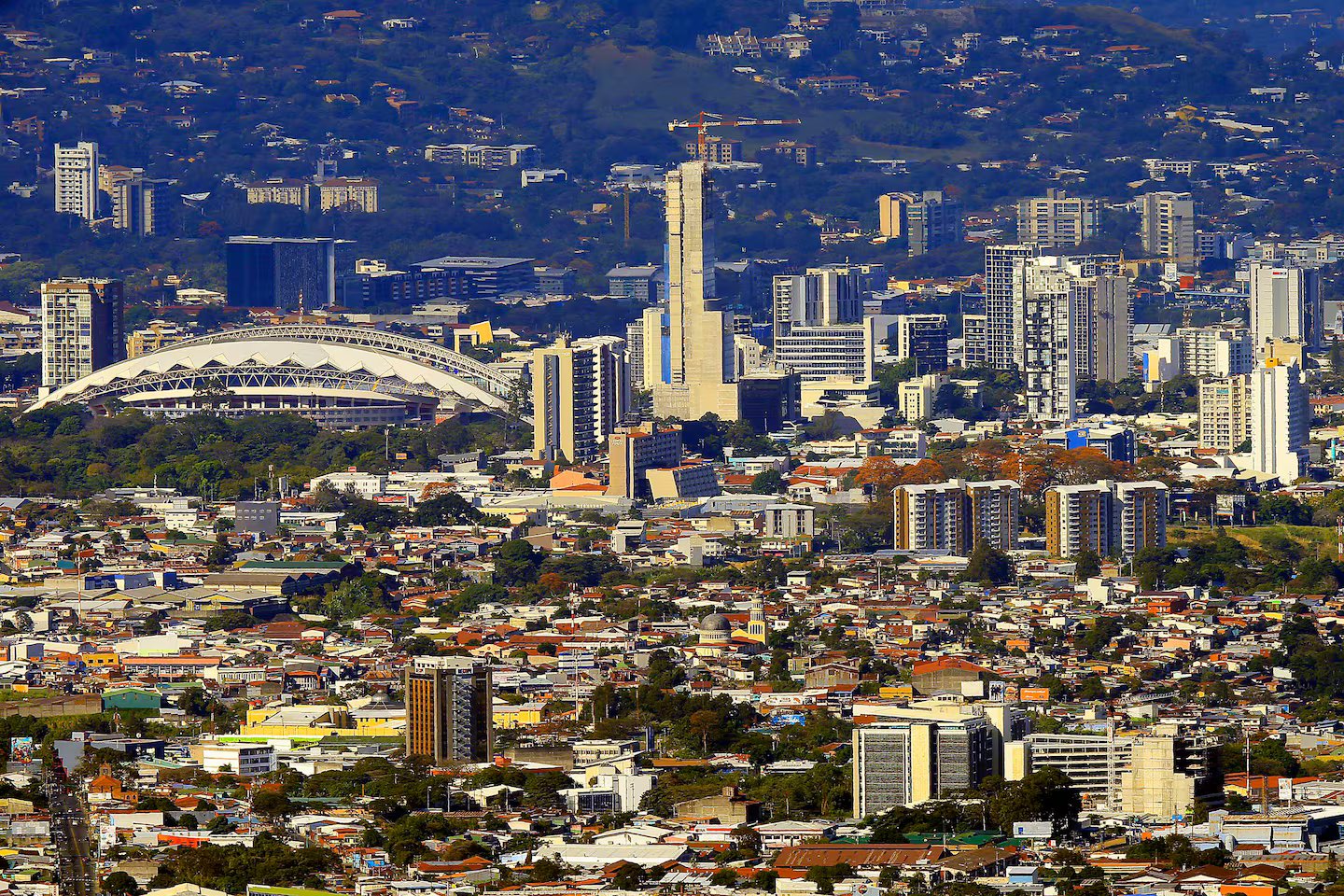
Population growth in the Central Valley will slow down in the next 25 yearsbut the projections show that it is not going to stop completely and that it will continue, at a lower level, towards the northwest of the region which houses the majority of inhabitants of Costa Rica.
According to the National Institute of Statistics and Censuses (INEC), of the four provinces that make up the Central Valley, Alajuela and Heredia will continue to grow (6.6% and 3.4% respectively), while in San José and Cartago the population will decreasewith falls of 1.4% and 4.1%.
The canton of the Central Valley that will experience the greatest population growth will be Poas of Alajuelawith 11.1%, and although the inhabitants of San José will fall in general terms, one canton in that province will have a pronounced growth: it is Alajuelita, with 10.2%.
The expansion of residents in Heredia will be driven, in part, by the cantons of Santa Bárbara and Barva, where population increases of 8.9% and 8.5% are expected.
The case of the Central canton of Alajuela also stands out, which will grow by 8% and, according to projections, in 2042 will become the canton most populated in Costa Ricasurpassing the capital San José, a city that will reach its peak in 2032 with about 356,000 inhabitants and then begin to decline. Meanwhile, Alajuela will continue to grow until it exceeds 354,000 residents in 2050.
These projections present a contrast with the first 25 years of the 21st century, in which population growth reached 32.5%. However, the phenomenon that occurred at that time was smaller than the demographic explosion of the mid-20th century, which led to a 100% growth between 1950 and 1975.
During this century, Alajuela and Heredia grew at the same level, both at 37.6%. The cantons of Alajuela located within the Central Valley went from 481,403 inhabitants in 2000 to 662,594 in 2025, while Heredia increased from 326,898 to 449,955.
The trend of greater growth in the northwest of the Central Valley was already marked, because unlike Alajuela and Heredia, the growth in San José and Cartago did not even reach 30%, with records of 26.1% and 27.3%, respectively.
Despite this trend, municipalities and businesses must prepare to maintain their services and infrastructure according to population demand.
In this regard, the mayor of Poás, Heibel Rodríguez, explained to The Nation that your canton has taken measures to guarantee water for the inhabitants and continue in the process of developing the regulatory plan.
“We have expanded the range of servicesfor example in sports topics. We are thinking about a project that has to do with the cultural center. And all of this is in preparation for the population growth that we are going to have,” he declared.
Regarding road infrastructure, he added that they are promoting that the San José-San Ramón route project includes a radial that links Carrillos de Poás with Route 1.
“We are already processing the resources to carry out the feasibility study with Mideplán (Ministry of Planning),” he stated.
natural growth
Olga Araya, INEC demographic statistics spokesperson, explained that the growth in the northwest of the Central Valley has more to do with “a potential for natural growth” from Alajuela and Heredia, where there is more space to build and fertility will not decrease as much as in other parts of the country.
Estimates and projections seek to predict the future based on information from the past, so INEC reviews them from time to time to update them if necessary.
“If any of the assumptions or any of the projections that I made for any of these components do not behave as I expected, that is where we go in again to make reviews and new calculations and establish whether it is appropriate to do all the calculations again in order to establish a more real population,” he said.
He stated that, currently, the institution monitors population behavior to establish whether the assumptions they made in 2024 and 2025 are still valid.
The figures may change according to new phenomena or public policies that influence demographic behavior.
For example, the Central canton of San José would reach its population peak around 2030, and then begin to decrease, but the expectation of the capital Municipality is to repopulate the city center and for San José to stop being a transit point.
Araya stated that these plans should not focus only on creating housing conditions, but also security and access.
“We must remember that in recent years the center of San José has become depopulated because it has become very commercial, very economical,” he indicated.
How are projections made?
To achieve these projections, INEC takes into account data since 1950 for national-level calculations, and since 2000 for specific ones by province, canton and district.
The institution analyzes the behavior of mortality, fertility and migration.
“Based on this past behavior, models already established in the demographic field are generated to be able to say that the global fertility rate has a clear decline,” he explained.