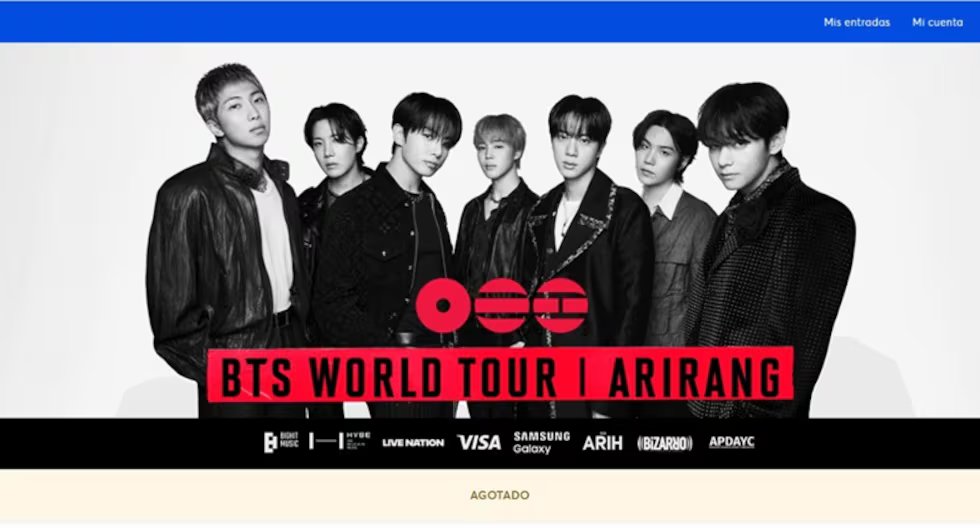
The line was not on the street, but on the Internet. And even so, it was massive. During the pre-sale for the BTS concerts in Lima, more than 521 thousand fans tried to secure a ticket at the same time, turning the process into one of the greatest tests of digital demand that the entertainment industry in Peru has faced.

BTS arrives in Peru for the concerts on October 7, 9 and 10 at the National Stadium. (Photo: Arirang/AFP)
The data, provided by Ticketmaster for El Comercio, shows not only the magnitude of interest, but also the capacity to mobilize a ‘fandom’ that operates with its own logic. At its highest point, the virtual queue reached peaks of more than 250 thousand users connected simultaneously, a figure that, in terms of traffic, rivals sporting events or large-scale technological launches. But beyond the volume, what is surprising is the speed.
Entries that disappear in hours
The purchasing process was short-lived. In less than two hours, the main areas were already sold out. East and West—intermediate locations in price but privileged in visibility—were the first to disappear, confirming a consumption pattern where experience weighs as much as cost.
The magnitude of the traffic did not take the industry by surprise. Ticketmaster Peru was already projecting a ‘sold out’ in record time, an expectation that ended up aligning with the volume of users who entered the platform during the pre-sale.

This is the BTS Peru Map for October 7.
“Yes, we definitely expect a ‘sold out’. The demand will be much greater than the number of tickets available,” commented Andrea Hablutzel, deputy general manager of Ticketmaster Peru to the Dean at the beginning of April.
The behavior is not coincidental. The BTS ‘fandom’ – known as Army – does not act individually, but in coordination. Buy as a group, share information in real time and prioritize strategic decisions before entering the platform.
This is also reflected in another key data: the average purchase was 2.33 tickets per person.

Army Peru
The buyer profile confirms that the BTS phenomenon is driven by a young audience, although the purchasing decision may also involve their family environment. 80% of those who participated in the pre-sale were women, while the dominant age group was 18 to 25 years old (47.49%), followed by the 26 to 35 year old range (25.94%).
Although the bulk of buyers came from Peru (94.37%), pre-sales also showed an international flow. Countries like Ecuador (1.52%) and Mexico (0.67%) appear among the main connection points.
This reinforces a trend. And Lima is beginning to consolidate itself as a regional hub for large-scale concerts, capable of attracting not only local demand, but also musical tourism.
But interest was not limited to those who managed to buy. In total, the platform registered more than 6.5 million visits, a figure that shows the magnitude of the phenomenon even among those who were unable to access an entry.. In digital terms, BTS not only fills stadiums, it also pushes online demand to the limit.

BTS began their “BTS World Tour Arirang” tour this Thursday, April 9, in the South Korean city of Goyang. (Photo: Jung Yeon-je / AFP)
Given this level of demand, the system incorporates restrictions. Ticketmaster highlighted that tickets can only be transferred 30 days before the event and can only change the owner once, a measure that seeks to stop informal resale.
“We have invested a lot in anti-bot technology and in tools such as the virtual queue to organize the flow. In addition, we work with systems such as dynamic QR codes that change every 20 seconds, which makes it impossible to falsify tickets,” mentioned Andrea Hablutzel, from Ticketmaster.
He also specified that the objective is to protect the real fan in a context where scarcity turns each ticket into a coveted asset.
More than a concert: an industry in motion
Behind this digital avalanche there is not only musical enthusiasm. BTS is part of a global phenomenon that exceeds 800 million followers. Each country he visits activates consumption chains linked to tourism, transportation, commerce and entertainment.

BTS performed on March 21 at Seoul’s Gwanghwamun Plaza in their first concert in almost four years, before 260,000 fans in the city and millions more who followed live around the world. (Photo: Kim Hong-Ji / POOL / AFP)
/ KIM HONG-JI
What happened in Peru also responds to a broader business model. The company behind the group, HYBE Corporation, has made the relationship with fans the axis of its strategy, monetizing the connection through digital platforms, exclusive content and experiences.
With more than 521 thousand users in a virtual queue and a demand that far exceeds the available supply, the BTS case confirms what the industry anticipated, a ‘sold out’ in record time. But it also confirms that today concerts are no longer measured only in attendees. They are measured in data, in traffic and in millions of consumer decisions happening at the same time.