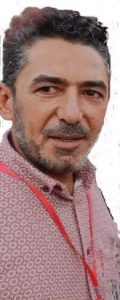
Firas Al-Najjar between realism and abstraction:
I don’t like staying in one school
Babylon – Kazem Bahiya
Firas Muhammad Al-Najjar, at childhood, began to lean towards the art of drawing. He began to scribble on paper, and from that moment he began to draw slowly, passionately and passionately, and when he entered primary school, he continued to develop his talent. It was his world in which he loved to soar. Then he entered the Institute of Fine Arts and graduated from it, until he achieved a presence in the plastic scene, and today he is considered one of Hilla’s artists. We met him to shed light on this experience of his, so we told him:
□ What does drawing mean to you?
Drawing is one of the arts through which I can express what is inside me without restrictions and reservations. It is a means of emotional release and revealing all the things inside me, in addition to presenting topics through which I can influence others.
□ How did he attract you to his seriousness, and what are the factors that contributed to you growing up as an artist?
Drawing is a talent that is created with a person. Since my childhood, there were signs of drawing, and in the primary stage and in the first grade, the art education teacher paid attention to me, and I remember that I drew a gun with its details, and she said, “Who drew this for you?” I said, “I am a woman.” She said, “Can you draw it on the blackboard?” I said, “Yes.” Then I drew it with white chalk, and the students applauded for me. After that, the teacher took me to the rest of the classes from first to sixth in my Shatt al-Arab school to draw on the blackboard, and they applauded. For me. This was the main motivation for continuity, in addition to the parents’ great role in providing drawing supplies of colors and other materials. I continued in the primary stage, and the students gathered around me when I drew. As for the middle stage, the art education teacher, Rabah Al-Saadi, helped me develop well through motivation and support. I tried to apply for admission to the Institute of Fine Arts, but my parents refused because of the distance in Baghdad. In the middle stage, I moved away from drawing and turned to Arabic calligraphy.
Unique style
□ I see more than one artistic school in your work, and you have not established a unique style?
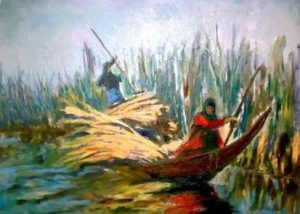
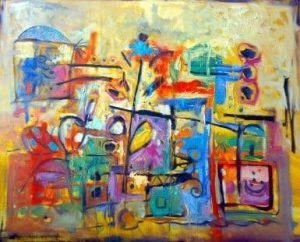
-Although I love the realistic school of drawing, I like to experiment with the other schools, when I feel that the other schools are more free to express the inner artist. Sometimes I paint with expressionism and other times with abstraction.
□ So, what is the artistic style and approach that you follow in your recent plastic works?
-I try to move between realism and abstraction because I do not like to stay in one school and to break the boredom and monotony of staying in one mold.
□ Plastic artists who influenced your style?
The pioneering artists had a great impact on my artistic career through female photographers, such as the artist Faiq Hassan, Jawad Salim, Hafez Al-Droubi, and others. As for the college, artist professors had a major role in influencing, such as Fakher Muhammad, Kazem Noir, Makki Omran, the late Abdel-Sada Abdel-Sahib, and others.
□ What topics do you like to address through your paintings?
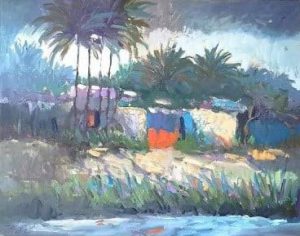
-The topics that are closest to me are the topics of nature, as they are the topics in which the artist is most freed from many restrictions, in addition to being a wide space of freedom.
□ I see in your works a memory of time and place that has never left, such as nature and rural life?
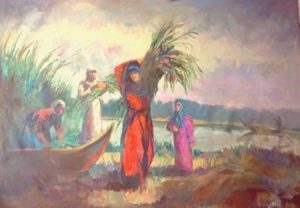
The spatial environment constitutes an inner knowledge storehouse of the artist’s personality in consciousness, and my city (Madhatiya), in most of its former areas, constitutes a diverse environment of orchards and green spaces. Through it, he recalled scenes that began to shrink in light of the urban expansion in the city.
□ The most important elements of an artistic painting. Is color a basic element in the painting or the subject, or do they complement each other?
Color, line, space, subject matter, and other elements together form the artwork in an interconnected manner. One element may dominate another, but the elements as a whole remain a problem for the artwork.
□ Can you explain to us your vision of the reality of Iraqi plastic art today, and who among its pioneers stands out to you?
In recent years, art has developed rapidly in Iraq, and very good energies have begun to emerge in the artistic field. Openness to the world and the development of the color industry have contributed, in addition to its reasonable prices and diversity. The abundance and diversity of exhibitions and contact with well-known artists with a good history in drawing, in addition to the ease of obtaining video clips of the stages of drawing, sometimes in detail, by skilled artists around the world through websites have contributed effectively to the development of many of the creative energies of the painter. As for the pioneers in art, the first pioneering artists such as Faiq Hassan, Jawad Salim, Shaker Hassan Al Saeed, Kazem Haidar, and others constituted an important reference for me and for many of the artists whom we contemporaries.
□ What is the most important thing in your work?
Social topics constitute a large share of my work. Perhaps it is nostalgia for a life we lived previously, in light of the rapid pace of life we currently live in and the dangerous change in many of the heritage and traditions that were previously constants.
□ Finally, what is Firas Al-Najjar’s dream?
-The possibility of influencing society through art, and the development of society’s aesthetic and taste concept because of its great influence in shaping collective awareness.