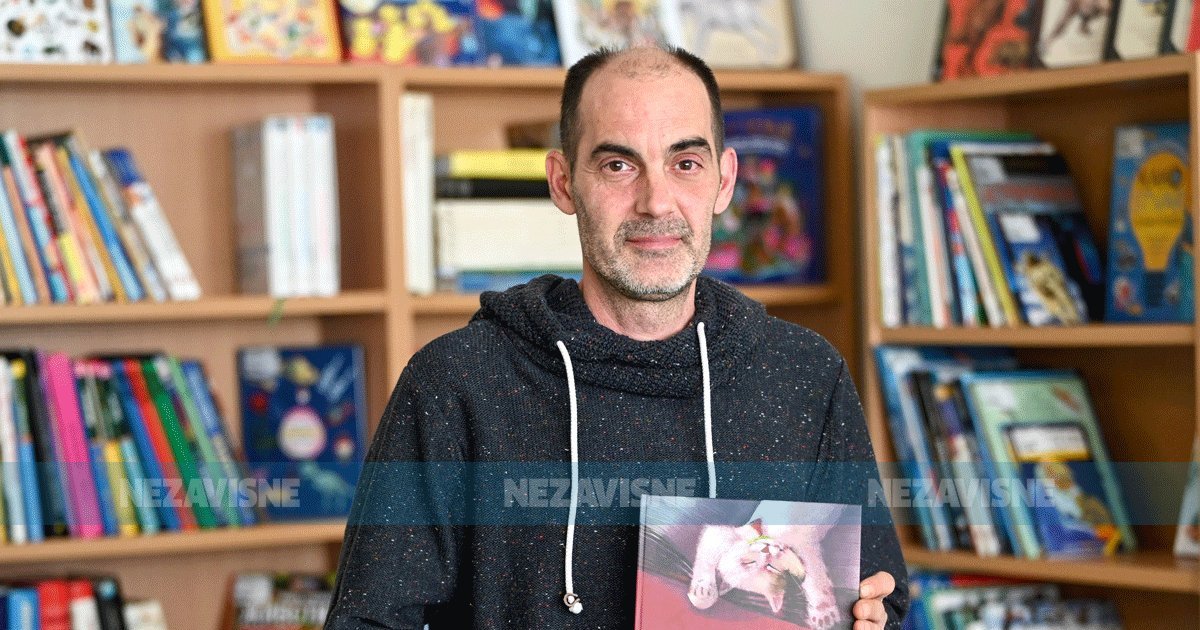
EAST SARAJEVO – Berislav Blagojević from Banjaluka is this year’s winner of the “Sovica” literary award for the manuscript “The Tale of the Unloved”, announced the Institute for Textbooks and Teaching Aids of the Republic of Srpska.
What you need to know:
- Berislav Blagojević, winner of the “Sovica” award
- Prize-winning manuscript “The Tale of the Unloved”
- The story combines childhood, imagination and contemporary challenges
- The work thematizes the influence of artificial intelligence and the loss of creativity
- Ecological message through the story of “unloved” animals
The jury, which consisted of Sanja Macura, Jelena Kojović Tepić and Jelena Kalajdžija, stated in its explanation that this is a true literary and artistic work, in which, through a short novel and the author’s fairy tale hidden in it, through the contemporary moment, childhood, the challenges of growing up, friendship and love are talked about.
Theme of the work and contemporary context
They further state that this is a work that talks about reading books and writing in a time in which artificial intelligence stands in front of people as a challenge behind which threatens the death of imagination, curiosity, creativity and free thinking, about creatures that are not on almost anyone’s list of favorite animals, about ecology, about this planet of ours that flickers between survival and disappearance with every tick of a mechanical screw.
“The manuscript begins like all fairy tales: ‘Once upon a time, long ago’, to immediately sail into the sea of artistic expression through which the words say more than their meaning and spread like the foam of waves touching the shores beyond themselves: “but still not too long ago, because no one remembers that long ago, but somehow a little long ago, enough not to be forgotten without turning into a legend in which it is not known what really happened and what was invented, so, once upon a time, there were some beings and beings and there was a region where they lived. The author interweaves two narrative threads – the first weaves in the school and the second in the imagination of a special girl,” the jury continues.
Narrative threads and school environment
Through the meeting of one Konstantin, as reported below, who peers over his shoulder into a notebook and one Lena, who writes down a fairy tale in that notebook, an ordinary, most ordinary extended stay at school becomes the scene of a meeting of two worlds – the one in which books and literature are the cure for all ills, primarily for boredom, which, of course, simply does not exist for someone who reads a lot and at the same time writes, and the world that is the everyday life of most of today’s children, whose days (and a good part of the night) filled with games, the Internet, social networks and “enter” which gives answers to all questions instead of them and in which boredom is frequent and even boring to itself, because the imagination retreated in front of the virtual world, fell asleep somewhere and hid so that no one could see it so sad and abandoned.
“The wealth of conveyed meanings that language and literature offer to those who read and the poverty of understanding of that same language in those who do not read, emanate from every page of this manuscript written with a lot of love and understanding for all the bumps, mistakes, misconceptions, for all the whims, vanities, teasing and falling in love that exist in the world of a child,” the jury’s decision further stated.
Lena and Konstantin – meeting of two worlds
Lena and Konstantin, he writes further, are faced with life’s challenges that are neither small nor easy and they look for a way out of them in different tracks, until they meet and something that at first looks like a collision of differences turns into a meeting in which two worlds embrace tightly and with the warmth of friendly (and long, a little more “real”) love enrich, complement and ennoble each other.
Artificial intelligence and “dueling” in creativity
“At the same time, the reader is presented with a duel in literary creation between Lena and Konstantin (who uses artificial intelligence) and during which both of them move into Lena’s imagination in which Living Water flows through the Živí Dol and from which animals begin to flee towards the Misty Forest and the Silent Cave, driven by man’s merciless exploitation of natural resources. A man who only takes and does not return anything to the Earth, initiates a real animal exodus”, explained is below.
Animals, ecology and “unloved beings”
And these animals, in addition to those that are constantly present in children’s stories (birds, deer, rabbits, squirrels, butterflies), are also those from which we most often recoil, attributing to them qualities that they do not have and being afraid of them for reasons known only to us, humans.
“These, ‘unloved’ creatures (crows, spiders, salamanders, frogs, moles, caterpillars, bugs and beetles), become the center of the story of the struggle for survival, of the search for Paradise Valley, which exists as much as there is faith in it, and that faith and search cannot exist without cooperation, friendship, association and at least a temporary abandonment of all charms, arguments and arguments, intolerance and disagreements,” writes the jury.
The message and openness of the work
Through each step of the unusual animal company, the relationship between Konstantin and Lena grows, so that in one moment those two worlds merge into one.
“The special value of this manuscript is given by its openness to the reader, because the author has left a space that is literally filled in and added to by everyone who will read the book. Thus, each reader will be a bit of the author of this book at the same time, and if his imagination is really rich, he will also succeed in incorporating himself into the book as a character,” the jury explained.
The jury’s conclusion
Although the members of the jury, as they state themselves, are not fans of searching for the lessons of literary works, in the end they admit that the manuscript “The Tale of the Unloved” shows how a flourishing term worn out in teaching, through true art, can gain new life.
“‘Fairytale of the Unloved’ is instructive in the most beautiful way possible, embraced by love for everything that lives and breathes, interwoven with wonderful humor, woven into the glory of the idea of freedom of the spirit that does not accept what is prescribed and usual, but strives for the blue of the sea and the sky, and at the same time firmly holds the hand and guides everyone in whose eye at least for a moment a glimmer of stardust of imagination and dreams sparkles,” the jury’s decision concluded.
16 manuscripts that met the conditions were submitted to the competition for the “Sovica” literary award, but one manuscript was subsequently withdrawn.