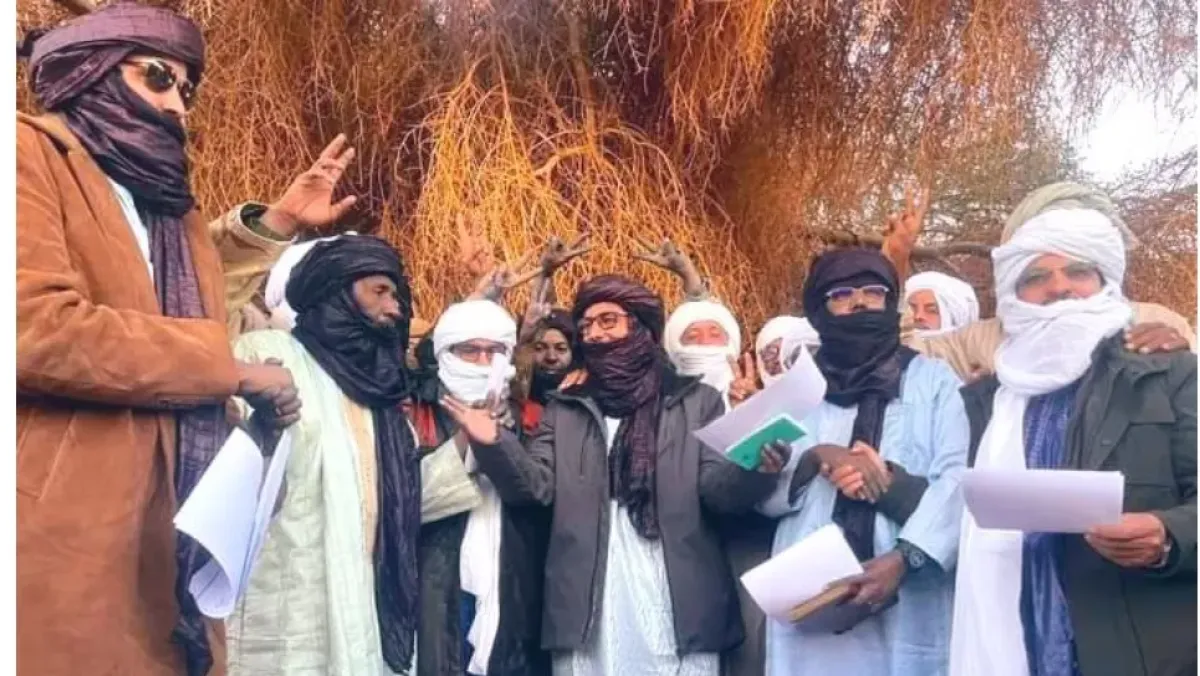
In the attacks launched by the militants of the “Front for the Liberation of Azawad”, in coordination with elements of the “Front for the Support of Islam and Muslims”, which is classified as terrorist, the thin line dividing the concepts and practices of “terrorism”, “secessionist or liberation projects”, as well as “legitimate self-defense” emerged.
These concepts have greatly intertwined in Mali recently, where the Azawad see themselves in a position of legitimate defense of their separatist project and of themselves, in the face of what they consider to be harassment by the transitional authorities who sought the help of regular and irregular foreign powers. On the other hand, the central authorities treat this perception as a form of terrorism.
However, the point that increased the confusion of the situation and the disappearance of this thin line between the three concepts, was the announcement by the Azawad organization of coordination with the “Jabhat Nusrat al-Islam and Muslims,” which is classified as terrorist, as this was a step imposed by the stage and the nature of confrontation and balances, as well as in response to the government’s bringing in foreign forces, according to their justification.
Accordingly, the “Front for the Liberation of Azawad” is working to clear itself of the description and stigma of terrorism that has attached itself to it, following its announcement of coordination with elements affiliated with the “Front for the Support of Islam and Muslims,” during the attacks carried out last Saturday, which resulted in complete control of the city of Kidal and the killing of the Minister of Defense in the transitional government.
There is, until now, no unified international or UN classification that includes the Azawad among terrorist organizations, unlike the “Group for the Support of Islam and Muslims,” with the exception of the position of the Malian government and some parties that consider it a rebel or armed group outside the authority of the state.
In this context, the organization said that it is following with great interest the recent reactions issued by some parties of the international community regarding the current events in Azawad and the rest of the regions of Mali, refusing to classify its armed actions as terrorist acts.
The bloc, based in the north of the country, confirmed in a statement today that all its movements “are consistent with the basic principles of Islam and the rules of international humanitarian law, and that they derive their legitimacy from defending the inalienable right of the Azawadi people to self-determination.”
The Azawad accused “the illegal military regime in Bamako of seeking to impose terrorism charges on them,” reiterating “their firm adherence to the principle of legitimate defense, and their full commitment to protecting the civilian population in the context of the conflict.”
The organization justified its position by saying that the Azawadi people had been, for decades, among the most prominent victims of terrorism, whether carried out by the regime in Bamako, or violations committed by Russian mercenaries linked to the Wagner Group, or by other extremist groups, or as part of multiple destructive agendas directed against them, as it described it.
Al-Azawad cited “several accredited human rights organizations, along with civil society actors, documenting serious crimes that included mass massacres, extrajudicial executions, enforced disappearances, acts of torture, and cannibalism, in addition to the looting and destruction of property.”
Despite the seriousness of these violations, the organization adds, it was noted “the absence of firm condemnations or clear positions at the regional and international levels regarding the grave violations to which the Azawadi people are exposed.”
Based on its awareness of the complexity of local dynamics in a context characterized by multiple actors, the organization called for adopting a balanced and responsible reading of the facts on the ground, based on proven facts and respect for international humanitarian law.
The Azawad also renewed their call on the international community to “assume its full responsibilities in protecting the civilian population, in the face of the practices of the military junta in Bamako and its resort to mercenaries.”