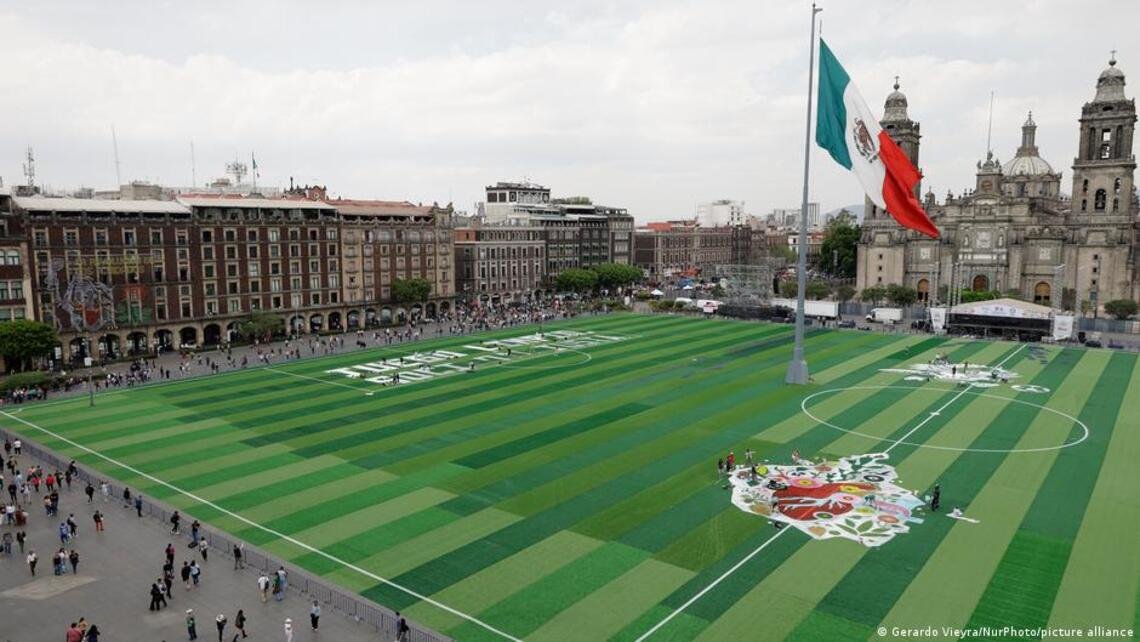
On June 11, 2026, the Mexican and South African teams begin the World Cup with the opening match at the Azteca Stadium in Mexico City. At that moment, Mexico will find itself in the eye of the international public attentionsince it will host thirteen matches, which will be held in Mexico City, Guadalajara (in the west) and Monterrey (in the north of the country).
The attention of all those who care for safety It focuses especially on the city of Guadalajara, since the activities of the Jalisco New Generation Cartel (CJNG), whose leader, Nemesio Oseguera, alias “El Mencho”, was killed in February of this year, a fact that unleashed a wave of violence with dozens of road blockades, attacks on businesses and scenes of chaos in twenty states of the country.
The extensive network that the CJNG cartel demonstrated to have at that time shows its extensive presence in the national territory, which implied a great effort for the authorities to restore circulation, preserve public order and safeguard the integrity of citizens.
Arrest of “The Gardener”
The capture of Audias Flores Silvaalias “El Jardinero,” in the coastal state of Nayarit on April 27, was very different: not a single shot was fired. Furthermore, the number of armed attacks was very limited and was not activated the extensive network of the CJNGwhich was limited to the burning of vehicles and more local businesses.
“El Jardinero”, considered one of the possible successors of “El Mencho”, was in charge of the CJNG’s drug trafficking operations in Nayarit, Zacatecas, Michoacán and Guerrero and, from that position, he directed the expansion of the cartel’s activities beyond the borders of Jalisco, especially with regard to the strategic control of the long coast of Nayarit to receive shipments of drugs or chemical precursors by sea.
Whether the arrest of “El Jardinero” really implies a weakening of the cartel organization is rather doubtful, since the CJNG operates with a logic of redundant structures that allow it to resort in a relatively short time to alternative channels for its illicit businesses.
Now everything points to Juan Carlos Valencia González, “El 03”, stepson of Nemesio Osegura González, “El Mencho”, as the strongest leader of the cartel, who is rumored to have handed over “El Jardinero” to the authorities. It is not predictable if the power vacuum in the cartel will begin greater internal conflicts that could especially affect the state of Jalisco, with its capital city, Guadalajara.
Guadalajara, the drug capital?
This city, one of the three Mexican venues for the 2026 World Cup along with Mexico City and Monterrey, is known as “the second city of Mexico”, not only for its high population concentration, but also for being a cultural center of the country.
For a long time it was considered the city where cartel leaders sought recreation and sent their children to schools, which is why it was considered a “quiet place,” until the expansion of the CJNG began to change the social climate of the city.
It is now the place where drug traffickers launder most of their profits, where more people disappear than anywhere else and where cartels have been able to control entire regions, allowing them to set up their recruitment and training centers there. The influx of “easy money” caused a real estate boom in luxurious neighborhoods marked by narco architecture and the excessive construction of shopping centers that today dominate the image of the city.
However, the presence of drug trafficking Not only does it threaten citizen security, but it also affects the tourist attraction expected for the World Cup in this city, which is why voices have emerged that have recommended changing the venue of the soccer matches scheduled in Guadalajara to another city in the country.
The Government of Claudia Sheinbaumfor its part, has made it clear that it will be able to guarantee security conditions for the celebration of this sports championship in the city. Many commentators believe that the arrest of the CJNG leaders is part of the strategy to weaken criminal structures and prevent them from interfering in the development of football activities in June.
The World Cup and the feeling of security
Recent surveys among Mexican citizens reflect that only 14 percent consider that the World Cup “it will bring more security to the country”while 55 percent feel “concerned about this event taking place in Mexico” and that acts of drug violence will occur during the World Cup in the country.
The first reason is common crime (robberies and assaults), which worries 79 percent of those surveyed, closely followed by organized crime activities, which worries 74 percent.
What draws attention is the uncertainty of the population regarding possible demonstrations in the streets, in which interest groups could try to take advantage of international attention to express their concerns regarding the political agenda and damage the image of the country with acts of vandalism or violence, since there are many social issues in Mexico that are not sufficiently addressed. However, the expectation of the country’s tourism promotion and a possible economic spillover from this international event accompany the expectations of the Mexican population.
At the same time, the enthusiasm of Mexican soccer fans is very high, 82% of those surveyed want to follow the Mexican team on a daily basis. The pride, especially in having part of the championship in their own country, also extends to Mexicans living in the US and Canada, co-organizing countries of the World Cup.
Concern over the possibility that ICE USA may be trying to capture people for deportation in the stadiums has marked the enthusiasm of the Mexican diaspora in the neighboring country, which is somewhat slowing down their intention to attend games on US soil. In this way, the feeling of insecurity has become a binational sensation, even if for different reasons.