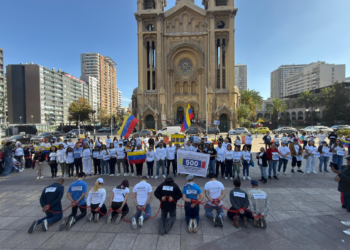
The Government of Spain will end in June 2026 the so-called “express regularization” or exceptional humanitarian route that, since 2018, has allowed almost a quarter of a million Venezuelan citizens to obtain residence permits almost automatically for humanitarian reasons.
From that date, Venezuelans must process their applications through the ordinary immigration procedure, like the rest of the migrants.
The measure, reported by the newspaper El País and confirmed by the Minister of Inclusion, Social Security and Migration, Elma Saiz, responds to the proximity of a new extraordinary regularization process that the Executive has been processing since January 2026, after an agreement with Podemos. According to the minister, it is “a change of form, not substance,” since Venezuelans will be able to take advantage of this massive route once the exceptional period is over.
What was the express route?
Since 2018, in the context of the serious political, economic and social crisis in Venezuela, Spain has systematically granted residence permits for humanitarian reasons to Venezuelan applicants, often linked to requests for asylum or international protection. This privileged route allowed around 240,000 people to be regularized, relieving pressure on the asylum system, which at times was dominated by this group.
As of June 30, 2026, this systematic and agile concession will end. Venezuelans who have not yet obtained a resolution must opt for the general routes of the Immigration Regulation (such as social, labor or family roots) or, where appropriate, for the extraordinary process that will be opened soon.
Extraordinary regularization: an alternative for thousands
The Government has already initiated the procedures for an extraordinary regularization aimed at foreigners who already reside in Spain. According to known details:
- Applications can be submitted between April and June 30, 2026.
- Main requirement: having arrived in Spain before December 31, 2025, proving at least five months of continuous stay at the time of application and having no relevant criminal record.
- The initial authorization will be for one year, with a residence and work permit, and may be extended or modified later.
Minister Saiz has highlighted that this procedure will be “agile, without excessive bureaucracy” and will benefit thousands of Venezuelans and other migrants who are already integrated into Spanish society.
This decision comes at a time when Spain seeks to balance immigration control with the integration of people who already live and work in the country. Government sources indicate that the express route fulfilled its exceptional objective during the Venezuelan crisis, but now a more homogeneous and sustainable framework is prioritized.
Migrant organizations and immigration lawyers are closely following the final details of the royal decree of extraordinary regularization, which is expected to be published in the coming weeks.
Sources consulted: El País, RTVE and Ministry of Inclusion, Social Security and Migration