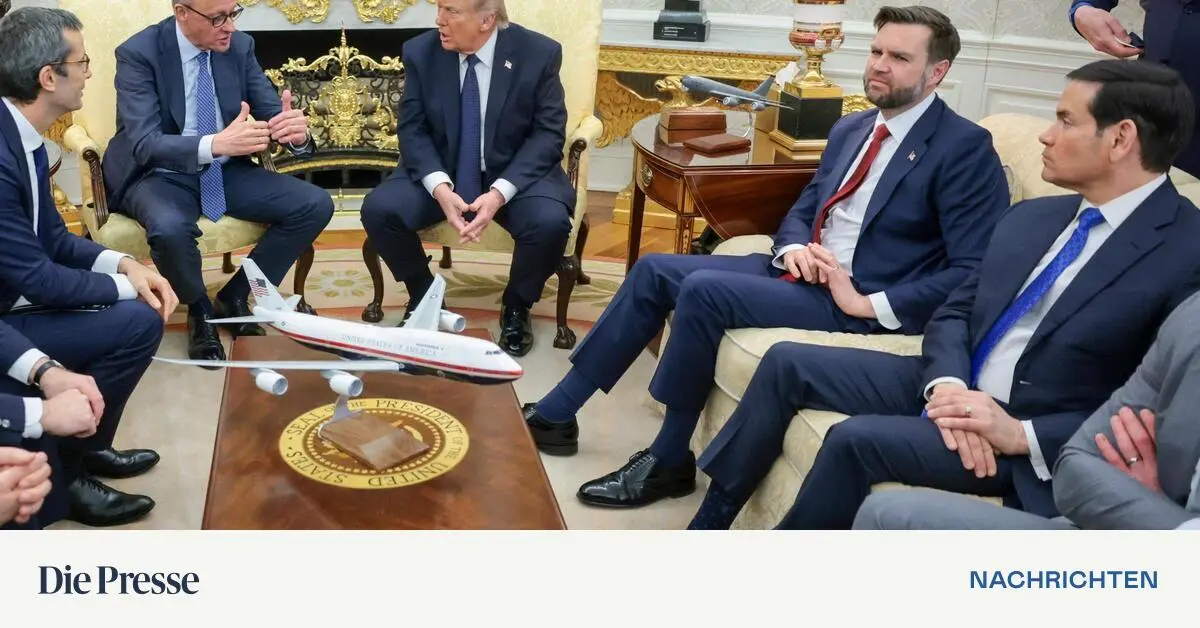
The USA is considering reducing troops in NATO member state Germany, writes Donald Trump on Truth Social. The background is German Chancellor Merz’s criticism of the Iran War.
According to President Donald Trump, the USA is examining a possible troop reduction in Germany. A decision should be made shortly, he wrote on his Truth Social platform. The announcement follows Trump’s clear criticism of German Chancellor Friedrich Merz for making critical comments about the US offensive against Iran.
“He has no idea what he’s talking about!” Trump wrote on his Truth Social platform on Tuesday, referring to Merz (CDU). It is no wonder “that Germany is doing so badly, both economically and in other respects!” He accused the Chancellor of agreeing that Iran had nuclear weapons.
Trump doubled down on Thursday, accusing the German chancellor of having been “completely ineffective” in the Ukraine war. “The German Chancellor should spend more time ending the war between Russia and Ukraine,” the US president wrote on Truth Social. Merz should take care of “rebuilding his ailing country, especially the areas of immigration and energy.”
German Foreign Minister Joachim Wadephul reacted calmly to Trump’s threat to withdraw. “We are prepared for it,” he said on Thursday during a visit to the Moroccan capital Rabat.
Trump had already threatened to reduce the troop contingent in Germany during his first term in office (2017 to 2021). A few months before he left the White House, he announced that he wanted to withdraw 12,000 of the 35,000 US soldiers from Germany at the time. Several thousand of them were to be relocated within Europe, while others were to return to the USA. At the time, Trump described the project as punishment for what he saw as insufficient German military spending. His successor Joe Biden then stopped the plans after taking office.
According to information from the US military in mid-April, around 86,000 soldiers are currently stationed in Europe – around 39,000 of them in Germany. The number changes regularly, also due to rotations and exercises.
During the Cold War, US troops were seen as a security guarantor for the Federal Republic and have become an important economic factor for the regions around the bases. Thousands of local workers are employed by the US military, and thousands more jobs depend on US troops, especially in Rhineland-Palatinate, Baden-Württemberg and Bavaria.
The huge Ramstein air base near Kaiserslautern alone, with the largest US military community outside the United States, is estimated to generate hundreds of millions of euros in wages, salaries, rents and orders in the regional economy every year. The largest US military hospital outside the USA is currently being built near the base.
There have been dozens of large US military bases in Europe for decades, which are of enormous importance in America’s global operations – for example in the Middle East. They are used to station troops, weapons, ships and aircraft; drones are controlled from there and the injured are also cared for. In Germany, in addition to the Ramstein airfield in Rhineland-Palatinate, there is the US High Command for Europe (EUCOM) in Stuttgart.
At the end of 2025, the US Congress approved a security mechanism according to which the total number of forces permanently under the European Command area of responsibility cannot be less than 76,000 for more than 45 days. After that, certain reporting channels would have to be followed in order to achieve a reduction.
In March, Trump had promised the Chancellor that the USA wanted to maintain its troop presence in Germany. “This is good news, but I didn’t expect it to be any other way,” said the CDU chairman in Washington after a meeting with Trump.
Given Trump’s critical stance towards Europe, there had previously been speculation that the President could also withdraw US soldiers from Germany. Merz did not say whether Trump had promised that the US contingent would remain the same.
Last summer – during Merz’s previous visit to Washington – Trump personally gave Germany hope that the US soldiers stationed there would remain at their current troop levels. When asked by a reporter whether he would leave US troops in Germany, he said: “Yes, we will talk about it.” If Germany wants the American soldiers there, he is willing to do so. “Yes, we will do that. It’s no problem.”
If you take Trump’s recent statements as a benchmark, the personal relationship with Merz seems to have reached a new low. Merz countered this impression on Wednesday. “The personal relationship between the American president and me remains good – at least from my point of view,” he said. “We are still in good discussions with each other.”
The Federal Chancellor and the US President maintained a fairly good relationship with each other for months. Recently, however, Merz adopted a new tone and publicly criticized Washington. He accused the US government of not having an exit strategy for the Iran war. “Because the Iranians are obviously stronger than expected and the Americans obviously don’t have a really convincing strategy in the negotiations,” he said during a discussion with students in Marsberg in the Sauerland.
“The problem with such conflicts is always: You don’t just have to get in, you also have to get out again. We saw that very painfully in Afghanistan, for 20 years. We saw that in Iraq,” the Chancellor continued. The Americans “obviously went into this war without any strategy” in Iran. This makes it all the more difficult to end the conflict now. “Especially since the Iranians are obviously negotiating very cleverly – or not negotiating very cleverly,” said Merz. “An entire nation is being humiliated by the Iranian government.”
Merz is not the first leading politician in Europe whom Trump has massively attacked. British Prime Minister Keir Starmer and French President Emmanuel Macron have also fallen out of favor with the Republican. Recently, after the US President’s criticism of the Pope, there was even a clash between him and the Italian Prime Minister Giorgia Meloni. (APA/dpa)