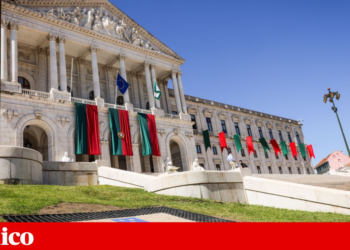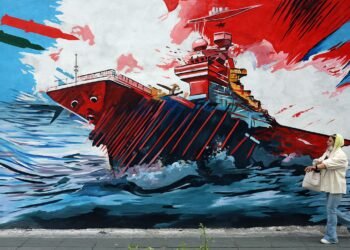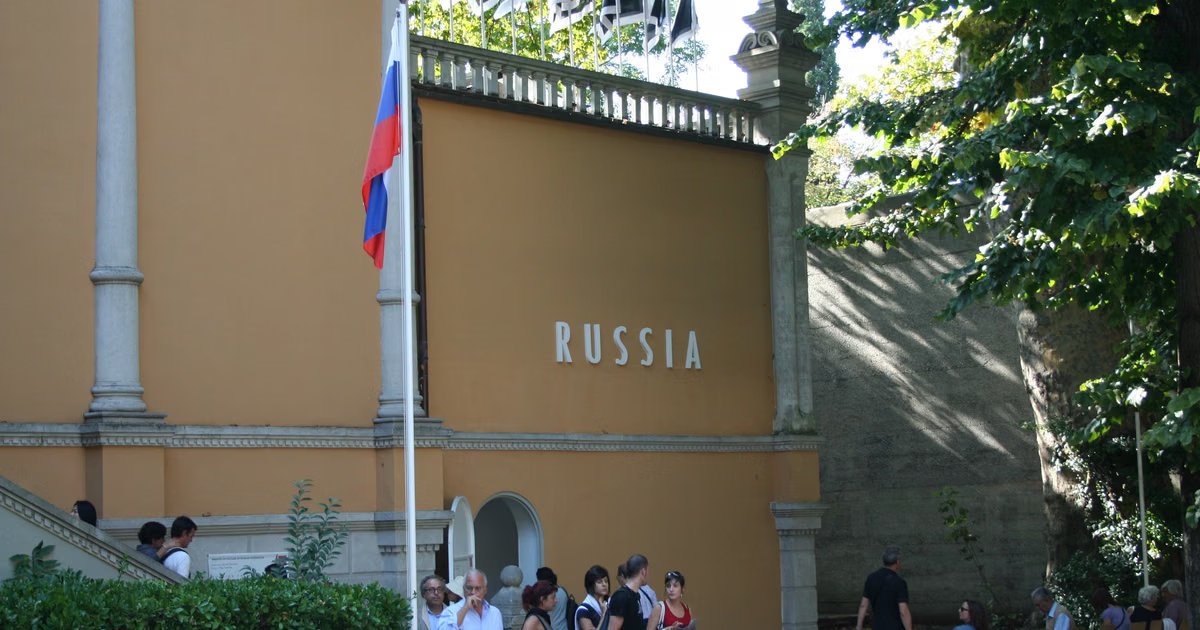
The jury for the Venice International Art Biennale, which begins on May 9, said at the end of this week that it will not take into account artists from countries whose leaders face accusations of crimes against humanity at the International Criminal Court, in a reference to Russia and Israel. This panel, composed only of women and who will select the winners of the Golden Lion and Silver Lion awards among the 110 participants, declared that they feel obliged to commit themselves “to the defense of human rights” as part of their role in this event, often described as “the Olympics of the art world” due to the prestige it represents for the contemporary artists who participate in it.
“As members of the jury, we also have a responsibility towards the historical role of the Biennale as a platform that connects art to the emergencies of its time. We recognize the complex relationship between artistic practice and the representation of the nation-state, which constitutes a central structure for the Venice Biennale, particularly the way in which this relationship links the work of artists to the actions of the State they represent”, said in a statement the jury panel, composed of Solange Farkas, Zoe Butt, Elvira Dyangani Ose, Marta Kuzma and Giovanna Zapperi. “In this edition of the Biennale, we wish to make our intention clear: to express our commitment to the defense of human rights and to the spirit of Koyo Kouoh’s curatorial project. Consequently, this jury will refrain from considering countries whose leaders are currently being accused of crimes against humanity by the International Criminal Court.”
It should be recalled that Russian President Vladimir Putin is accused of war crimes for the deportation and illegal transfer of Ukrainian children, while Israeli Prime Minister Benjamin Netanyahu is accused of war crimes of starvation as a method of war and of intentionally directing an attack against the Palestinian civilian population, as well as crimes against humanity of murder, persecution and other inhumane acts, at least between October 8, 2023 and May 20, 2024.
The Fundação Bienal responded to this announcement, saying that the jury has “complete autonomy and independence of judgment”, classifying its decision as a “natural expression of freedom”. Previously, it had justified Russia’s participation, claiming that it “rejects any form of exclusion or censorship of culture and art”, stressing that “the Biennale, like the city of Venice, continues to be a place of dialogue, openness and artistic freedom, encouraging connections between peoples and cultures, with the lasting hope that conflicts and suffering will cease.”
The president of the Biennale, Pietrangelo Buttafuoco, had already defended the return of Russia, after an absence declared in 2022 due to the invasion of Ukrainestating that the event should be “a space of truce” where art prevails over geopolitics, confirming that Iran, Israel, Ukraine and Belarus would also be present.
“This is further proof that Russian culture is not isolated and that attempts to ‘cancel’ it, undertaken over the last four years by Western political elites, have not been successful,” Mikhail Shvydkoy, Putin’s representative for international cultural exchanges and former Minister of Culture, told ARTnews.
Brussels issues ultimatum
The Biennale’s decision has already been criticized by several governments, starting with the Italian one, led by Giorgia Meloni, a strong critic of Moscow and an ally of Kiev, but also by the Ukrainian one. “Unfortunately, no one who has been involved in international cultural projects in the last four years is very surprised, because Russia has been finding ways to reach important spaces in one way or another all this time,” said Ksenia Malykh, co-curator of the Ukraine pavilion at the Venice Biennale.
The Minister of Culture of Latvia, Agnese Lāce, who led 25 European countries calling for Russia’s exclusion, assured that she will boycott the opening of the Venice Biennale on May 9 if Moscow’s participation materializes, as this gives “legitimacy, through an important European cultural platform financed by European resources” to an aggressor country.
But the most impactful reaction came from the European Commission, which revealed on Thursday that it had sent a letter to the event organizers informing them of their intention to end or suspend a subsidy of two million euros after Moscow was allowed to return. “There is only one ongoing grant, worth two million euros for the next three years, and that is the one we intend to end or suspend,” said a spokesperson for the European Commission, adding that the Biennale has 30 days to respond to the letter.
An ultimatum that comes without surprise, after the comments made by the leader of European diplomacy at the beginning of the week. “While Russia bombs museums, destroys churches and tries to erase Ukrainian culture, it should not be allowed to display its own,” said Kaja Kallas. “Russia’s return to the Venice Biennale is morally wrong, and the EU intends to cut its funding.”