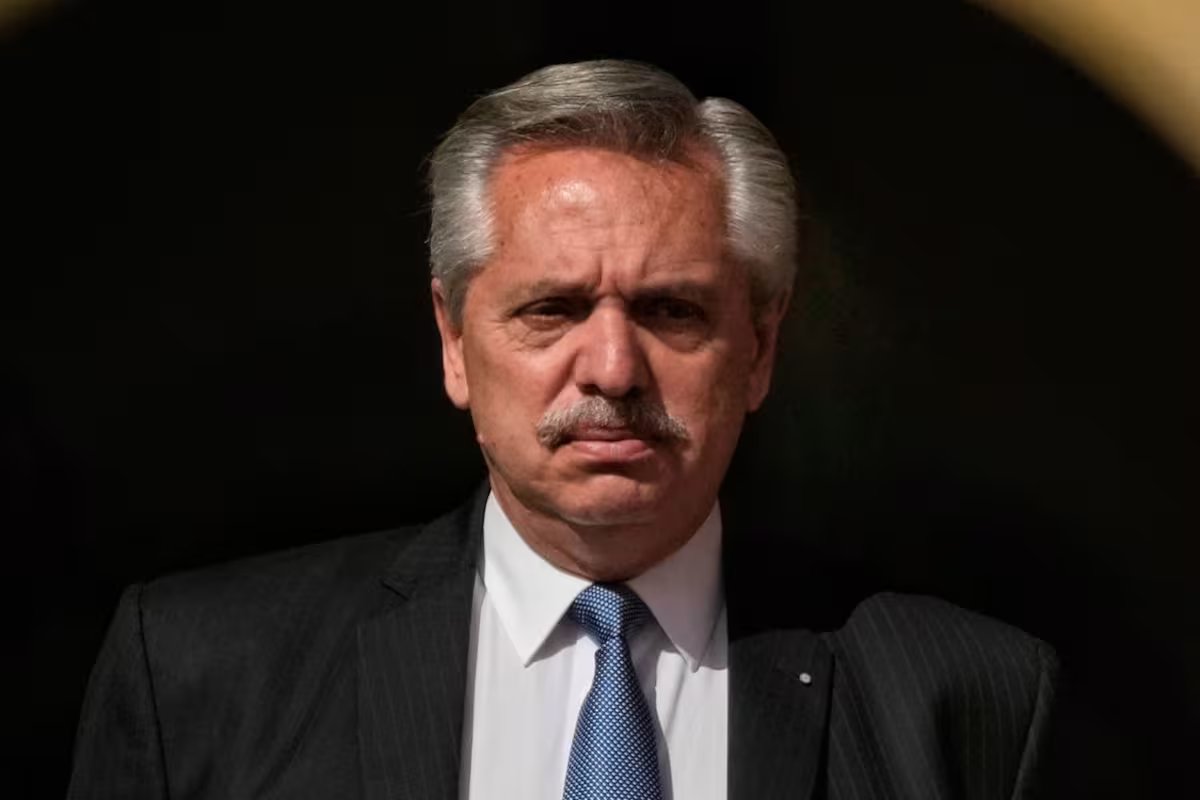
The Federal Court of Cassation yesterday annulled the prosecution of the former president Alberto Fernandez in the case in which he was being investigated for contracting state insurance for the benefit of business friends of his.
The ruling is up to the judges Mariano Borinsky and Javier Carbajowho formed a majority, with the dissent of the chambermaid Gustavo Hornos, who voted to leave the prosecution of the former president firm.
In this way, Chamber IV of the Federal Chamber of Criminal Cassation granted the appeal of the defense of Alberto Ángel Fernández.
He thus annulled the resolution that had confirmed his prosecution in the case and ordered that the Federal Chamber issue a new ruling.
The reason why Borinsky and Carbajo annulled the prosecution is that the prosecutor before the Federal Chamber, José Agüero Iturbe, understood that there were no elements to prosecute the former president.
When the case reached the Court of Cassation, the prosecutor before that court, Raúl Pleé, maintained the opposite and demanded to confirm the prosecution, but Borinsky and Carbajo understood that it did not correspond because the case no longer had any impetus from the prosecution. Without accusation, the accusation cannot prosper.
The case investigates alleged irregularities in the contracting of insurance by State organizations based on Decree 823/2021, which centralized these operations in Nación Seguros SA
According to the records of the case, the scheme would have allowed the intervention of intermediaries and private co-insurers with commissions higher than those of the market and possible state damage.
This is a file of high public impact, in which Alberto Fernández had been prosecuted for negotiations incompatible with the exercise of public office, with an embargo for $14,634,220,283.68 and where a ban on leaving the country was ordered.
Borinsky maintained that there was no controversy between Fernández’s defense and the prosecution, since both had asked to revoke the prosecution and rule that there was no merit.
Since there was no controversy between the prosecutor and the defense (since both requested a lack of merit), the judges of the Federal Chamber confirmed the prosecution without a “sufficient accusatory basis.”
Thus they violated due process and the guarantee of impartiality. In legal terms, they violated the principle that “there is no judge without an accuser,” they argued.
For the magistrate, the confirmation of the prosecution by the Federal Chamber implied excessively resolving the accusation’s claim and affected the accusatory principle and that of due process.
Along these lines, Borinsky stressed that the subsequent intervention of the Attorney General before the Chamber of Cassation, Raúl Pleé, did not remedy the problem.
According to his vote, Pleé’s opinion did not offer specific reasons, tailored to the case, that justified deviating from the previous fiscal position.
Borinsky said that he relied on general invocations of the principle of unity of action of the Public Prosecutor’s Office and it was not enough to support the inadmissibility or rejection of the defense appeal.
Carbajo supported Borinsky and considered that the ruling of the Federal Court that had confirmed the prosecution had been issued “in excess of the claim duly stated by the prosecution.”
That is why he proposed to allow the former president’s appeal for cassation, annul his prosecution and return the file to the Federal Chamber to issue a new ruling.
The vote of Gustavo Hornos It was in dissent with Fernández. Hornos proposed to declare the appeal inadmissible.
For him, the ruling that confirmed the prosecution is not a final ruling nor comparable to such, so it was not appropriate for the Federal Court of Cassation to intervene.
Furthermore, he understood that the defense had not demonstrated a current grievance that was impossible or late to repair later.
Hornos also argued his vote by relating the lack of prosecutorial accusation. He said that Pleé had argued that the appeal was inadmissible and therefore that it should be rejected for the process to continue.
From there he understood that the existence of a sufficient federal question was ruled out. In his opinion, Pleé’s position supported the accusation and was enough to advance the case.
For Hornos, Pleé’s ruling, based on the unity of action of the Public Prosecutor’s Office and the need to investigate crimes of state corruption, made it possible to rule out the violation of the accusatory principle and justified declaring Fernández’s appeal inadmissible, to make his prosecution final.
The chambermaid said that the prosecution issued without preventive detention and confirmed by the Court of Appeals was “sufficiently founded in law and in the records of the case,” in relation to the facts investigated.
Hornos described the maneuver, speaking of an “irregular targeting scheme in the contracting of state insurance.”
And he explained that “it would have operated by taking advantage of the centralization provided by Decree 823/2021, which allowed the improper incorporation of intermediaries and private co-insurers.”
“This would have resulted in the payment of commissions higher than those of the market and in the eventual contracting of unnecessary or over-invoiced services, with the consequent economic damage for the State,” he wrote.
Despite this ruling, the appeals of the other defendants Diego Nicolás Rosendi, Agustín Beraldi and Bri Brokers SA were declared inadmissible, according to the majority made up of Carbajo and Hornos.
However, in practice, the annulment of the former president’s prosecution opens a door for these defendants. Borinsky warned that when having to issue a new ruling, the Federal Chamber must “examine the scope that should be assigned to what is resolved here with respect to the adherents, according to the particularities of each one, their procedural situation and the degree of connection or identity of grievances.”
That is, although the Court of Cassation did not automatically disassociate them, it forced the Federal Court to review whether this annulment affects Rosendi, Beraldi, Bri Brokers SA and the rest of the defendants in the file.