I have read many declarations of love to books and literature, but I must admit that none of them impressed me like this one: “Our squad was attacked by a German battalion. We threw ourselves into the trenches. At one point I was tempted to continue reading while we were pinned down under fire. I was slightly wounded that day. The point is that the book kept running through my mind even under quite heavy fire, it was so interesting. Most unusual, because I never set foot in the West Point library except on orders, but I liked the book.”
It is clear from the context that this is a confession of an American officer in the Second World War. Libar, which possessed him to such an extent that even under enemy fire he thought of continuing to read, is the novel “One Tree Grows in Brooklyn”, by the author Bessy Smith.
They couldn’t take away reading from us
And he felt that longing on the Normandy beach on June 6, 1944, in the wake of D-Day. You’ve all seen “Saving Private Ryan” and have at least a rough idea of the extent of the horror that greeted the Allied forces there. Despite everything, including the fact that as an officer he was directly responsible for the lives of the soldiers he commanded, his thoughts wandered from the hellish cauldron in which they all found themselves together, across the ocean to peacetime New York.
Only a shade less impressive is the testimony of the lieutenant Robert Kee whose plane was shot down over Germany, so he spent three full years in the Stalag Luft VIII camp. He described his experience as follows: “We would not have survived without books. They represented our only reliable support, the only real comfort. When food was scarce, when clothing was scarce, barracks were overcrowded and icy, and the news was bad, we always had books. Reading was a pleasure that, like sleep, could not be taken away from us. I remember the books I read then with great warmth.”
Every literature teacher should start the first lecture of the new school year with these two confessions. Maybe his mostly uninterested students would scratch their heads and decide to give books a chance. I guess there is some devil in them when some point out that they saved their lives, and others admit that they almost lost their heads because of them.
In the beginning it was always a word
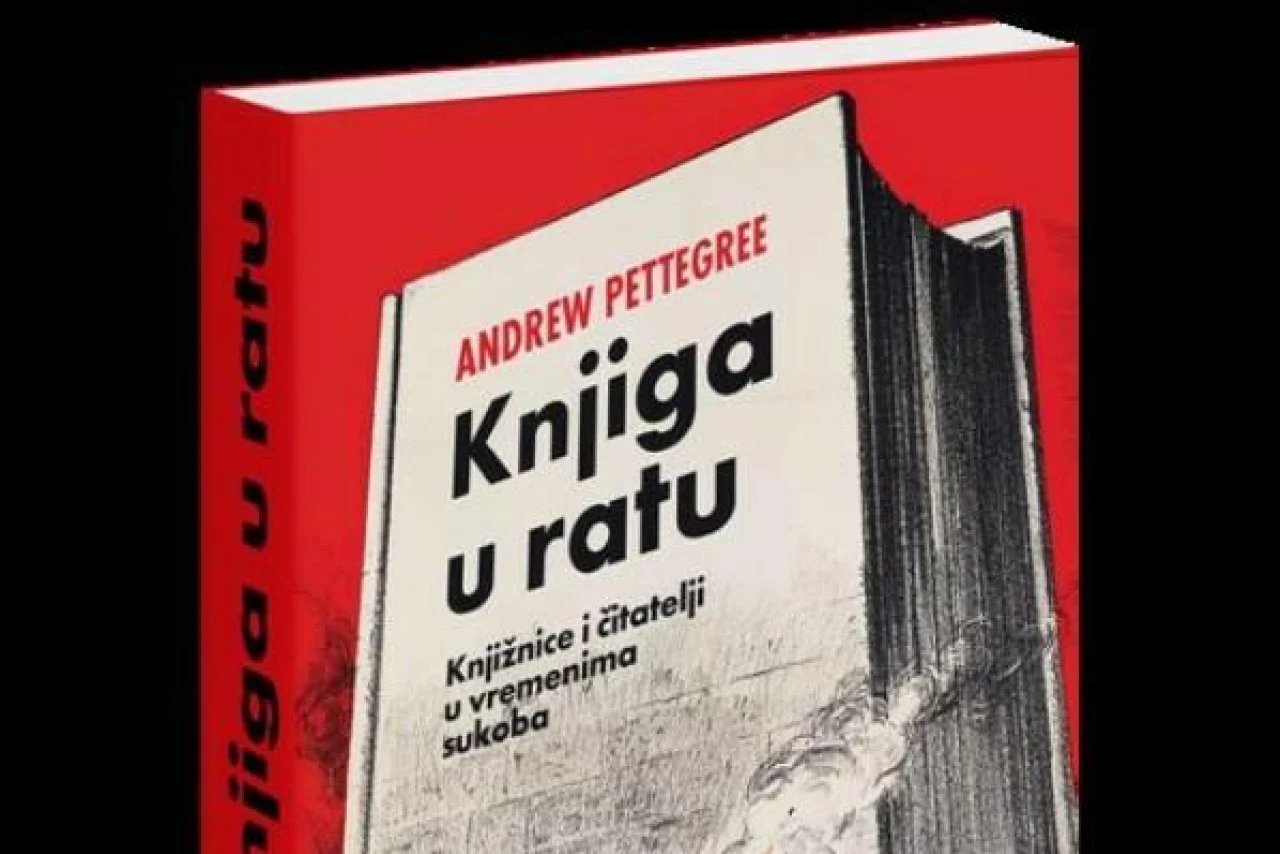
I kindly pass on these two impressive testimonies to you Andrew Pettegreea distinguished British historian born in 1957, for whom it is currently being translated Marin Popović and Petra’s books, the monograph “Books in War: Libraries and Readers in Times of Conflict” was published. It is a real miracle that no one before him had thought of writing such an ambitious and meticulous librarian that would deal with the role and courage of literature in the great armed clashes that reshaped history.
Namely, if we are talking about wars, we can say with peace of mind that it was always the case in the beginning. Big plans for conquering the world first existed as literary facts, only later to become political or military. Remember with only Hitler’s programmatic papacy under the title “Mein Kampf”. In addition, all the prominent protagonists of the great wars were very enthusiastic readers.
Josif Visarionovich Stalin he had a collection of fifteen thousand books in his Kremlin apartment and dacha near Moscow. That they did not serve him as mere decoration is evidenced by the fact that on the margins of a large number of volumes that have been preserved, one can see the comments he wrote. His marshal Georgy Zhukov he was an even bigger book lover, he had his apartment upholstered with a total of twenty thousand titles. Furthermore, Mao Zedong first he was a librarian, and then he became the author of the best-selling book in history: his “Little Red Book” was printed in a hallucinogenic circulation of one billion copies and translated into fifty languages.
A touching dedication to magic
Only people who swore by books could make a big contribution to their destruction and obliteration. Every large-scale armed conflict is always, among other things, if not above all, a fight against the culture or memory of the community that one wants to subjugate or wipe out. Fortunately, this axiom also has a twist: cannons, tanks and planes are not enough to defend oneself. Books are neither helmets nor bunkers, but they can still save lives.
The protagonists of Andrew Pettegree’s sweeping study are ideologues, propagandists, censors, spies, robbers, librarians, publishers, authors, readers… a rich ensemble of distinctive characters who were scattered in every war on a wide stretch from the trenches on the front line to the deep background, and for each of them books were important for some reason.
In addition to gathering in one place a very rich treasure trove of astonishing data on the delicate dynamics of the relationship between literature and war, the author also wrote a kind of touching tribute to the magic of reading.