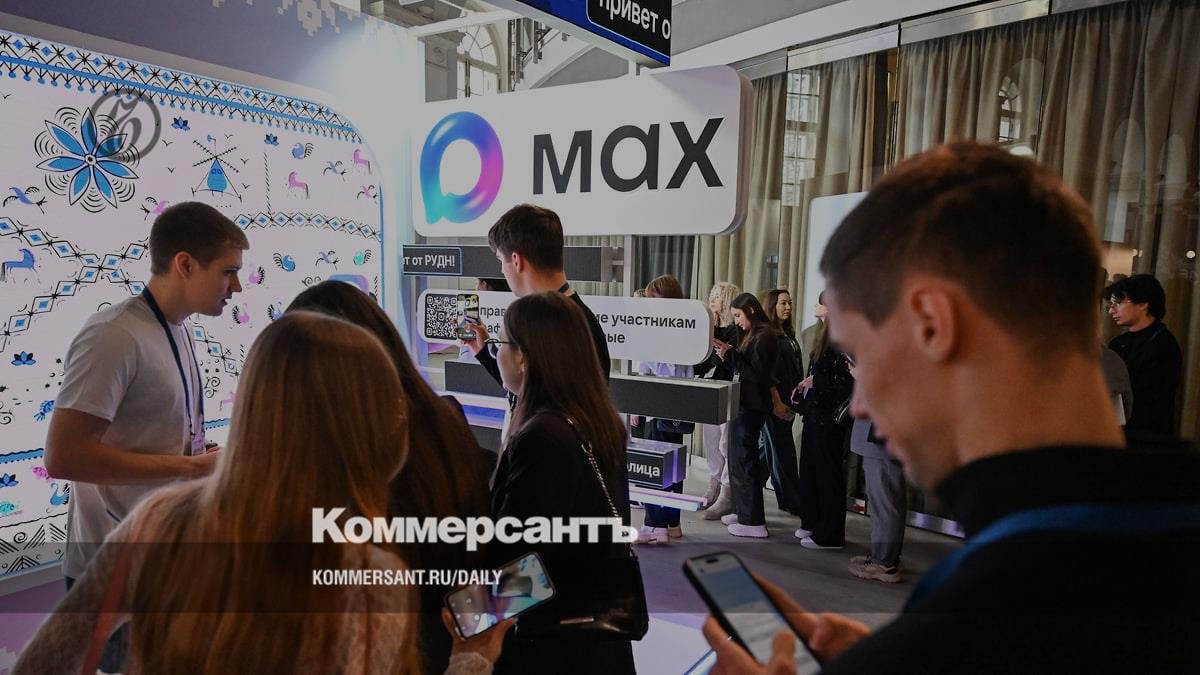
By the end of the year, the volume of advertising in the Max messenger may reach 2.5 billion rubles, while at the end of 2025 it was estimated at 600 million rubles. Market participants note that the budgets and coverage of the national messenger began to grow after the Telegram slowdown, but even in the current conditions, activity in Max is not yet comparable to the latter.
Advertising placements in Max by the end of 2026 in monetary terms will amount to 2–2.5 billion rubles, predict Telega.in and the Association for the Development of Interactive Advertising (ARID). In general, this volume is about 3–4% of the influencer marketing market, which by the end of 2025 could slow down to 50–60 billion rubles. At the same time, if audience involvement and its flow into the messenger grows rapidly, advertising in Max could reach 3–5 billion rubles, Telega.in adds.
The leader among channel categories for promotion in Max is “news and media” with more than 50% of investments, and the leader among advertiser categories is “online education” with more than 30% of expenses.
Last fall, Telega.in predicted the volume of budgets in Max at the end of 2025 at the level of 500–600 million rubles. (cm. “Kommersant” dated September 3, 2025).
Earlier, Kommersant wrote that the growth rate of the Russian advertising and online promotion market decreased from 53% in 2024 to 28% in 2025; in total, the industry earned 1.569 trillion rubles. In early March, the FAS declared advertising on Telegram and YouTube illegal due to blocking of sites by Roskomnadzor, but later delayed the ban until the end of 2026.
Max already has both pioneers with successful experience and those who are waiting for the first public market cases; this is a normal structure for the new platform, says Alexander Kuksa, co-chairman of influence marketing at ARIR. In 2026, the platform will grow due to active testing of placements, growth of the average check and development of platform channels, says Telega.in CEO Vladimir Mosin.
The Max press service told Kommersant that the platform is developing the functionality of channels, due to which the subscriber base and the number of advertising integrations are growing. In the future, the service intends to develop and implement advertising inventory, but the company did not specify the timing of its launch.
Market participants believe that from an advertiser’s perspective, Max has some work to do. This is due to a shortage of advertising inventory and limited analytics, says Igor Demidov, CEO of the digital agency D-Agency.
In addition, when the audience is transferred to the site from Telegram, a significant part of active subscribers is lost, he reminds. Kommersant’s interlocutor in one of the media publications, which placed advertisements in Max, encountered conflicting results. According to him, due to the fact that the site does not have a statistics office, it is necessary to turn to third-party services that do not provide accurate results on coverage and its source. At the same time, services like Yandex Direct indicate that the cost of a subscriber in Max is even higher than in Telegram: 159 rubles. against 100 rub.
NMi Group says that the budget forecast looks realistic, but we must not forget that this is an “artificial increase” and the audience is actively migrating to Max against the backdrop of Telegram restrictions. There is currently no full-fledged advertising inventory as such in Max, and the coverage of blogs is not comparable with Telegram – real growth in placements in Max can only be seen after the FAS ban comes into force, they remind. Earlier, Kommersant wrote that in March Telegram traffic decreased by 18%, while in January it grew by 5%, while Max’s traffic has been growing since the beginning of restrictions.