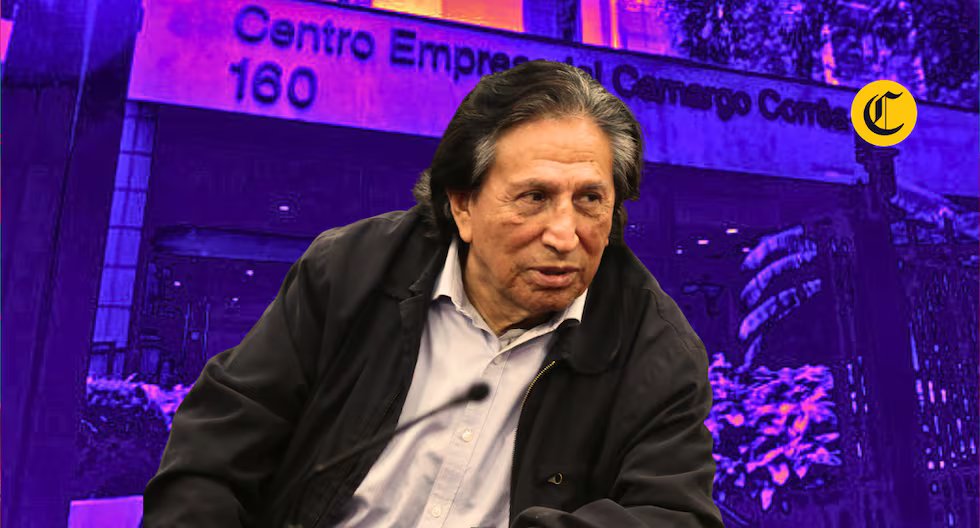
According to a resolution of April 21, accessed by El Comercio, the supreme court ordered that the file be sent to the Ministry of Justice through the Presidency of the Supreme Court and also inform the Attorney General’s Office of the decision.
The extension of extradition is a necessary process so that Toledo Manrique can be subjected to an oral trial in this case, where the Public Ministry has requested 24 years and eight months in prison against him.
With this decision, the highest instance of the PJ approved the request formulated by the judge of the First Preparatory Investigation Court of the National Superior Court of Specialized Criminal Justice, Richard Concepción Carhuancho, who in January of this year issued the order of prosecution against Toledo Manrique and others involved in this case.
He Public Ministry (M.P.) accuses the former president of the alleged crimes of money laundering and collusion aggravated by his alleged participation in illicit acts during the tender for the Project “South Interoceanic Road Corridor, Peru – Brazil, Section 4: Inambari – Azángaro” in favor of the company Camargo Correa, in consortium with Andrade Gutiérrez SA and Queiroz Galvao SA).
Toledo Manrique already has two convictions that are under appeal. In the Odebrecht Case (Tranches 2 and 3 of the IIRSA Sur) he was sentenced to 20 years and six months for money laundering and collusion. While in the Ecoteva case, the court sentenced him to 13 years and four months for the crime of money laundering.
The former president has been held in the Barbadillo Prison (Ate) since April 2023, when he was extradited from the United States.

ALEJANDRO TOLEDO-TRAVO IV INTEROCEANIC EXTRADITION
Awaiting approval in the US to undergo oral trial
According to the judicial resolution, the Supreme Court concluded that there is probable cause to prosecute Alejandro Toledo for each crime.
The Peruvian justice system presented 37 elements of conviction to support the alleged crimes of money laundering and collusion, for which it seeks to place Toledo Manrique once again in the dock.
“On the merit of these documentaries, the participation of Alejandro Toledo Manrique in the crimes of collusion and money laundering can be evidenced.”
Along these lines, the referee pointed out, in the present case, the conduct attributed to the defendant Alejandro Toledo is criminal in the United States, although under a different name.
In addition, it is contemplated as a crime of bribery of public officials and witnesses, stipulated in article 201 of Title 18 of the Code of the United States of America.
While money laundering is contemplated as a crime of laundering monetary instruments, stipulated in article 1956 of Title 18 of the Code of the United States of America.
The judicial resolution was signed by the supreme judges Víctor Prado Saldarriaga, Manuel Luján Túpez, María del Carmen Altabás Kajatt, Saúl Peña Farfán, Sara Maita Dorregaray,

For the alleged crime of collusion, Toledo Manrique is alleged to have initiated collusive negotiations in 2004 with businessman Marcos de Moura Wanderley with “knowledge and will, taking advantage of his privileged and high-ranking position” in the state public apparatus, given his status as president of Peru (2001-2006 period).
According to the accusation, both held meetings in both Brazil and Peru, in which they agreed that the Brazilian company Construcoes e Comercio Camargo Correa SA-Sucursal Perú, would be favored in the concession process of the “South Interoceanic Road Corridor, Peru-Brazil, Section 4 (Inambari-Azángaro)” Project.

ALEJANDRO TOLEDO-TRAVO IV INTEROCEANIC EXTRADITION
To this end, between 2004 and 2006, it allegedly carried out various irregular acts that prevented the granting of Tranche 4 from being an impartial, transparent process with a plurality of bidders, thus defrauding the Peruvian State.
Therefore, according to the accusation, with his actions, Toledo Manrique prevented the concession from being granted under better conditions and for a reasonable amount for the Peruvian State, thereby causing the undue exposure of economic resources to the detriment of the public treasury.
“By virtue of this illicit pact, the company Construcoes e Comercio Camargo Correa SA Sucursal Perú undertook to make payments, up to the sum of USD 6,313,075 (six million three hundred thirteen thousand seventy-five US dollars); of which, USD 5,411,207 (five million four hundred eleven thousand two hundred seven US dollars) should have been for the then presidential president Alejandro Toledo Manrique, an amount equivalent to 3% of the value reference (original) of the project, of which USD 3,984,335 (three million nine hundred and eighty-four thousand three hundred and thirty-five US dollars) were identified, while USD 901,868 (nine hundred and one thousand eight hundred and sixty-eight US dollars) would be for the person with the initials ‘JR’”
Regarding the alleged crime of money laundering, the accusation points out that after an agreement with the deceased effective collaborator, Josef Arieh Maiman Rapaport, he used his bank accounts of the latter’s offshore companies, Trailbridge Ltd., Warbury & Co., Merhav MNF and Confiado International Corp., to carry out complex financial operations, acts of money laundering, in order to hinder the alleged acts of bribery of the Camargo Correa company and prevent its seizure or confiscation.
The former president would have ordered five transfers for the total amount of US$760,001 made by three offshore companies linked to the Camargo Correa company to be received in three Maiman companies. Then, part of the money was transferred again to other accounts of Maiman’s companies, in two operations.
And, in a second stage, 34 transfers from 26 offshore linked to Camargo Correa would have been received in the accounts of the company Warbury & CO. at Barclays Bank PLC in London (offshore provided by Josef Maiman Rapaport).
“In that sense, Alejandro Toledo Manrique had control of the fact, having ordered the deposits to be made to the accounts of Joseff Maiman Rapaport (third party), in order to avoid the identification of their origin, seizure or confiscation, since the tainted money was the product of the collusive agreement executed between him and the representative of the Camargo Correa company, Marcos de Moura Wanderley, within the framework of the concession of the Interoceanic Road Corridor Project, Section 4.”
Now, the Ministry of Justice and Human Rights must present the request to the Council of Ministers for approval and the government, through the Foreign Ministry, can send the request to the United States for approval in that country.

Alejandro Toledo is facing legal action against the United States Department of State to truncate his extradition.