The removal from power of the Hungarian Prime Minister Viktor Orbán through a categorical electoral defeat generated a wave of comments in the European public space, and the geopolitical and economic effects of the change of “regime” in Budapest seem to extend beyond the borders of the country, considering the refractory speech of the former leader towards most of the strategies proposed in the community block over time.
In addition to the vast implications of the wave of far-right populism in Europe in recent years, European political analysts have analyzed in recent days how the Hungarian government’s ties with the US MAGA movement will evolve in the future, given the political capital invested by the Americans in the Fidesz party, but also how the calculations regarding the economic and military future of Ukraine, still under attack from the Kremlin and with a position uncertain about European integration and NATO.
“I first met Orbán shortly after he was re-elected as Prime Minister in the spring of 2010, when I traveled to Budapest with the excellent American Ambassador Eleni Kounalakis (today Lt. Governor of California). Orbán struck me as charismatic and intelligent. He spoke English quite well, and his positions seemed well thought out. I left there convinced that he would be someone to work with pleasure to work with. So much for first impressions.
We discussed at length the NATO mission in Afghanistan, where Hungary had more than 600 soldiers, most of them involved in training the Afghan National Security Forces. Orbán was generally favorable, but it was clear he had reservations about several other alliance missions, from peacekeeping operations in the nearby Balkans to combating piracy off Somalia. When the war in Libya began a year later, Hungary refused to participate, and over the next decade Orbán became a major obstacle to the alliance. The worst was that he got closer and closer to his Russia Vladimir Putinwhich led to controversial energy agreements with Moscow and the support of several Russian positions, contrary to NATO objectives”, explained, in a recent material, James Stavridis, Bloomberg analystformer admiral in the US Navy and former supreme commander of NATO forces in Europe.
According to him, given that the alliance operates on the basis of full consensus in major decisions, the former Hungarian prime minister single-handedly managed to delay the accession of Sweden and Finland for over a year and did everything in his power to undermine European support for Ukraine. By the time he was rejected by the electorate, he was widely considered Putin’s main ally in Europe and a Trojan horse within the alliance.
Three strong points for Ukraine, with Orban’s departure from power
With his defeat came three important geopolitical and military advantages for the West. The first and most obvious is that Hungary will no longer try to sabotage European involvement and support for Ukraine. While some difficulties may remain from Slovakian leader Robert Fico, the most vocal opponent of NATO and EU positions is out of the equation, Stavridis explained in a recent Bloomberg analysis.
Basically, the current situation means that more military, financial and humanitarian aid can go directly to Kiev. “It is more important than ever, given the almost total withdrawal of US support under the Trump administration. NATO will also have a freer hand to provide training, intelligence, technology and logistical support to the Ukrainians under pressure. This is very bad news for Moscow,” the analyst added.
A second strategic aspect of Hungary’s return to the West is geographical. Located in the heart of Central Europe, Hungary shares borders with seven countries, including Ukraine. It is a crossroads country, capable of creating strategic and logistical bottlenecks for NATO and the EU. The analyst clarified that this role dates back to the days of the Austro-Hungarian Empire in the 19th and 20th centuries, when Hungarians used their geographical position to strengthen their trade economy. And if the Hungarian state moves away from Moscow, not only Ukraine becomes relevant, but also the border with Serbia, in the context of Putin’s constant efforts to expand Russian influence in the Balkans. In addition, Papa Air Base in western Hungary is home to NATO’s multinational strategic airlift capability and the fleet of C-17 aircraft that I relied on during my time as Supreme Allied Commander.
Finally, with the departure of Orban, the Hungarian army can modernize quickly and integrate seamlessly into NATO. Although it only has about 30,000 troops, Hungary is investing in modern front-line equipment, including new German Leopard 2A7 tanks and formidable Swedish JAS 39 Gripen jets. Although it barely meets the old NATO target of allocating 2% of the GDP for defense, the future prime minister, Peter Magyar, leader of the center-right Tisza Party, promised to increase this level to 5% by 2034, the former NATO official also explained.
European accession suddenly became a more realistic scenario for Ukraine and Moldova
The electoral defeat of Hungarian Prime Minister Viktor Orbán has also led several European diplomats and officials to speculate that Ukraine and the Republic of Moldova will be able to advance in the process of joining the European Union, ending a four-year deadlock regarding the two states’ candidacies, according to a recent analysis political.
The two countries saw their path to membership delayed after they were granted candidate status in 2022, with Orbán blocking the official launch of negotiating “clusters”, the groups of reforms and commitments that candidate states must meet before joining. Those talks would begin shortly, according to four European officials and diplomats familiar with the negotiations, who spoke on condition of anonymity to discuss confidential discussions, POLITICO reported. But after the EU finally managed to unlock Ukraine’s €90 billion loan, “now is the time to look ahead” to the “next step”, namely its membership bid, European Council President António Costa said upon arrival at the EU leaders’ summit in Ayia Napa on Thursday after talks with the Ukrainian president Volodymyr Zelensky.
The first legal step on Kiev’s path to the EU, the opening of cluster one, has been blocked by Hungary for years, but could become possible once a new government is installed in Budapest, officials said. Concretely, Ukraine expects the cluster negotiations to be opened in “the next few weeks”, Ukrainian Deputy Prime Minister Taras Kachka said in a video interview with POLITICO, on which occasion he also specified that he considers the meeting of European affairs ministers on May 26 as a possible deadline for the opening of the first negotiating cluster. Although Brussels and Kiev are already holding informal talks, the decision to formally move forward must be unanimously adopted by all 27 EU governments, and so far Hungary has blocked progress.
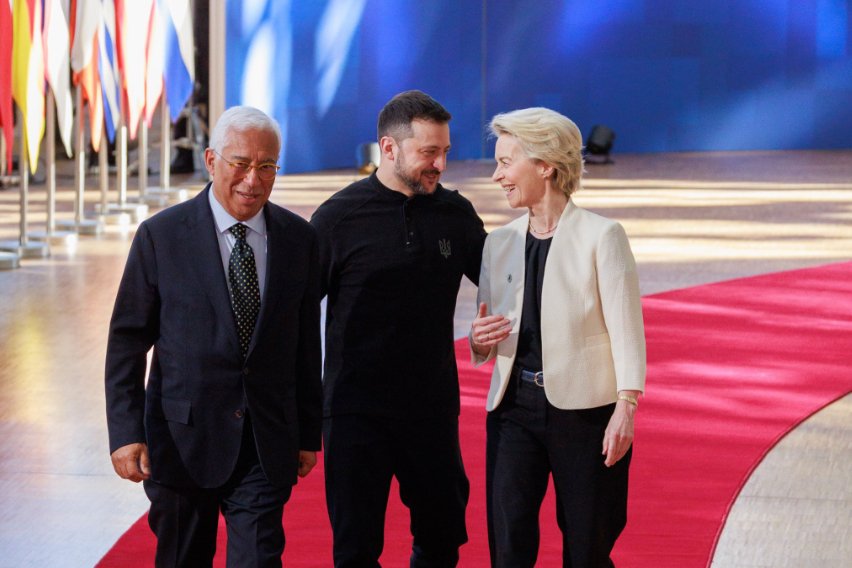
Until the meeting of EU leaders in June, Kachka also explained that it would be possible to open all the active negotiation clusters for Ukraine, a fact confirmed, according to the quoted source, by the European commissioner for enlargement, Marta Kos. We remind you that the Ukrainian president, Volodymyr Zelensky, together with Costa and the president of the European Commission, Ursula von der Leyenmet on the sidelines of the summit of European leaders on Thursday, April 22, in Ayia Napa, where they “called for the opening of the negotiating clusters without delay,” according to a joint statement.
Although the EU has previously expressed concerns about Ukraine’s anti-corruption efforts, some Ukrainian lawmakers have opposed changes requested by Brussels. Kachka said these objections are a natural part of the democratic process, but rule of law reforms are already underway. The problem is also that several European capitals have already rejected the idea of new states being admitted for geopolitical reasons, amid fears that future governments could regress in terms of democracy and the rule of law, generating new confrontations similar to those caused by Hungary. At the same time, however, a broader discussion about reforming the membership process or admitting new members without full rights has not yet advanced.

The draft of the new Salary Law could be launched at the end of the week, if there is a political agreement, said on Tuesday, April 28, 2026, the interim Minister of Labour, Family,…