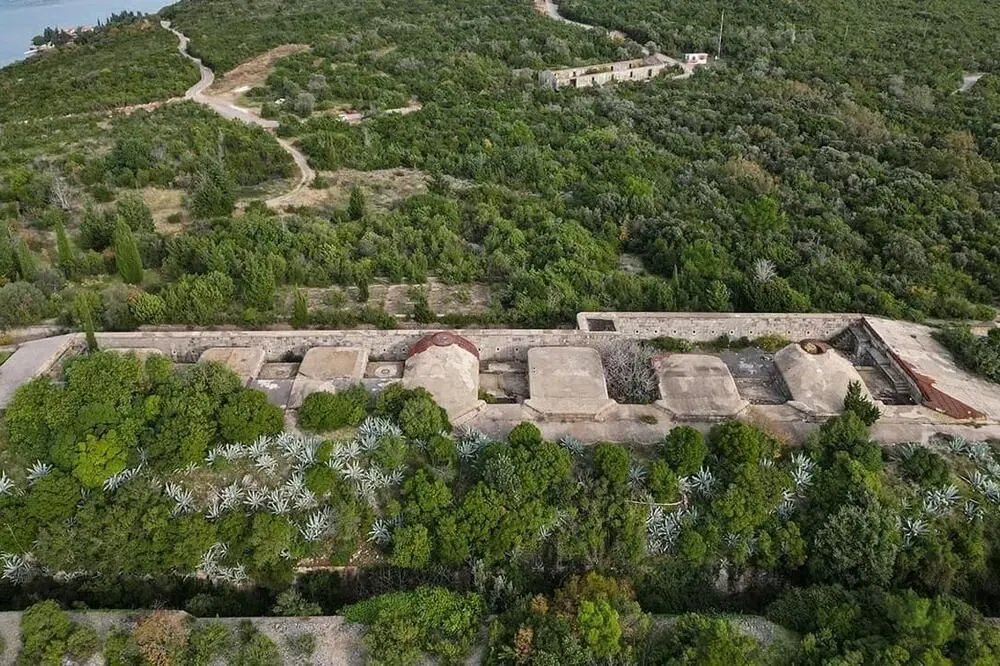
On the website of the real estate agency “Dream Estates Montenegro”, which is part of the international group “Savill”, an advertisement was published for the sale of the Austro-Hungarian fortress Kabala on the coast of the Luštica peninsula, at the entrance to Boka.
As stated, “land/projects/ruin” with a total area of 23,539 square meters is being sold at a price of five million euros.

On the “Dream Estates Montenegro” website, it is stated that it is about the “historic Austrian fortress Fort Kabala, Luštica peninsula”, on the administrative territory of the municipality of Herceg Novi.
“A rare opportunity to own a piece of European military history, above the peaceful coastal village of Rose, at the entrance to the magnificent Boka Kotor Bay, rises Fort Kabala – an exceptional fortress built at the end of the 19th century, between 1895 and 1897, by the Austro-Hungarian Monarchy. Designed as part of the South Adriatic defense system, the fort once guarded the strategic sea passage to the Boka Kotor Bay, one of the most beautiful natural bays in From its elevated position, Fort Kabala offers stunning panoramic views – of the Croatian coast and the Prevlaka peninsula in the west, and of Igalo, Herceg Novi and the Montenegrin Riviera in the east,” the ad says.
In the Administration for the Protection of Cultural Property “News” it was unofficially said that they are aware of the ad for the sale of Kabbalah, and that they will officially inform the National Commission for UNESCO and the Government about it, so that the state may eventually take adequate steps to return that valuable historical object to its possession and adequately protect it.
The brokers in the sale of this real estate state that the Kabala fortress is an “architectural heritage”.
“Constructed of stone, brick, concrete and reinforced metal, the fort has two main levels – a lower level with garrison quarters and ammunition stores, an upper defensive platform for artillery and observation. Surrounded by a protective wall and a dry moat, the fort is an outstanding example of late nineteenth-century Austro-Hungarian military engineering. Although currently overgrown with agaves, cypresses and ivy, the structure remains stable – ready for a visionary investor who will return it to its historical glory”, the ad reads.
It is pointed out that this property has “potential for development” because it includes a plot of 23,539 m², “zoned for tourism and hospitality development.”
“According to the local planning document, it is possible to build various tourist facilities, including: a tourist center, a hotel, villas with swimming pools for rent, a closed complex of villas, private accommodation, tourist facilities in the coastal zone, sports and recreational facilities, a park for special tourist purposes. Thanks to its elevated position by the sea, it is ideal for a project that combines history, exclusivity and nature, from a destination hotel to a private rest area with an impressive view of the sea”, advertises the old Austro-Hungarian fortress in the “Dream Estates Montenegro” agency.
As advantages of this location, they cite its relative proximity to the tourist resort of Luštica Bay, Tivat Airport, the Old Town of Kotor and Porto Montenegro, as well as the island and the Austro-Hungarian fortress of Mamula, which the Egyptian-Swiss company Orascom has already turned “into an exclusive boutique hotel and spa center.”
“Despite its hidden location, Fort Kabala is well connected to the main destinations of the Montenegrin coast, allowing both privacy and practicality. The advantages of this investment are that it is an authentic Austro-Hungarian fortress (1895-1897), exceptional panoramic views of the Adriatic and the Bay of Kotor; a large plot with flexible tourist zoning; a unique architectural identity – the basis for a project with a recognizable character; one of the last privately owned historical fortresses on the Montenegrin coast.”
They state that Fort Kabbalah is “more than real estate” and “a call to visionaries”.
“It is an opportunity to revive a monument of European history and turn it into a destination that combines the past and the future. Whether you imagine it as a luxury resort, a heritage museum or a private estate, this property offers unlimited potential for those with imagination and ambition,” said the “Dream Estate Montenegro” agency.
The tracks lead to Panama
Although the Kabala fortress is more than a century old and is part of the unique and complex Austro-Hungarian fortification system “Boka coastal fortress”, which is part of the cultural and historical heritage not only of Montenegro but also of a dozen independent European countries that made up the Austro-Hungarian Empire, it does not have the official status of an individual cultural property in Montenegro.
In the records of the Real Estate Administration of Montenegro, the cadastral plot 1527 KO Rose, where the Kabala fortress is located, is officially listed as “barren land” with an area of 23,539 square meters with the burden of marine property, but according to the official records, there are no registered buildings on it. The company “Norex Management Montenegro” from Podgorica is registered as the current owner of this property. The company “Janov White Sea Investment SA” from Panama appears as the sole founder and owner of this company in the records of the Commercial Court.
As “Vijesti” announced in September 2005, the submarine mine “Kabala”, among the six investors who sent bids at the competition of the Fund for the Reform of the Defense System of the State Union of Serbia and Montenegro, was bought by the Belgrade company “ADOC” for 1.65 million euros.
Kabala is just one of a series of old Austro-Hungarian fortresses in Boka that fell into private hands because they were sold in 2005, at the dawn of the Montenegrin referendum on independence, by the then Fund for the Reform of the Defense System of the State Union of Serbia and Montenegro. Namely, the Austro-Hungarian fortresses in Boka, for decades before that as military objects, were part of the property of the former JNA, and when the Montenegrin authorities, led by the DPS, agreed with the then government in Serbia, led by the Democratic Party, on the formation of the Fund for the Reform of the SCG Defense System, these fortresses, as well as a good number of other attractive properties on the coast that were part of the property of the then Army of the State Union of Serbia and Montenegro, were declared surplus and their accelerated sale began. usually at symbolic prices. At the head of SCG and the Defense System was the president of SCG state union, high-ranking DPS official Svetozar Marović, and the Defense System Reform Fund then sold some of the most attractive properties on the coast to businessmen and companies that were later linked to the Budva organized crime group led by Svetozar Marović, who is now a fugitive from justice.
Some of the Austro-Hungarian fortresses that were sold at the time were tried to be resold by the new owners, so in 2021, the Montenegrin public was dismayed when a large sign “For sale” with the seller’s contact number appeared on the Arza fortress on the promontory of the same name on the southern side of the entrance to Boke Bay. That number was also called by the then Montenegrin Minister of Finance and Social Welfare, Milojko Spajić, who then wrote on the X social network that “no one answers his phone number.”
“We will check the ownership. After decades of usurpation, the state should take over such cultural treasures and valorize them properly,” said Spajić at the time, however, Arza has not been returned to state ownership to date.
The cabal was armed with eight artillery pieces
Fort Kabala with an area of 3,719 square meters is only one of a series of fortresses in Boka that are considered a cultural asset, but due to the carelessness of the former authorities, they never received that status and are unprotected.
Fort Kabala is located at an altitude of 110 meters above sea level, and was built from 1895 to 1897 as part of several fortifications that made up the so-called the second defense line of the southern defense zone of the Boka coastal fortress.
Kabbalah was built of stone, and during the Austro-Hungarian era this fortress was armed with a battery of four 210 mm mezers and a battery of four 150 mm cannons.