 7 minutes reading‘
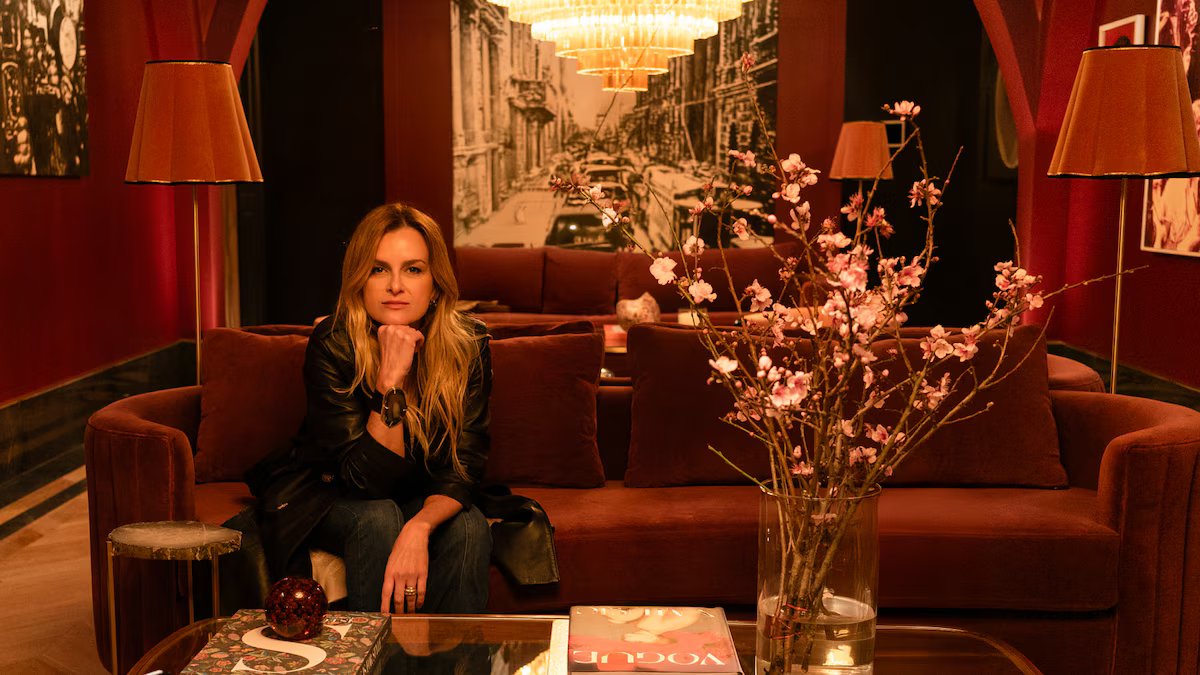
Passion runs through everything he does. Cooking, designing, thinking about a project or entertaining friends: the Argentine designer Gabriela López Monzón He gives himself completely in every gesture. “Everywhere I am, I do my best”says. And he adds, almost as a warning: that intensity also implies renunciations.
Mother and professionalGabriela – better known as Gaby – made herself and started again when she felt necessary. Moved by an unstoppable determination, she chose to listen to that passion for art and design that has accompanied her since she was a child and change course forever.
It all started when he moved with his family to Mexico City. “I left as a lawyer—I practiced law for 17 years—and that trip was, for me, an opportunity to rethink everything that was making noise in my head When you are a mother, you begin to think about the example you set, what you are teaching and what legacy you leave. That’s when I decided to kick the board.”remember.
From a very young age, Gaby had a deep connection with art. “It awakens my emotions, it makes me feel alive”says. Even when I was practicing law and going through an intense and demanding professional life, that creative side never stopped accompanying heralthough then I considered it just a hobby. “My two worlds coexisted. I would take off one suit and put on another”.
That change was visible inside. When working at home, her children—especially the eldest—noticed the transformation: they told her how happy they saw her, how her face changed and her eyes shone when she connected with art. Her husband also perceived it clearly. “He told me: ‘It’s very crazy how we have such a different version of you when you meet yourself,’” she says. As if in that intimate, almost daily gesture, there was already beating the certainty of a path that sooner or later was going to impose its voice.
In Mexico it began a new stage, one more within their many lives. “There I started another life, in which I found myself again after going through a very serious accident in Argentina, just before leaving,” she says. He had taken a door in front of him. Gaby points to her left arm: for a year she was diagnosed with 100% disability.
“I arrived in Mexico with my arm completely disabled, unable to move it. And I told the doctor, with total determination, that if there was even a slight possibility of recovering it with rehabilitation, I was going to do it,” he remembers. True to his character, he did not miss a single session: I went every day, even Saturdays and Sundays. “That was how “I managed to recover 60% mobility, when no one was betting that that would be possible”says.
Gaby always knew that art was her thing. It was in that context when he decided to study Sculpture at the University of San Carlos. In one of the first classes, the teacher observed her and was direct: how are you going to carve marble if that arm doesn’t respond to you? ““I was determined that I would be able to.”remember.
“And that’s when I collided with reality: There was something I couldn’t do. Not this. It was one of those limits that we need to hit against to understand how far to go.” That moment marked an abrupt stop. “That’s as far as I got.” And as so many times in its history, That wall he found himself against was not an end, but the beginning of another way—more conscious, more possible—of approaching art.
Following your passion for design and interior designbegan to study it in depth and shape what would be C’est Moihis future studio and plant for architecture and interior design projects. His first works focused on interior design projects in different houses, and then he continued with a stage of furniture production. In that process, he also allowed himself to cross over into fashion. “My time in Mexico was an explosion of creativity, color and freedom. I was always very respectful of myself, with what I feel, think and where I want to go,” she summarizes.
“I think that, at some point, we all seek the approval of others. I’m quite rebellious with that: I always go after what makes me happy. That’s when I feel like I have no limits. I could never put a stop to my creativity.”
His return to Argentina was not easy. When she left, she was a lawyer; When he returned, not anymore. “There I had gone as ‘Dr. López Monzón’ and I came back a designer,” she says. The change baffled many. Remember that, without exception, friends, family and his entire circle reacted the same when he announced his decision: to invest his savings in the development of his brand and in his own showroom. “They told me I was crazy, that I should go back to the profession. It was as if they couldn’t get out of that only possible window.”
But that foreign resistance was also the driving force. “Why couldn’t I do something else? Where is it written that I have to continue doing the same thing all my life?”“, he asked himself. Against all odds, he advanced. So in 2016 C’est Moi was bornalong with a showroom around the Patio Bullrich. “In a short time, it grew a lot, and that filled me with satisfaction.”
“Art is within me and in every material I choose: I look for objects with history, I transform them and make them reborn, rescuing their essence.”
“I design for the soul. I value authenticity, craftsmanship and the imprint of making, because my path was the fusion of art and design, that which connects me with who I am.”
“My goal is to awaken something. It’s not enough for me to make a space beautiful: I want it to make an impactthat remains engraved on the retina and remains, even for a moment, in the memory of those who visit it,” confessed the designer.
This year, in her third participation in the exhibition, Gaby decided recover a fragment of your family history. By accepting the challenge, I was going through a moment of intimate search: the user who would inhabit that future apartment nor the way to articulate the complex had yet to appear. The scene—like so many times on his tour—occurred almost unintentionally, at his weekend home in Pilar.
They were looking for something—she no longer remembers what—when her husband suggested going up to the attic. She hesitated: that closed, musty-smelling space did not tempt her at all. But he went up anyway, up the folding ladder, among stacked boxes and accumulated dust. “And all these boxes?” he asked. “No idea, I’m not interested,” she responded, convinced that there was nothing for her there.
However, they began to open them. And then his father’s microscope appeared. The precision scale. Laboratory flasks. Everything was there. Those objects that had formed silent part of his childhood and adolescencewhen he spent hours in the family laboratory. The surprise was immediate. “There I understood”remember. Years ago, when her father dismantled his three large laboratories—donating much of the equipment—she had asked him for some parts. “Give them to me,” he then said. “Even though you always said you hated the lab,” he replied. “It doesn’t matter,” she replied. “It’s part of my story. Someday it will be useful to me.” It took 17 years until that request found its meaning.
That night he couldn’t sleep. The discovery had taken her directly to her parents and to a part of her work that had always marked her: that kind of alchemy that he did during complex surgeries. Urgent diagnoses, substances combined at full speed, decisions that could save a life. “We made it, we saved it”he celebrated when everything went well. Over the years, he understood how much of that had remained engraved in her.
It was from the reunion with those objects that He imagined another form of laboratory: one linked to the plants, essences and well-being. This is how it was born The alchemist’s refuge: a space for he care, rest and hug. That turn was restorative. The found jars took on a new meaning. He cleaned them one by one, with patience and loving obsession, looking for honor its history and transform it. Thus, what had been demand and absence became calm, memory and healing.