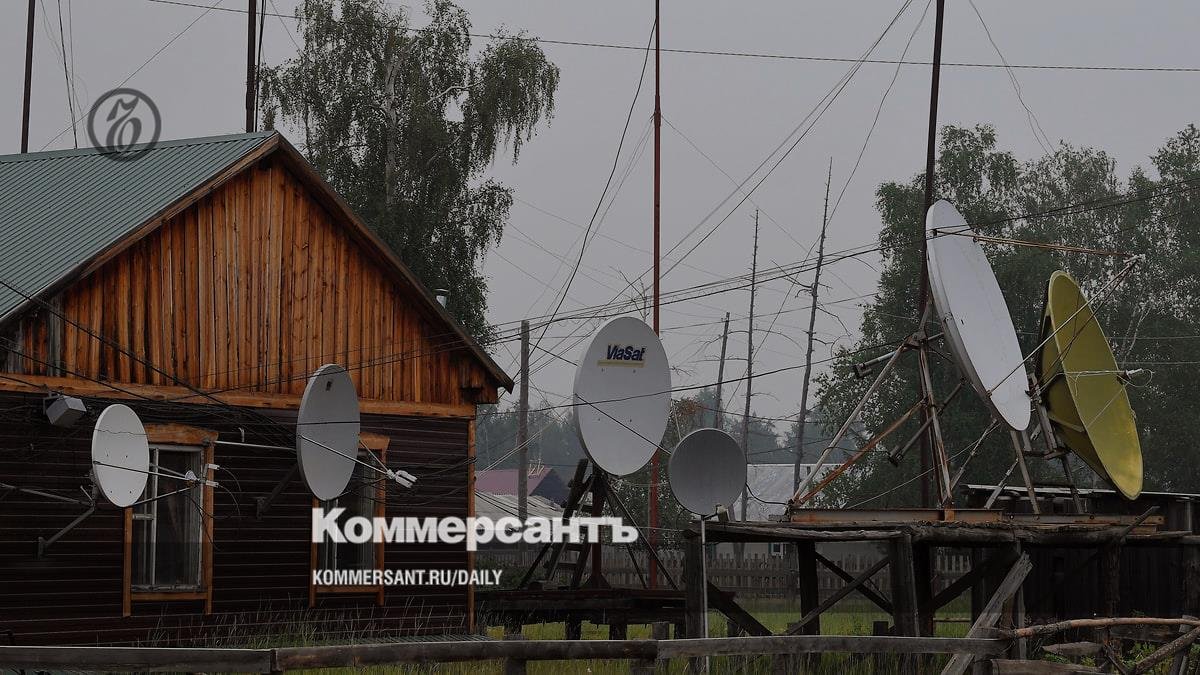
The Big Four operators were required to provide coverage in more than 150 small communities by March 2027. Now there is at least one operator in these locations, but the Ministry of Digital Development says that the rest do not “provide a sufficient level of communication.” For telecom companies, such projects are not a priority in terms of payback, experts say, but the policy of forced expansion of coverage gives subscribers a choice and eliminates the opportunity to dictate prices to one operator.
The State Commission on Radio Frequencies (SCRF) obliged VimpelCom, MegaFon, MTS and T2 to provide coverage in more than 150 settlements with a population of 1 thousand people or more until March 31, 2027, follows from the SCRF protocol published on the website of the Ministry of Digital Development. From the appendices to the protocol it follows that MTS does not have coverage in 68 settlements, T2 does not have coverage in 66, VimpelCom does not have coverage in 12, and MegaFon does not have coverage in 6.
It also follows from the protocol that SCRF expanded by more than 70%, to 1426, the number of sections of federal highways on which there will be no LTE coverage. Earlier in January, SCRF identified a list of 821 road sections in 33 regions of the Russian Federation throughout the country that will not be covered by LTE. The Ministry of Digital Development explained that it is impossible to provide coverage in these areas due to the lack of energy infrastructure.
The Ministry of Digital Development told Kommersant that in Russia there are no settlements with a population of 1 thousand or more where there is a complete lack of mobile communications.
“Each of them has coverage for at least one operator. At the same time, each company has settlements with a population of more than 1 thousand people in which it does not provide a sufficient level of communication, while other operators provide it,” the ministry added.
They explain that operators must, by March 31, 2027, provide coverage to all settlements with a population of 1 thousand people or more in the constituent entities of the Russian Federation in which they are allocated a radio frequency resource in the 900 MHz range, and all settlements with a population of 2 thousand people or more in the constituent entities of the Russian Federation in which the spectrum in the 1800 MHz range is allocated. At the same time, coverage of at least 90% of the territory of each settlement must be ensured, the ministry adds.
Operators report that they will have time to fulfill the requirements.
VimpelCom says that all tasks “within the framework of this order will be completed on time, and where necessary, sharing will be used.” MegaFon says that they are “consistently implementing a network development program in small settlements,” and to “increase efficiency and speed up the construction of infrastructure, they are actively using a sharing model with other operators.” MTS will “use every opportunity to meet coverage requirements” and is currently working on “plans, options and their assessment.” T2 declined to comment.
The lack of full coverage in settlements with a population of 1 thousand or more is “primarily an economic issue,” says Svetlana Arkhipkina, director of the Digital Transformation practice at Strategy Partners: “Such territories are characterized by low subscriber density, high CAPEX for infrastructure construction and long payback periods, especially taking into account the need to provide up to 90% coverage, which often requires the installation of several base stations in complex geography.” She explains that operators have historically invested primarily in higher-margin urban and suburban areas, where ARPU (average revenue per subscriber) is higher and there is a “faster return on investment”: “Projects in small communities are sometimes implemented in the red, so without regulatory pressure or co-financing mechanisms (for example, through government programs to eliminate the digital divide), operators do not prioritize such investments.”
Because of this, compensation for “market failures” falls on the state. The policy of forced presence of several operators in remote regions eliminates the situation when one player can dictate prices without improving quality, adds Ekaterina Litvinova, senior manager of TeDo business consulting practice.