Is Attica “gray damari”, as the lyricist Alkis Alkaios wrote, or are we drowning in its stones, as he said in Summer Solstice the poet Giorgos Seferis? What is under the asphalt that we step on every day? What constitutes the underground of the capital? Recently in Kypseli, liquid cement appeared gushing from the road, as a result of which various theories (even speculations) about the phenomenon were said and written. It may, in the end, have been proven that the responsibility was borne by the metropontician digging in the area for the metro extension projects, however the main question remains: what lies beneath us?
We talked with the general manager of EAGME (Hellenic Geological and Mining Research Authority), geologist Dionysios Goutis, and these are the things we picked out from our conversation:
“The basic rock that makes up the Athenian subsoil is the classic Athenian slate which occurs widely in the area. It has a long history, but we cannot say that it has any great value to be studied further. We should understand that this geological background is the result of processes that began millions of years ago.”
“Regarding the ‘liquefied slate’ mentioned in the recent Cypseli incident, it is something that is not true, for the simple reason that the Athenian slate cannot be liquefied. In this particular case we are not dealing with one rock, but with successive series of rocks.”
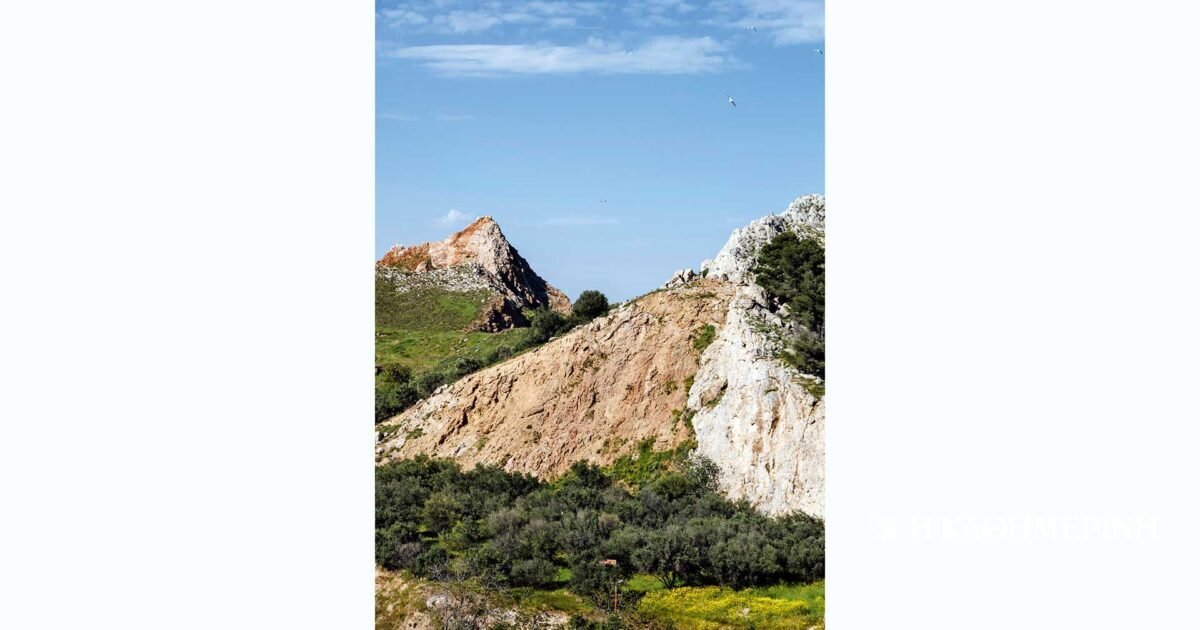
“There is an interesting point in Athens where a morphological paradox is observed. In Alsos Galatsiou, where there used to be a quarry, stands a mountain, one part of which is brown and the other white. In fact we are dealing with an impressive union of shale with limestone.’

“However, we cannot speak of a single geological formation of Athens. They say, in the past, lignite was found in the area of Peristeri, which was actually mined. Of course, we are not talking about large quantities.”
“If we talk about the wider region of Attica, we will see that there are points which the ancient Greeks exploited even for military reasons. A good example is Lavrio and its ancient mines. From there they mined galena with which they made silver, therefore money, which they had an immediate need to build the fleet that then faced the Persians in the naval battle of Salamis.”
“During the flood phenomena in ancient times, Kifissos brought down transported materials from the north, with the result that the ancient ones that we find, while they were originally on the ground, end up underground. Obviously, we understand that the ancient Greeks did not bother about this. It happened because of Kifissos and because of these deposits we find ancient things when we dig underground in the capital. As happened during the period when the works for the construction of the Athens metro started”.
“I would say that, in the case of Athens, the subsoil is what affects the type of our buildings and not the other way around. Obviously, where we have loose soils, they are compressed by construction. It is one thing to build on a rock and another on soft ground. Overall, however, I would not say that modern Athenians have a negative impact on the underground of the city.”