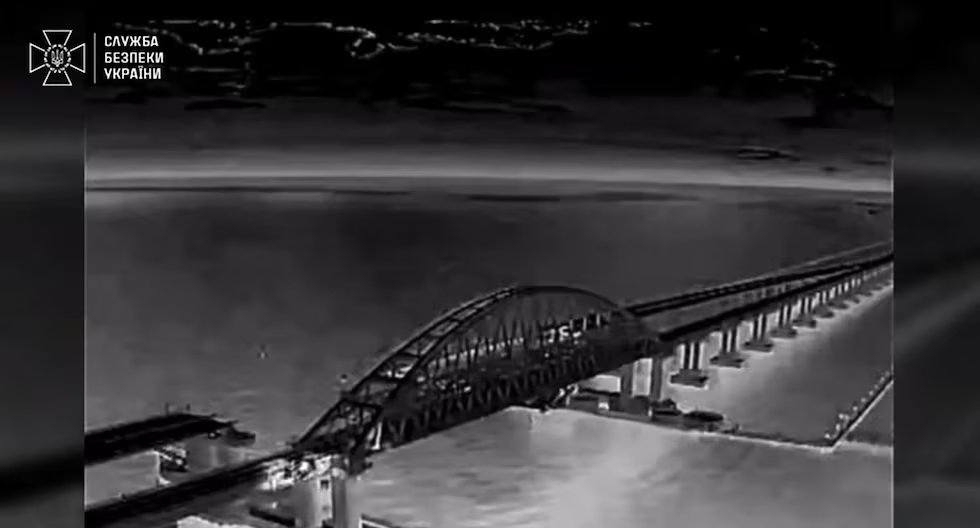
He Crimean bridgealso known as Kerch bridgehas 19 kilometers long and connects the Crimean peninsula with the Russian region of Krasnodar, through the Kerch Strait. The Ukrainian action destroyed 270 meters of road.
Its road section was inaugurated on May 15, 2018 by the Russian president, Vladimir Putin, who participated in the ceremony driving a truck; while the rail connection came into operation in December 2019.

A painting of Russian President Vladimir Putin’s 2018 inauguration of the Crimean Bridge remains on display in an exhibition pavilion near the Kremlin. (EFE/ Ignacio Ortega).
/ Ignacio Ortega
Construction was promoted by the Kremlin after the annexation of Crimea in 2014. The bridge is of strategic importance for Moscow because it constitutes a direct route to transport fuel, food, goods and military supplies to the peninsula.
Since the beginning of the Russian invasion of Ukraine in February 2022, it also became a fundamental route to supply troops deployed in Crimea and in the south of Ukraine.

The location of the Crimean Bridge. (Image generated with AI, Chatgpt).
Russia had deployed a layered protection system to protect the Crimean bridge. The device combined long-range air defense systems, such as the S-300 and S-400, with short-range Pantsir-S1, Tor and Buk batteries, as well as surveillance radars and electronic warfare equipment to detect and jam Ukrainian drones and missiles. Added to this were floating barriers and maritime structures to prevent the approach of naval drones, as well as boat patrols, observation posts and land surveillance positions.
Despite this deployment, Today a section of the road section, which is located at the height of the steel arches of the road, is at the bottom of the sea.
How did Ukraine plan and execute the attack?

Below, capture from a video published on November 17, 2026 showing the damaged Crimean Bridge (Kerch Bridge), and above, a view of the bridge taken on October 14, 2022. (Photo by Handout / various sources / AFP).
/ HANDOUT STRINGER
An analysis of the Institute for the Study of War (ISW) emphasizes that the attack was not an isolated event, but the result of several weeks of preparation, weakening of Russian air defenses and application of new technologies.
The president Volodymyr Zelensky confirmed that the destruction of part of the bridge was the seventh stage of an operation that took place over several weeks.
On the night of November 16-17, Ukrainian forces attacked the bridge for the second consecutive day, destroying the metal arch that supported the section intended for vehicle trafficcausing the road to collapse for vehicles. They also damaged the railway section.
In all phases of the operation Ukraine used 11 types of missiles and drones. Zelensky detailed that these are the Dovbush, Vendetta, Da Vinci, Sichen, Mich-2000, Ruta, Palianytsia, An-197, FP-1, FP-5 Flamingo and R-360 Neptune.
The strategy consisted of progressively weaken Russian defenses before launching the final attack. To do this, Ukraine first attacked Russian air defense systems, surveillance radars, electronic warfare equipment, anti-aircraft missile launchers and mobile groups tasked with intercepting drones.
The objective was to breach the Russian defensive shield around Crimea. and allowing Ukrainian missiles and drones to reach the bridge, the ISW noted.
According to statements by Russian military bloggers collected by the ISW, the Ukrainian forces would have used several hundred drones to saturate the anti-aircraft defenses, followed by missiles that attacked the bridge with intervals of just four or five minutes.

Video capture from November 17, 2026 showing a missile flying towards the Crimean Bridge (Kerch Bridge), which links Crimea to Russia. (Photo by Handout / Telegram / @V_Zelensky_official / AFP).
/ HANDOUT
The ISW highlighted the technological innovation that allowed Ukraine to reach vulnerable points on the bridge. He noted that kyiv used signal repeaters operated by its Unmanned Systems Forces. These devices allowed communication and control of the missiles to be maintained until moments before impact.
According to a Ukrainian official cited by The Times, The operation did not depend on the Starlink satellite connection, but from drones that retransmitted radio signals.
This technology made it possible to direct the projectiles with greater precision towards structurally vulnerable points of the bridge.
The ISW stated that Ukraine managed to attack sections of the bridge from distances greater than 250 kilometers from the front line.
The ISW also received criticism from Russian military bloggers, who They questioned Moscow’s ability to protect its strategic infrastructure.
Among the main vulnerabilities identified are: the absence of a unified national air defense command and control system, the fragmentation of responsibilities between the military, security forces and regional authorities, the differences in equipment and technology between air defense units in different regions and the priority that the Russian command gives to operations on the battlefront to the detriment of the protection of its rear.
A strategic coup

File photo of the Crimean bridge after suffering an attack in 2022. (EFE/Str).
For the international journalist and analyst Carlos Novoathe Ukrainian attack represents an offensive of great strategic importance because “cuts the supply circuits that Russia uses to sustain its military presence in Crimea and southern Ukraine.”
Add that The result also highlights the high degree of planning and coordination achieved by the Ukrainian forces. Consider that this is not an isolated action, but rather an operation in which different entities participated and that required a strategy prepared in advance.
“It is a well-prepared, well-appropriate strategy that responds to a coordination policy that has several heads and not just one. There is a high level of coordination”he highlights.
The analyst indicates that The Ukrainian ability to carry out operations of this nature must be understood in the context of a war that has dragged on much longer than Moscow expected. “Russia underestimated Ukraine’s resilience and the duration of the conflict. This situation has had important consequences for its military capabilities.”
Novoa does not rule out that Ukraine has received intelligence support from some countries in the NATOwhich could explain part of its ability to identify Russian vulnerabilities and execute precision strikes against strategic targets such as the Crimean bridge.
“Ukraine has been able to take advantage of the wear and tear of the Russian Armed Forces and the weaknesses of its command structure. “It has also managed to maintain its capacity to respond despite the difficult international political situation and the rapprochement between Donald Trump and Vladimir Putin.”he maintains.
“Ukraine’s counterattack is lethal. It has waited, it has endured and it has known how to capitalize on the weaknesses and fissures resulting from the wear and tear that the Russian Armed Forces may be experiencing”he states.
Novoa also establishes a difference between the political and military leadership models of both countries. While Russia maintains vertical leadership, in which Putin concentrates final decisions, Ukraine presents a decision-making structure that it describes as more horizontal and oriented toward thinking about military operations in the medium and long term.
An important victory, but not definitive for Ukraine

Russian President Vladimir Putin visits the Kerch Strait Bridge, also known as the Crimean Bridge, on December 5, 2022. (Photo by Mikhail Metzel / SPUTNIK / AFP).
/ MIKHAIL METZEL
Despite the magnitude of the blow against a fundamental infrastructure for Russia, Novoa considers it premature to affirm that the attack alone will modify the military balance in the region. He warns that Moscow retains its capacity to respond and that its historical experience in war forces it to avoid any prediction of defeat.
“Russia may be in disorder, it may be beaten or attacked, but it cannot be considered defeated”, warns.
He recognizes that the operation constitutes a victory of great importance for kyiv and that could force Russia to rethink its military and logistics strategy in Crimea. However, he insists that the result must be evaluated cautiously and based on Russia’s ability to adapt to new conditions.
“This is a very important victory for Ukraine, which can rethink the balance in the region, but I would not consider it an absolute victory for the Ukrainians.””, he concludes.