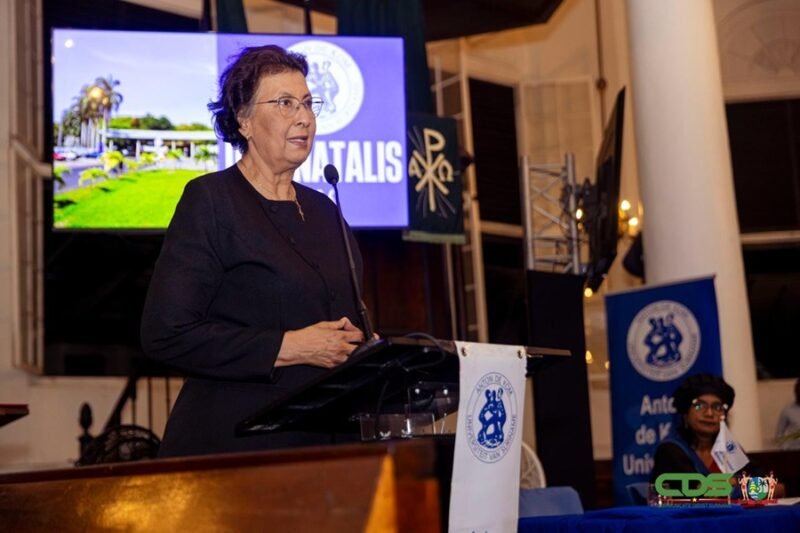
“I’m not giving you a promise of that ehsome specific means, but what I promise you is my commitment and what I ask of you is your commitment.” President Jennifer Geerlings-Simons said this on Thursday at the celebration of the 58th Dies Natalis of the Anton de Kom University of Suriname (Adek) in the Center Church. The state court, who himself studied at the university, noted that the government will make efforts to support the institution in addressing its challenges. “Today we are starting a new path at this Dies Natalis,” she said.
Text Edwien Bodjie
Image CDS
Geerlings-Simons wants to enter into discussions with the university board again to work together on solutions. However, she made it clear that the responsibility does not lie solely with the government. The university community must also commit to further strengthening the institution. She did not make a concrete commitment about additional financial resources or a specific amount.
“We must also produce knowledge ourselves, conduct research and develop innovative solutions that match our own reality”
OWC Minister Dirk Currie
Inclusive education
Minister Dirk Currie of Education, Science and Culture addressed the university community about the role he believes Adek should play in the future development of Suriname. He called the 58th Dies Natalis a moment to reflect on the development of higher education and the course for the coming years. “Which university does Suriname need for its future development? And what should we do today to further shape that university?” Currie asked rhetorically.
According to him, human dignity, justice and equal opportunities, values associated with Anton de Kom’s name, should guide education policy. “We must not leave anyone behind and must open ways to make education accessible to everyone,” the minister said.
According to him, young people from the interior should be given the same opportunities as their peers in Paramaribo. Students with disabilities must also be able to participate fully in education. Financial circumstances should not constitute an insurmountable obstacle to pursuing a course.
For Currie, accessibility means more than just the ability to register. Students must also receive the guidance necessary to successfully complete their education. Quality and accessibility must go together. This requires current study programs, expert and motivated teachers, good research and continuous quality improvement.
Knowledge center
Moreover, Adek must be more than an institution that trains students, the government official emphasized. The university must also be a knowledge center that helps solve social issues and provides direction for the development of the country. Currie mentioned the oil and gas sector, agriculture, tourism, healthcare, technology and climate change as areas where scientific knowledge can contribute.
To fulfill that role, cooperation with government, business and social organizations is necessary. However, according to Currie, this collaboration should not be at the expense of the university’s scientific independence. “Scientific independence is essential,” he underlined.
Researchers must be able to think critically, dare to challenge existing views and base their conclusions on careful research, even when the results do not correspond to what policy makers or other stakeholders would like to hear. At the same time, the government must actually use scientific knowledge in the development and evaluation of policy. According to the minister, decisions must increasingly be based on reliable information, analyzes and demonstrable results.
Technology
Currie also drew attention to the mental health of students and employees. The pressure to perform and uncertainty about the future can affect well-being. The university should therefore not only be a place where knowledge is transferred, but also an environment in which students feel safe, respected and supported.
He also pointed out the rapid developments in the field of technology and artificial intelligence. Suriname must avoid remaining a consumer of technology developed elsewhere. “We must also produce knowledge ourselves, conduct research and develop innovative solutions that match our own reality,” was his message. This requires investments in digital infrastructure, research capacity and the further development of students and teachers.
Challenges
Before the speeches by the president and minister, Adek’s leadership gave a presentation on the state of affairs within the institution. We looked back on the academic year 2025-2026 and discussed developments, plans and bottlenecks.
One of the most important challenges remains the shortage of resources. This hinders the university in carrying out its activities. Adek needs better financial and organizational conditions to improve its functioning and realize its ambitions for the coming years.
The Dies speech was given by Silvano Tjong-Ahin and Maureen Lichtveld. Tjong-Ahin spoke on ‘Leadership and effective governance: first strengthening the government’, while Lichtveld discussed the topic ‘Health, Wealth, and Leadership: What Does Green Have to Do with It?’ treated. The celebration was under the umbrella theme ‘The role of the Adek as a leader in shaping the future of Suriname’.