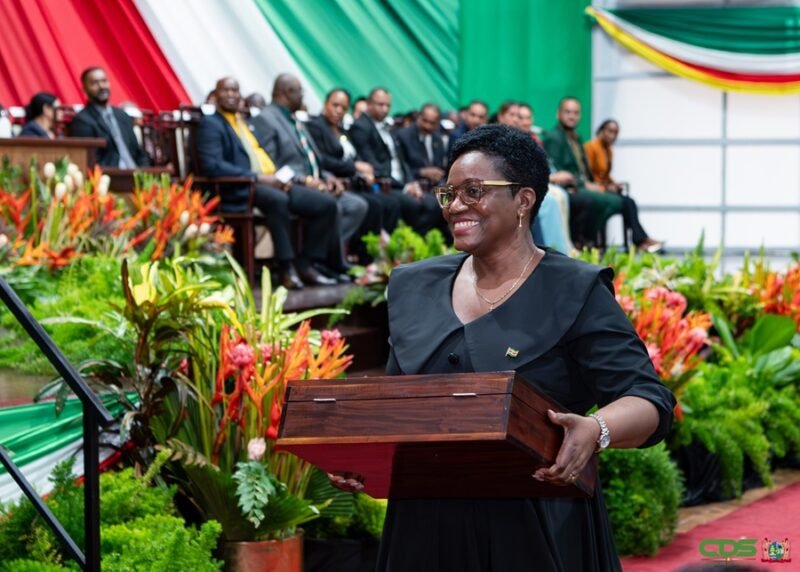
President Jennifer Geerlings-Simons presented a fairly nice picture of the recovery of the Surinamese economy on Wednesday in her second annual speech. But with oil revenues in prospect for 2028, the urgent question is whether the government can handle the next billions.
Text Ivan Cairo
Image CDS
It is a truth that is as old in economics as humanity: when raw materials flow, the state quickly loses its grip. There are plenty of examples of this in the world. Suriname is on the eve of its greatest economic transformation since the discovery of bauxite and gold. Oil exploitation off the coast will begin in 2028 and the expected revenues are expected to significantly change the small country.
“The oil revenues are coming and President Jennifer Geerlings-Simons rightly insists: the state’s financial house must be in order before the first dollars flow in“
But in her second annual speech in the National Assembly, the president painted a picture that reflects not only optimism, but a deeply rooted sense of urgency. The showcase of the Surinamese economy has been polished, but the foundation is fragile.
Keep a cool head
The undisputed facts are impressive at first glance. While Suriname fell prey to a deep crisis in 2020, the macroeconomic stabilization initiated by Gerlings-Simons’ predecessor Chandrikapersad Santokhi with the support of the International Monetary Fund has turned the tide nicely. Inflation has been curbed to below 9 percent, international reserves have risen to a historically high two billion US dollars, and the economy is growing.
Debt restructuring via new bonds has broken the acute stranglehold on short-term debt. Geeerlings-Simons can rightly brag about this. She got the country out of intensive care.
But there was no triumph in her speech, rather the sober warning of a doctor – which she is – who realizes that the patient still has a weak constitution. “Organizations easily decline due to lack of attention, manpower and resources,” he said. It’s quite an understatement. Santokhi has also often spoken about weakened and hollowed out working arms of the government.
Threat of resource curse
The state institutions have been eroded after years of neglect and political interference. This is the core of the dilemma the head of state now finds himself in. The government is trying to repair the roof while the sun is already appearing on the horizon.
Oil revenues are coming and Geerlings-Simons rightly emphasizes that the state’s financial house must be in order before the first dollars flow in. It is a direct reference to the lessons learned by neighboring countries.
The ‘resource curse’ is lurking: the danger that oil revenues will be so high that other sectors such as agriculture and tourism will be outcompeted and neglected and that the government will fall into a patrimonial system of cronies and subsidies.
To avert that curse, Geerligs-Simons is focusing on digitalization, a strengthened tax authorities – this has also been heard from successive presidents for decades – and tough budget discipline. But reality often clashes with ambition in ministerial offices.
The introduction of a modern tax and collection authority has been announced again. Some draft laws are already ready. But the cultural change within the government cannot be captured in a few draft laws. Smuggling and the informal economy are still rampant and the government’s implementation capacity is, in the honest words of the president himself, “low”.
Social pressure and inflation paradox
At the same time, her government is under enormous social pressure. Years of crises have eroded the purchasing power of Surinamese people. The recent 15 percent wage increase for civil servants and the doubling of child benefits are therefore more than justified corrections; it is a political necessity. But citizens do not judge economic recovery by the primary balance, as Geerlings-Simons knows better than anyone, but by the contents of the shopping basket.
Yet a paradox is visible here. By increasing government wages and social services, the state pumps extra money into the economy. In a country with a weak production base and high import dependence, this is a perilous undertaking. The risk that this spending impulse will reignite inflation and put pressure on the carefully stabilized exchange rate is real. Geerlings-Simons also recognizes this: “Improvement of income only improves living conditions if we can keep the exchange rate stable.”
It’s an elegant way of saying: social increases are at stake when macroeconomic discipline weakens.
Real testing begins in 2028
The true test for the president’s policies does not start today, but in 2028. The government wants oil revenues to be used for diversification, infrastructure and a strong social safety net. Beautiful words and intentions. But history shows that there is a great temptation to turn every new oil dollar into a political gift for one’s own supporters.
Suriname has more or less passed the stabilization phase with flying colors. The figures for 2026 don’t lie. But numbers do not tell us how strong the institutions are that are supposed to manage them. The race against time started when TotalEnergies announced its investment decision at the beginning of October 2024 to start pumping oil off the coast in 2028.
The question is not whether Suriname will become rich from oil, but whether the country (especially its political government) has the wisdom and institutional backbone to manage that wealth well. Every Surinamese knows that if the foundation of the house is shaky, a new coat of paint on the walls is of no use without first solving the problem.