On October 26 (Monday), Wendy Jap-A-Joe, former director of the Telecommunications Authority Suriname (TAS), lost her summary proceedings, on Tuesday she was granted legal access to appeal, on Wednesday the hearing started and on Friday a decision was already made. The dispute was settled in two bodies within four days, a remarkable speed for the Surinamese judiciary. Criminal cases, civil proceedings and even summary proceedings, on the other hand, can take months or even years. The Court of Justice has not publicly explained why the TAS case in particular was handled so quickly.
Text Ivan Cairo
Image dWT archive & Jason Pinas
Jap-A-Joe’s appeal followed two summary judgments dated October 26, in which the subdistrict court judge rejected her claims and ruled in favor of TAS. The dispute revolved around the end of her five-year appointment as director and the meaning of an indefinite employment contract. On October 30, the Court of Justice confirmed the previous decisions.
“The TAS case shows that under certain circumstances the Court of Justice can conclude an appeal within a few days, which is to be welcomed”
Smile, no explanation
Lawyer Gerold Sewcharan, who represented TAS, stated that in his more than 25 years of legal career he had never experienced an appeal being heard and heard so quickly. At the same time, he acknowledged that accelerated treatment is legally possible. The lawyers for TAS and the state did object to the short preparation time. According to them, they only received the grievances during the first hearing, after which they were given the opportunity to respond.
The fact that an urgent procedure is handled quickly is in itself to be welcomed. After all, legal protection loses its meaning when a ruling comes too late. But it is precisely the exceptional speed that makes the question relevant which circumstances were decisive for the Court of Justice to hear this case almost immediately.
During the first public hearing of the Court of Justice, Sewcharan made a comment about the speedy access to justice, but he received nothing more than a smile from the three judges. There was no substantive statement or explanation.
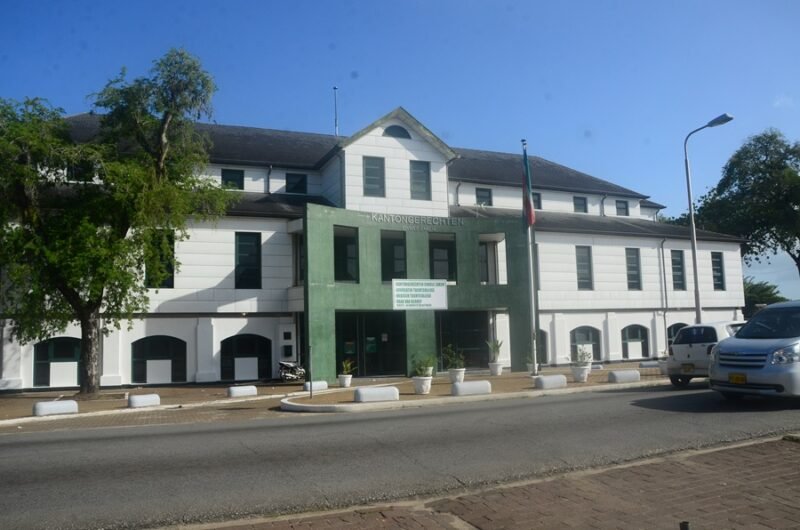
(read more below the photo)

Years of backlogs
The slow legal process in Suriname is not a new phenomenon. In recent decades, international organizations have repeatedly pointed to long waiting times, staff shortages and organizational limitations. The World Bank calculated in ‘Doing Business 2020’ that judicial enforcement of a standardized trade contract in Suriname took an average of 1,715 days according to its research model, almost four years and eight months. That figure also included the execution of the judgment and is not an average for criminal cases or appeals.
The US State Department also reported delays in its human rights reports. The 2022 report cited an estimated backlog of five to six years in civil courts. Later reports also pointed to the shortage of judges and support staff.
A poignant example is the Hewitt case. An appeal filed in 2003 was delayed for seven years due to registration problems. The Inter-American Commission on Human Rights ruled that the delay was not justified. In August this year, the commission announced that the case had been referred to the Inter-American Court of Human Rights.
Also criticism from our own country
Although these figures and examples relate to different types of procedures and periods, they show that timely legal protection has been a problem in Suriname for years. Besides, the concerns are not limited to international reports. The Surinamese Bar Association has previously pointed out increasing workload, staff shortages at registries and organizational bottlenecks. Such problems not only affect lawyers, but especially citizens who depend on the judge for the resolution of their dispute.
The Organization for Justice and Peace and the 8 December 1982 Foundation have drawn attention to timely justice and the actual implementation of judicial decisions during the lengthy December murder trial. Their criticism concerned a specific criminal case, but underlined the social importance of justice that does not continue indefinitely.
In August this year, the Association of Surinamese Business, the Association of Surinamese Manufacturers, the Association of Small and Medium-sized Organizations in Suriname, the Citizens’ Initiative for Participation and Good Governance and CGB jointly emphasized that citizens and companies must be able to trust that legal disputes will be handled within a reasonable period.
Even the Court of Justice repeatedly recognized that complaints about the slow handling of substantive disputes, both at first instance and on appeal, are frequent. Lack of capacity and financial limitations were cited as causes.
Why this priority?
The difference between an urgent appeal and an ordinary criminal case should not be ignored. Summary proceedings are intended for situations in which a lengthy substantive procedure cannot be expected. However, this does not mean that every summary proceedings will be settled within a few days. Even in such proceedings, the preparation, hearing planning and ruling can take months.
Therefore, the speed of the TAS appeal is a legitimate subject of public interest. The Court of Justice has not yet disclosed which specific circumstances justified almost immediate treatment. This missing explanation makes it difficult to assess how consistently the criteria for urgency are applied.
The question is not whether Jap-A-Joe had a right to appeal – she absolutely had that right – but why that legal remedy in this case led to a decision so exceptionally quickly.
More judges, shorter waiting times?
Fifteen new judges were installed on October 23. This increased the number of judges from thirty to 45, while the Court of Justice aims for sixty. At the opening of the court year earlier that month, court president Iwan Rasoelbaks had emphasized the importance of fast, accessible and professional justice.
The expansion offers opportunities to reduce backlogs. At the same time, Rasoelbaks warned about the retirement of experienced judges in the coming years. Moreover, the speed of court proceedings depends not only on the number of judges, but also on clerking staff, available courtroom space, file management and efficient organization.
The new judges only started leading hearings independently on October 26. It is therefore too early to determine whether their arrival has already led to shorter processing times and whether the rapid court appearance last week had something to do with this.
Summary justice for everyone
The TAS case shows that under certain circumstances the Court of Justice can conclude an appeal within a few days, which is to be welcomed. However, that does not mean that every criminal case or civil procedure can be handled equally quickly. Differences in complexity, evidence, witness interviews and legal regulations make this impossible.
“The slow judicial process in Suriname is not a new phenomenon. International organizations have repeatedly pointed out long waiting times, staff shortages and organizational limitations in recent decades.”
But litigants can expect that the judicial organization will provide insight into when emergency treatment is possible and how this will be decided. This is even more true in a society where lengthy procedures have led to complaints for years.
The speed with which Jap-A-Joe’s appeal was handled does not therefore need to be discussed. The question is rather why the Court of Justice has not publicly explained what circumstances justified this exceptional diligence. A transparent explanation would not only make the special treatment of this case more understandable, but also provide clarity to the many others who are still waiting for the start of their lawsuit or for the final ruling.