by Desney Romeo
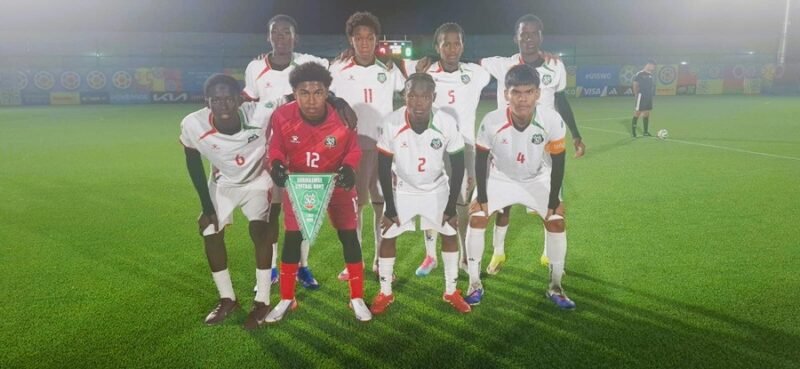
BAKU — Suriname ended The Fifa U-15 World Cup & Festival on Friday with a 2-4 loss against fellow regional Barbados. The island led to 3-0 within fifteen minutes, before Prefor Amoko was able to do something back in the seventeenth minute. Things didn’t really go well for Suriname defensively and within two minutes Barbados was able to score again: 4-1. In the twentieth minute it was captain Giam Sabajo who brought Suriname back into the match; 2-4. Despite many chances on both sides, no more goals were scored in the second half.
U15 national coach Orfeo Brondenstein says otherwise the True Time that he had warned his boys in advance about Barbados. “But it looked like the team had no enthusiasm. We couldn’t stop Barbados,” he responds. “I didn’t expect to concede so many goals, but yes, we also had chances and they were not taken. And it is known in football; when you get chances and don’t score, the opponent will punish you, which is what happened.”
While Barbados constantly brought in players, Suriname played in the same formation for a long time. Brondenstein has an explanation for that. “I have a lot of injuries and I have players who are not 100 percent fit. And I put people who want to carry out the assignments and are willing to work.” The national coach believes that everyone has been given a chance. “And those who perform get a second chance.”
Wise lessons
When asked what the most important thing this intensive tournament has taught him is, Brondenstein doesn’t have to think long. “Discipline! If your team is not disciplined, you will get nowhere.”
The national coach says he has spoken with a number of colleagues from the Caribbean countries. “And they seem to be struggling with the same problem; players do not carry out the assignments, but do what they want. There is really a lot of work to be done for us.”
On the other hand, Brondenstein acknowledges that it is “not easy” for this age group. “Playing ten matches in three weeks was quite tough. This was also a challenge for me, as I am used to coaching eleven against eleven. There were also days when you had to play two matches. If you are mentally weak, it is not easy. But I also experienced this as a learning process.”
The national coach said that what was also clear in this tournament is that it is important to play eight against eight locally on a smaller field, which will help the players to think and act faster. “On a large field you have a lot of time to recover, in contrast to the smaller space. Our neighboring country Guyana plays nine against nine.”
More than a football tournament
The first edition of The Fifa U15 World Cup & Festival concluded on Friday. Nearly three thousand youth football players from all six continents played against each other in 932 matches. Fifa indicated in its newsletter that the event was much more than a football tournament. “It was a global gathering of the next generation of players. An opportunity for young people from 189 countries to compete on the pitch and experience new cultures off the pitch.”
According to Fifa, the broad participation is reflected in the results. Some 187 of the 189 national teams won at least one match, a clear sign of the competitive opportunities offered by the tournament’s inclusive format.
The finals in the different levels also showed the international scope of the tournament. Four teams from the African Confederation – the Central African Republic, Ethiopia, Tunisia and Zambia – reached the final along with four European teams: Belarus, Czech Republic, Portugal and Spain. In addition, there were two teams from the Asian Football Confederation (Bangladesh and Tajikistan), one team from Concacaf (Canada) and one from Oceania (New Zealand) playing for first place.
It was striking that, unlike many other Fifa tournaments, where individual prizes, such as the Golden Ball or the Golden Boot, are central, only team prizes were awarded at this U15 event. There were no individual awards and no Fair Play award.