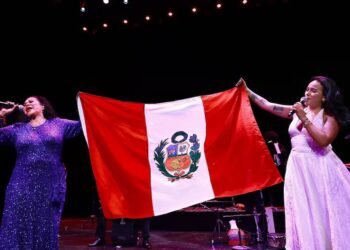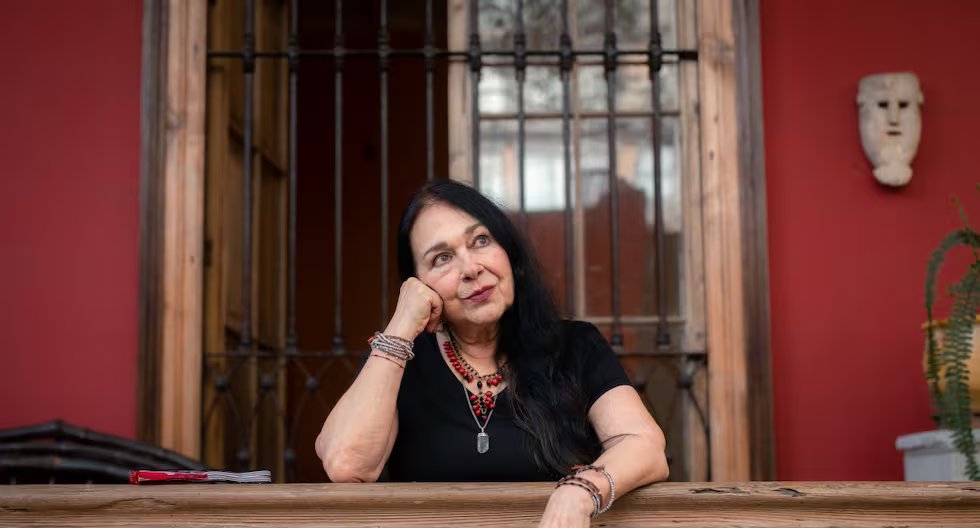

Memory is usually located in books, monuments or official archives, but Yuyachkani He supports his proposal to do so from the alchemy and poetics of the body. “Before we were marginal and that was what we had to do,” says Teresa Ralli, actress and member of the group. “But little by little other younger people appeared and there was a change from the marginal to the alternative. Perhaps what we transmitted was the daring to trust that we could, can and will be able to invent the drama we want, connect with other artistic and cultural sources, and compose the languages that provoke us, without stopping listening to the teachers.” Hence, there will be 40 performers who will meet at the Meeting of Creative and Performing Women, a space for dialogue and exploration that will open to the public on November 3, 4 and 5 at their home in Magdalena.
— What does an actress’s body remember or keep that official history always prefers to forget?
It seems that inside my body are the most intense moments I have experienced on stage. I remember a character I played in “Against the Wind” in 1989 and a presentation in the central square of Puno, at night and in the atrium of the church. My feet burned and froze at the same time, but just from feeling the energy and seeing the faces of the men, women, and ladies with babies who were approaching, I felt like I was flying. All the pain disappeared. I also remember how Chusco from “The Traveling Musicians” learned to throw away the dogs that entered the neighborhood stages, how he barked at the real dogs and they ran away. As a great researcher said: the history of Peru is not written, it is danced. So it hasn’t just been my body as an actress; If you watch, investigate and experience what happens in the country’s traditional dances, you can make a reading that is almost always secret and that is not usually recorded in the official history that is taught. For example, this Government has decreed that all books will be cleansed of ideologies which, in other words, means not maintaining very important aspects and stages. But these will remain in the bodies, in the memory that is discussed, sung and danced, and no one is going to erase them. This also happens with us as creators: my body remembers more than my mind and remembers complete sequences that, when physicalized, refer me to the context. In “Hasta qué, corazón” we put up a row of chairs, one of them empty that reminded me of Alberto Flores Galindo, who gave us his thesis on the mining movement so that we could write our first work.
—If our bodies keep those memories, surely they also keep the unpaid bills of violence and the precariousness of the country. Do you feel that the country owes you something, or does that debt go somewhere else today?
I feel that I do not have any debt to collect from anyone, not even from this country because it is the work of all citizens, including those cretins who usually take power from time to time. I don’t charge anyone anything, but I do have a debt with others. They are very personal debts. When I am with my students or with very young people who have not seen the previous works, my debt is expressed in the need to write or, what do I know, make a podcast (laughs), look for channels to tell those stories. When they hear them, those who did not experience them are deeply amazed because we have all gone through a stage in our youth in which we believe that the universe begins with us and that we are going to make a difference. It takes time for us to reach maturity and understand that we are just a pebble in the river of life, a little fish that has to learn to swim. That continuity in history is what they take away from us by saying that they are going to clean up school textbooks. That is the memory they take away from us when they say that the most important thing at school is not to dye your hair or cut it with a side part, instead of remembering that the bodies of girls and boys are respected and that they have to learn about the sexuality of the body to respect it. There is a brutal and infamous indifference, just as the silence is infamous. I feel that more and more people choose silence when they see that something terrible is happening because they think that it will not happen to them.
— Delusional?
Yes. It’s incredible because ten years ago when the harassment of Gaza began, people said: “Oh, how far away that is.” And now we have an international policy that wants to take over Latin America, that wants to take away our independence, extensions of that laboratory that was Gaza. And have you seen what is happening in Cusco? Communities of ex-soldiers who come from Israel and engage in brutally invasive behavior.
— Many creators work from autofiction, their personal archive. How to avoid being left alone in the intimate, individual way? How to avoid losing sight of the collective?
I couldn’t comment on other processes, but I do recognize in ourselves that each new route had a maturation process. In our case, there are several works that start from personal life and that have been transmuted into a reflection that involves everyone. This is the case of the work of Julián Vargas, “Des-Conocido”, or of Ana Correa in “Confesiones”; There she reveals all the characters she played and how they are woven into her life. They are works that were born from them, but that became something that touches those who see them. That’s the challenge. Something similar happens in literature, in poetry. Blanca Varela recognized how everything she wrote was born from her loneliness, from her awake nights and the ghosts that sometimes harassed her. It also happens when you read Jeremías Gamboa. Or in Mariana de Althaus, the way she delves into personal lives and her own process that turns that into a great work and manages to connect with the universe of any inhabitant.
— In the 70s and 80s, performing arts carried the utopia of transforming society at its roots. Today, in a more fragmented and disenchanted Peru, what has that utopia become?
You should ask that question to the entire Peruvian left. (Laughter) We were born with radical and partisan militancy, and theater was the territory from which we were going to transform our country and make the revolution. As time passed and we matured, deepened, studied, understood and hit ourselves, it was wonderful to realize that, before that revolution happened, we were going to change first. Theater was our personal revolution. The trips we made to get to know our country were also trips to our interior because when we started with the group in 1971, I had only gone to Chosica and the majority had visited, not only in real terms but also symbolically. Starting to travel our theater, taking from the Peruvian world and knowing how complex our reality was, was like opening a book that was transformed all the time. I hope we have been consistent with that. And just as reality changed, our theater changed and our notion of militancy changed. Because in the group we have been companions, lovers, boyfriends, we have gotten married, we have fought, divorced, separated and we have recognized each other again, and it is likely that the same thing will happen in the country. In Peru everyone is fighting with everyone, among other things, for not understanding that our reality is complex, for only paying attention to our thoughts and not listening. Rita Segato said that women not only fight for women, but we fight for humanity. I believe that now the arts are the territories and refuges of the true, of the human, even if we have different ways of approaching aesthetics and dramaturgy.
Besides…
Namely
“The Meeting has two parts. The first is closed and lasts three days: 40 women of all ages come not only from Central Lima or modern Lima, but from Iquitos, Piura, Huancayo, Puno, Cusco and Tacna. In the mornings we work on the body and in the afternoons we think out loud and listen to teachers who come to talk, such as Ana Wolf (Argentina), Mella Faye (United Kingdom), Teresa Hernández (Puerto Rico), Mariana from Althaus (Peru) and a Shipibo teacher who is going to share a song with us. Then comes the open festival, which includes exhibitions and surprise events, which will take place between works.”
When? On November 3, 4 and 5, 2026.
Where? Yuyachkani House – Calle Tacna 363, Magdalena del Mar.