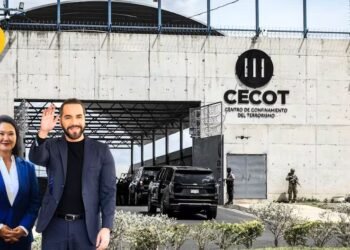
The President of the Republic, Keiko Fujimori, highlighted that the visit to the Terrorism Confinement Center (CECOT), a maximum security prison built by the management of the Salvadoran president Nayib Bukele, will serve as inspiration to implement similar measures in the six prisons that are under construction in Peru.
The visit to CECOT marked the beginning of his official agenda in El Salvador, which also included a bilateral meeting with Bukele.
The president was accompanied by Foreign Minister Carlos Espá and the Ministers of the Interior, César Astudillo, and of Justice and Human Rights, Ernesto Álvarez.
“We know that in Peru we need to build prisons, to finish six that are in process. And I think that today this journey will inspire us a lot to be able to replicate these prisons with all these initiatives, such as Plan Zero Leisure,” he said.
Fujimori also expressed his recognition to the security institutions of El Salvador and President Bukele for the actions carried out in that country.
“My recognition to the Armed Forces and National Police of El Salvador, because it is undoubtedly thanks to their joint effort that these results have been achieved and, of course, my recognition to the leadership and bravery of President Bukele,” he stated.

Keiko Fujimori gives statements after touring the CECOT. (Photo: Presidency)
The delegation was received by the Salvadoran Minister of Public Security and Justice, Gustavo Villatoro, who led the tour and explained the penitentiary management and infrastructure models implemented in his country. Also present were the Minister of National Defense, René Francis Merino, and the director of the penitentiary center, Belarmino García.
Villatoro explained that one of the main components of the strategy promoted by Bukele since 2019 has been the articulation of security actions with legal reforms aimed at combating gangs and reducing levels of impunity.
In turn, Merino recalled that, when President Bukele took office in 2019, gangs controlled 83% of Salvadoran territory. Faced with this situation, he explained that the intervention methods were rethought and coordination mechanisms were established between the institutions responsible for security.
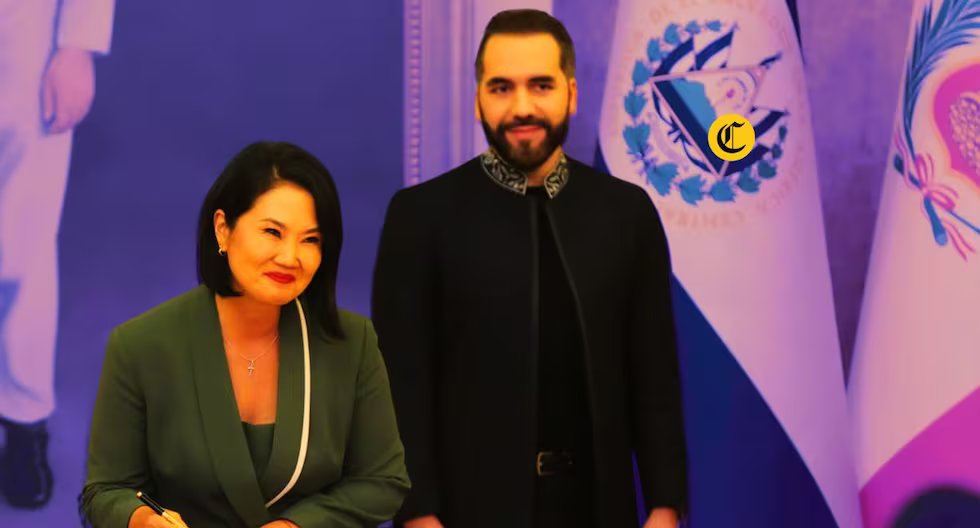
Subsequently, Fujimori was received with honors at the Presidential House, headquarters of the Salvadoran government, where she held a private bilateral meeting with her counterpart Nayib Bukele.
After the meeting, Fujimori and Bukele held a press conference and signed a joint declaration that contemplates cooperation commitments in education, health, security and institutional strengthening.
The president highlighted her journey through CECOT and expressed her recognition to Bukele. “Impressive, president, this emblematic construction, the emblem of peace and order in this country. With Minister Álvarez and Astudillo we are collecting several ideas,” he said.
Fujimori stated that in Peru there are different prisons whose construction is pending completion and that the construction of two more penitentiary establishments will be added.
According to him, one will be intended for highly dangerous inmates, with a model similar to the Salvadoran one, while the other will house not so dangerous inmates, where productive workshops will be implemented.
In addition, he explained that he extended an invitation to Bukele and that both signed different memoranda. Likewise, he stressed that he aspires to sign a free trade agreement with El Salvador.
Asked by a media outlet about how feasible it would be to implement the Salvadoran model in Peru, Fujimori responded: “The issue of insecurity and facing international criminal organizations leads us to collect the things that we can replicate, such as the construction of prisons, which were built in seven months, with absolute measures. This is something that of course we are going to take to Peru (…) The initiatives will be analyzed within the laws of our country, within our system.”
Meanwhile, the Presidency of El Salvador highlighted Fujimori’s visit on its social networks.
Fujimori will continue his agenda in El Salvador until Friday, October 30, when he plans to visit the Rosales Hospital, where he will meet with the Salvadoran Minister of Health.
Then, at 3 pm, you will visit an emblematic school and will hold a meeting with the Minister of Education, Science and Technology.
The president will return to Peru on Saturday, October 31. Your arrival in Lima is scheduled for 3:40 p.m.
After his visit to El Salvador, Fujimori will travel to Spain from November 2 to 6 to participate in the XXX Ibero-American Summit of Heads of State and Government, which will be held in Madrid on November 4 and 5.
The summit agenda includes topics such as environmental sustainability, digital transformation and artificial intelligence, education, science and innovation, social cohesion and international projection of the Ibero-American Community.
The CECOT is part of the security strategy implemented by the government of President Nayib Bukele and has become a reference for different governments in Latin America in terms of penitentiary and security policies.

The CECOT, the Salvadoran maximum security prison built by the Bukele administration.
According to information from the Salvadoran government, the facility has the capacity to house 40,000 gang members, whom the Bukele administration classifies as “terrorists.”
Inaugurated in 2023, the prison has been presented by the Salvadoran Executive as the largest in Latin America.