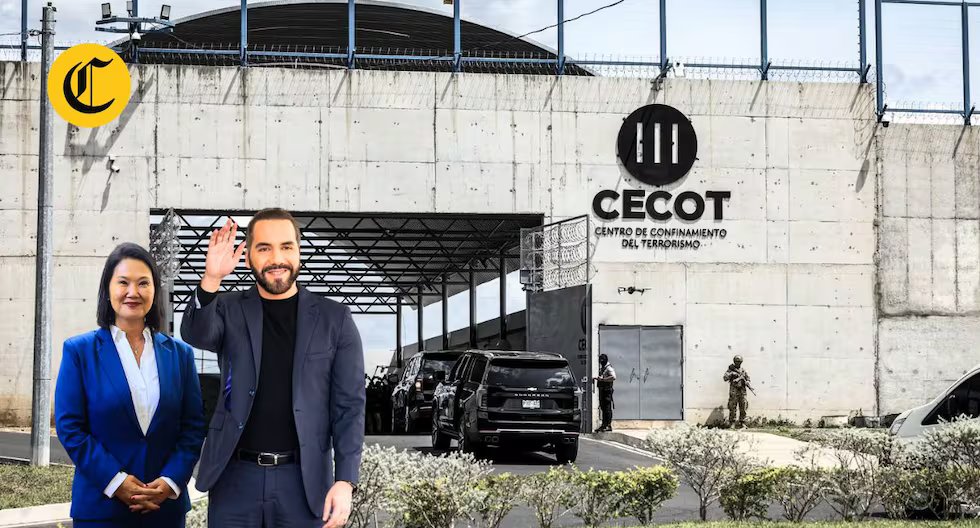
President Keiko Fujimori is making an official visit to El Salvador, along with a delegation made up of members of her Cabinet and with an agenda that includes a meeting with her counterpart Nayib Bukele and a visit to the Terrorism Confinement Center (CECOT), the maximum security megaprison inaugurated by the Salvadoran president as part of his strategy to confront gangs.
The head of state left this Wednesday afternoon on a commercial flight. First, he planned to make a stopover in Panama before arriving at his final destination, San Salvador, the capital of El Salvador, around 8:30 pm, according to the Foreign Ministry.
From the Government Palace, it was noted that Fujimori would carry out an agenda of activities aimed at “exchanging experiences” and “strengthening bilateral relations” in sectors such as justice, health, education and tourism.
In addition, it was highlighted that the president’s visit to CECOT is carried out “with the purpose of learning about the measures implemented by El Salvador to confront criminal organizations.”

Photo of President Keiko Fujimori and her entourage prior to her trip to El Salvador. (Photo: Presidency)
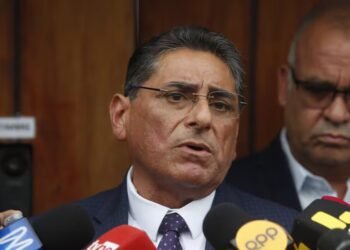
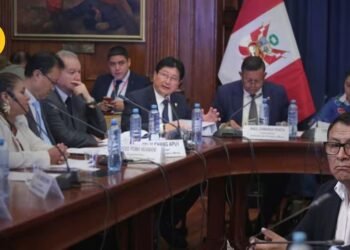
In the delegation, Fujimori is accompanied by Foreign Minister Carlos Espá and Ministers César Astudillo (Interior), Ernesto Álvarez (Justice and Human Rights) and Luis Dyer (Health), among other Government officials. The first vice president, Luis Galarreta, was in charge of the Presidential Office.
Earlier, the president of the Senate, Miguel Torres, described Fujimori’s trip as “fundamental” and “a success” to be able, as he maintained, “to rescue the best lessons learned regarding a country that has given the example of how to control, how to reduce crime, insecurity in its country.”
“They are not exact scenarios, of course not. However, I think there must be lessons learned that we are going to have to rescue. Congratulations on being able to recover security in our country,” he noted.
Fujimori’s agenda and the CECOT factor
According to the program sent to the Senate by the Government, this Thursday the 29th, in the morning, Fujimori will visit the CECOT, located in Tecoluca, southeast of San Salvador. He will also hold a meeting with the Minister of Justice and Public Security, Gustavo Villatoro.
CECOT was inaugurated in 2023 by Nayib Bukele. The megaprison was built in record time during the emergency regime and has capacity for 40,000 inmates. At that time, the Salvadoran president described it as “a gigantic work carried out in just seven months” and as “a fundamental piece to completely win the war against gangs.”

Police guard inmates belonging to the MS-13 and Barrio 18 gangs in the Terrorist Internment Center (CECOT) in El Salvador built by the Government of Nayib Bukele. (AFP).
/ –
According to reports from the AFP agency, this megaprison has reinforced concrete walls, cells with steel bars, security cameras, full-body scanners for those who enter, surveillance towers and devices to block communications with the outside.
In addition, it has been reported that the inmates are monitored by police and military personnel and that the facility does not have recreation areas or visiting rooms. The inmates sleep in bunk beds made of steel sheets, without a mattress or pillow. They are subject to a strict solitary confinement regime and only leave their cells to receive medical attention, exercise in a hallway or attend virtual court proceedings.
Human rights organizations have questioned the model that Bukele promotes.

Inmates remain in a CECOT cell. (Photo by Marvin RECINOS / AFP).
/ MARVIN RECINOS
After his visit to CECOT, Fujimori will have a private meeting with Bukele in the afternoon. In addition, he will hold an extended meeting with the ministers of State, after which an official dinner will be held.
On Friday the 30th, official activities will continue with confirmed visits to the Rosales Hospital and an emblematic educational center, as well as meetings with the heads of these sectors. His return is scheduled for Saturday the 31st.
point of view
In the opinion of political analyst Enrique Castillo, although any exchange of information is beneficial, the trip to El Salvador and the meeting with Nayib Bukele have a more “propagandistic” tone than an exchange of experiences that can be translated into public policies in favor of the country.
Castillo stressed that the realities of both countries “are absolutely different” and that the insecurity problems of El Salvador and Peru are different. From her perspective, the president could have learned the same information from her ministers or from a specialist.
“It is not that you are going to know something whose details or whose experience is going to be absolutely new and applicable to the country. And with respect to public policy, I do not think it will have a substantial contribution,” he asserted.