
DISCAIMER: All views and claims expressed in this article belong solely to the author and do not necessarily reflect the views of Dominica News Online.
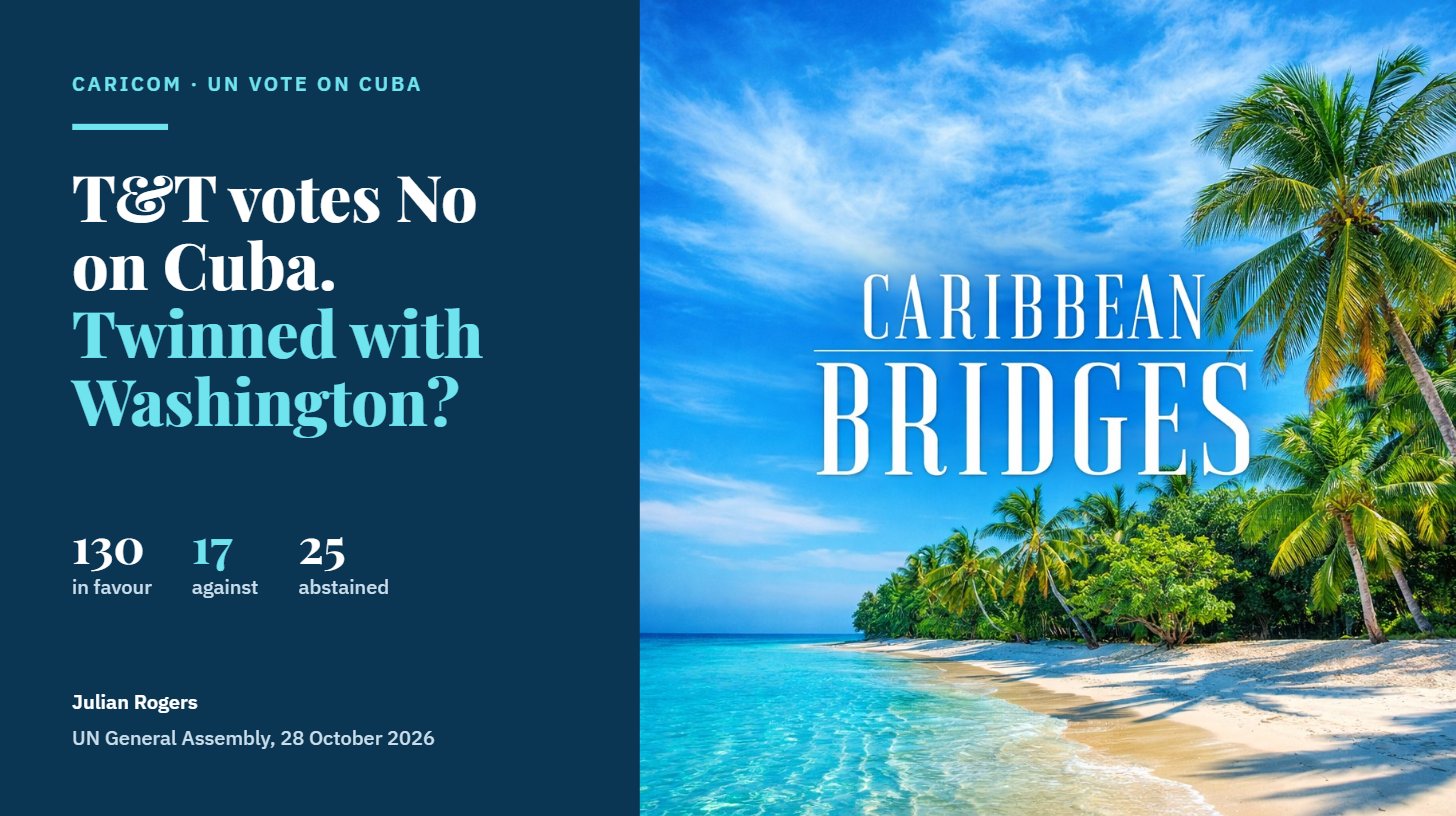
Trinidad and Tobago votes No on Cuba, twinned with Washington, as it prepares for the Security Council.
On Wednesday the UN General Assembly voted 130 to 17, with 25 abstentions, to call once more for an end to the American embargo on Cuba. Trinidad and Tobago, whose governments have backed that call for decades, was recorded among the 17 who voted No. Within CARICOM it stood alone, while Jamaica, Guyana and Haiti abstained.
This was not a stumble. T&T abstained on a procedural vote in July, said nothing in Tuesday’s debate, and then voted against, standing with the United States and Israel while Washington’s ambassador lobbied hard to peel states away from their old positions.
It is the latest link in a chain. Since October 2025 a US warship has docked in Port of Spain, a US military radar has gone up in Tobago, T&T’s airports have opened to American military flights, and the Prime Minister has applauded strikes on alleged drug boats that few Caribbean leaders endorsed. In March she was one of only two CARICOM leaders invited to Donald Trump’s Shield of the Americas summit, and afterwards she called him brave and visionary. On Cuba, T&T has already stepped away from the region, reserving its position on a CARICOM statement about the humanitarian crisis and sending its own relief rather than joining the regional effort. In July it signed agreements with American firms on data centres and steel. Call it what it is: a twinning.
There are defenses. T&T is seven miles from Venezuela, it has struggled with violent crime, and it needs gas, and the Prime Minister says the partnership is about public safety. Fair enough. But a foreign policy is judged in aggregate.
On Cuba, the Prime Minister argues that she will not support dictatorship anywhere, and this week she accused former regional leaders of backing for Cuba a system they would never accept at home. Washington’s ambassador argued in the chamber that Cuba’s troubles come from repression, corruption and military control of the economy. Those are arguments about Cuba. The resolution is something else. It endorses nothing in Havana, binds no one, and asks only that the United States end a trade measure the Assembly regards as contrary to the UN Charter. T&T voted for the same resolution a year ago, with its CARICOM partners, and Cuba’s embassy thanked it. The title has not changed. The company the Prime Minister keeps has.
The timing sharpens the point. In June, 181 of 190 states elected T&T to the Security Council for 2027 and 2028, unopposed and with the support of all five permanent members, Washington included. Its seat begins on 1 January. The government promised the world a “balanced, principled, reliable and pragmatic partner”. On Wednesday it showed only the last quality.
A seat on the Council is a test of whether a small state can think for itself when a great power would prefer otherwise. Twinning suits a town and its sister city. It is a poor posture for a country that says it will speak for the Caribbean where war and peace are decided. The Prime Minister owes the region a plain explanation.