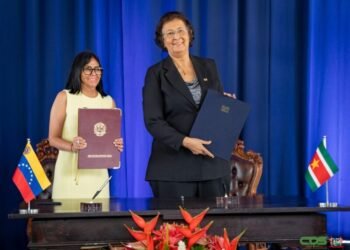
PARAMARIBO — The Ministry of Agriculture, Livestock and Fisheries (LVV) feels called to respond to recent reports and reactions in society about the fisheries agreement between Suriname and Venezuela. It is categorically contradicted that this concerns a new agreement or two hundred new foreign vessels that will have access to Surinamese waters. “These are Venezuelan flagged line fishing vessels that have been active in Surinamese waters for decades, mainly for the catch of red snapper and mackerel,” it is stated.
LVV assures: “The agreement also does not mean that Venezuelan vessels will have free access to Surinamese waters. Each vessel must have a Surinamese fishing license and comply with the fishing license conditions set annually by Suriname. Surinamese laws and regulations remain fully applicable. In case of violations, Surinamese sanctions may be applied, including fines, suspension or revocation of licenses and other legal measures.”
“The update of the agreement is precisely intended to make fishing more controllable and transparent”
In addition, the ministry guarantees that the agreement “does not prejudice the right and responsibility of Suriname to manage its own fish stocks”. “The Venezuelan vessels fish under the conditions that Suriname sets and within the measures that Suriname considers necessary for the sustainable use of fish resources.” The basic principle remains that anyone fishing in Surinamese waters must adhere to the Surinamese rules.
No new fisheries agreement
LVV clearly states that this is not a new fishing agreement that gives two hundred new foreign boats access to Surinamese waters. “It involves updating and re-establishing in law an existing fishing relationship that has been regulated by successive agreements since 1986, the latest agreement being that of February 13, 2007.
Because the commitment has not been renewed since then, the existing one is now being adapted to contemporary requirements for licensing, monitoring, control, traceability, sustainability and combating IUU fishing. “The current agreement is not a completely new arrangement, but an update, tightening and addition of an existing relationship, adapted to contemporary national and international requirements. The update of the agreement is precisely intended to make fishing more controllable and transparent.”
The current framework includes VMS/AIS monitoring, inspections at sea and in port, observers and the exchange of information on vessels, catches, landings and possible IUU fishing. When monitoring or scientific information gives reason to do so, Suriname also retains the authority to take measures with regard to permits, fishing areas, fishing seasons and other management measures.
Legal basis
It is emphasized that the agreement does not grant Venezuelan vessels free access or exemption from Surinamese legislation. “On the contrary, it brings existing activity under a clearer and more controllable legal framework,” LVV believes.
Legally re-recording the agreement is necessary to provide a clear legal basis for the activities of Venezuelan vessels in Surinamese waters. “This is also important in the context of the dialogue with the European Commission on IUU fishing. In that context, specific reference has been made to the need for Venezuelan vessels fishing in Surinamese waters to have a clear and valid legal basis and to be subject to an effective control and monitoring system.”
The lack of a current agreement created the risk that these activities were considered insufficiently regulated from the perspective of international IUU rules. “The update is therefore an important step to clearly establish the legality of this fishery.”
In addition, according to LVV, the agreement is important for the recovery of exports of fish products to the United States, as the international market demands more and more certainty about the legality, origin and traceability of fish products. “A current legal basis, effective control and a closed chain of landing and processing are therefore essential.”
Roll Cevihas
At the same time, an important economic chain for the Central for fishing ports in Suriname (Cevihas)the Surinamese processing companies, employment and exports, including to the United States, have been secured. “The aim of this agreement is therefore not less control, but rather more legal clarity, better monitoring, effective enforcement and sustainably regulated fishing.”
The catches must be landed centrally at Cevihas, which plays an important role in the reception, control and handling of the vessels. These use the facilities and services of Cevihas, including moorings, ice and utilities. “This generates income for Cevihas and contributes to the economic position of this parastatal company,” the ministry said. After the central landing, the catches are transported to Surinamese processing companies. These are largely dependent on this supply for their business operations, employment and export activities.