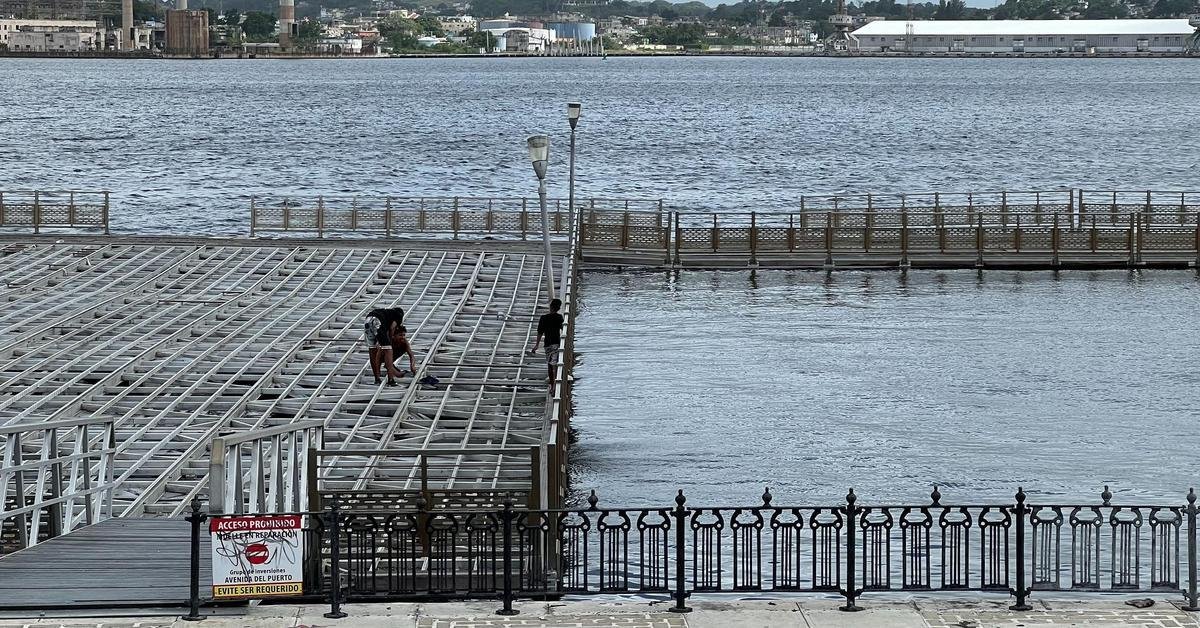
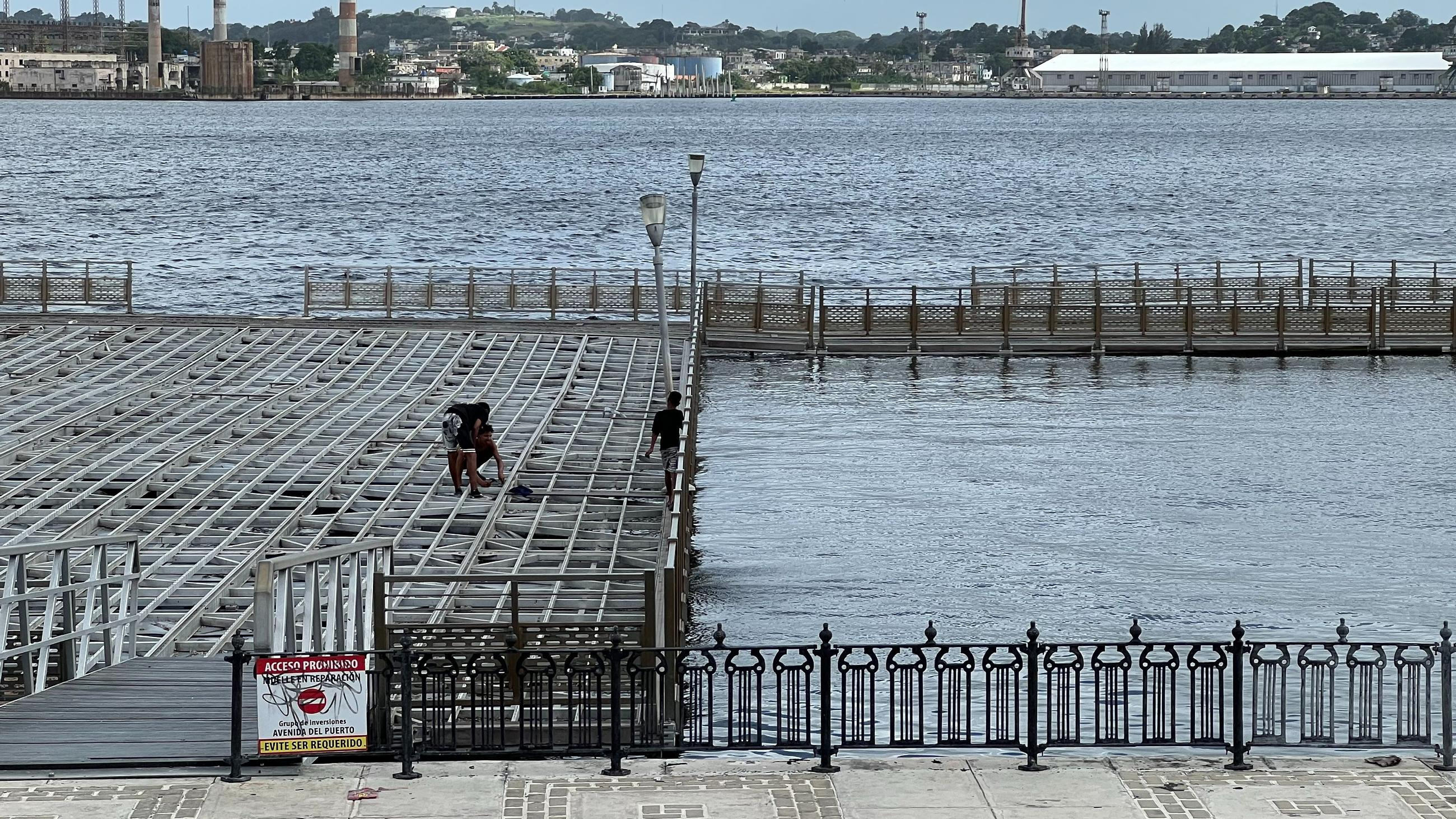
Havana/The floating dock of Alameda de Paula, in Old Havana, is one of those works that were born dying. Inaugurated just eleven years ago As part of the recovery of the coastline of Old Havana, it began to show damage shortly after opening to the public and today it is a floating skeleton, idle and meaningless. This Tuesday, 14ymedio was able to see several young people on a walk along Avenida del Puerto trying to tear out the metal beams with hammer blows, probably to sell them as scrap metal.
The platform has lost practically all of its wooden covering and the iron profiles form an open grid over the water. Several young people move between the beams and persistently hit the structure to detach the beams, even at the risk of falling through one of the numerous holes.
Several young people move between the beams and persistently hit the structure to detach the beams, even at the risk of falling through one of the numerous holes.
The sale of scrap metal, both to the Union of Raw Materials Recovery Companies and through informal, informal channels, is an interesting business for the official purchase priceswhich reach between 400 or 500 for copper, depending on its quality.
At the entrance to the floating ruin, a sign from the Avenida del Puerto Investment Group warns: “Access prohibited” and “Dock under repair,” accompanied by the warning “Avoid being required.” Someone has scribbled it with black marker. The young people ignore him and concentrate on dismantling it, against the grain of the cartel.
The scene is reminiscent of the so-called “flints” who for decades have dismantled the ruins of the Juraguá Electronuclear Power Plantin Cienfuegos, to extract all the scraps and usable materials from that great abortion of Castro’s triumphalism.
The floating promenade was part of a renovation project on Avenida del Puerto, promoted by the Office of the Historian of Havana during the last years of the late Eusebio Leal. The aim was to give Havana residents back contact with a bay from which the city had been practically separated for decades.
In November 2014, the recovery works on Avenida del Puerto ranged from the Caballería Pier to the San José warehouses, converted into a commercial and cultural space. The renovation of the surroundings also included the Alameda de Paula, the Emboque de Luz – terminal for the Regla and Casablanca boats – and the old Wood and Tobacco Warehouse, transformed into a brewery.
Opened in late 2015, the pier soon became a place to stroll at sunset, look out over the bay, chat, fish or enjoy the breeze. The couples even began to put padlocks on the railings as a symbol of eternal love, following a custom spread across bridges in other cities, such as the Pont des Arts, in Paris, where the authorities They banned that practice in 2015 due to the damage that the weight of the padlocks caused to the structure.
The deterioration began almost from its inauguration in 2015. Less than a year later the first damages appeared on the roof
But the deterioration began almost from the beginning. Already in 2016 defects appeared on the deck. In 2019, architect Orlando Inclán, one of the designers, recognized the official newspaper Havana Tribune the problems that the installation presented. “After the initial assembly, many of the boards were replaced because the first batch did not reach the required quality, but the second did,” he explained, pointing out as causes of the deterioration both the poor quality of that first batch and the damage caused by some visitors.
Inclán also admitted that there was no specific maintenance plan for the ride. “It is certainly necessary to offer intense maintenance to a work in operation for almost five years,” he warned. Even the railings, made of stainless steel to prevent corrosion, needed attention, although at the time he considered that it was still possible to reverse the deterioration because there were not so many missing fragments.
The walk It was closed in April 2021 due to the danger that its deterioration represented. A neighbor consulted by the Cuban Institute for Freedom of Expression and Press assured that he had not seen repair work.
In 2024, several complaints described a structure with holes, deteriorated railings and signs of abandonment. In August 2026, a photo report of OnCuba documented upturned boards, unwired lighting fixtures, and dangerous sections, while other citizen voices They warned of the disappearance of pieces and railings and appealed to the authorities.