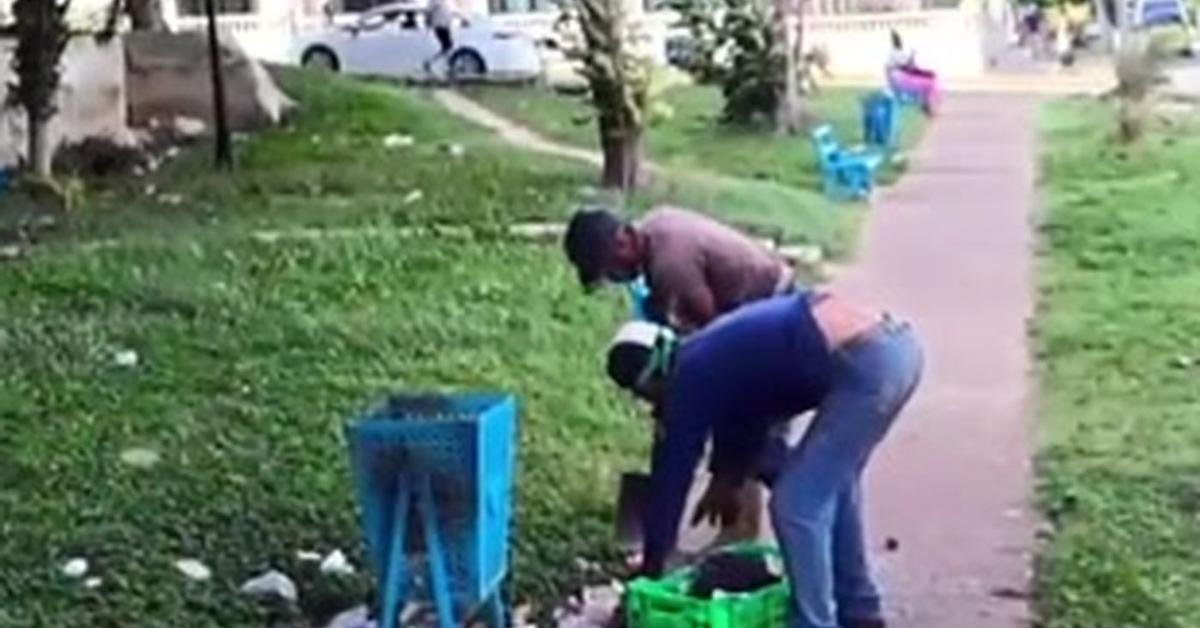
Havana/Not a broom, not even a dustpan. Two workers bend down to lift with their hands the waste scattered throughout the park at 19 and M, in Havana’s El Vedado. One holds a small plastic box, while the other picks up papers and containers from the floor. When they finish their work at that point and return to the small cargo vehicle that waits for them next to the sidewalk, there is still residue among the grass and around the trees.
The scene, recorded this Friday by this newspaper, shows the true reality of The Rampeñothe local development project that since July has been trying to alleviate the garbage collection crisis in a part of the Plaza de la Revolución municipality, whose leaders – the official Pedro Garcés at the head – continue trying to sell it as a success.
In a broadcast report The EFE agency highlights the activity of some 15 electric tricycles dedicated to removing waste from restaurants, shops, markets, homes and tourist establishments, including the Hotel Nacional de Cuba. The initiative currently has, according to its managers, 40 workers and a charging station equipped with 60 solar panels.
Businessman Yasier Hernández, 35, explained to the agency that the project combines private capital and sustainable technology to face a problem aggravated by fuel shortages and the deterioration of communal services. The vehicles make two trips a day, at eight in the morning and at eight at night. The advertised price for homes is 100 pesos per month, while commercial establishments pay different rates.
But what was recorded this Friday contrasts with that image of efficiency. “See the collectors how they work, with their hands!” says a resident who regrets that, after each operation, waste remains in the place. Bags, containers and papers are scattered along a green strip next to the sidewalk.
Even with these limitations, the situation of the streets served by El Rampeño contrasts with that of other neighborhoods in Havana, where the accumulation of waste has come to impede traffic. On the corner of Villanueva and Melones, in Luyanó, a mountain of garbage forced heavy machinery to be used to clear the road, as shown in other images collected by this newspaper.
In the video, a yellow front loader sinks its shovel between bags, cardboard, plastic and debris of all kinds accumulated next to the homes. The machine reverses, maneuvers and attacks the enormous garbage dump again, which occupies a good part of the road. The scene occurs on a street that gives access to the Miguel Enríquez hospital, known as La Benéfica.
“They spent a lot of days with the mountain of garbage there,” says a resident of the area. According to their testimony, residents had protested because, on previous occasions, the authorities had simply piled up the waste without removing it. This time, he says, a truck also arrived to take them away.
The history of El Rampeño has been marked by a succession of promises, limited progress and failures. When it was presented at the end of June, its promoters announced the incorporation of 30 electric tricycles and the hiring of about 70 workers. They also promised a solar charging station that would reduce dependence on the national electricity grid and extend collection to 14 constituencies of the Rampa Popular Council.
However, when service began on July 1, they were only operational five of the 30 planned vehicles. The lack of resources limited from the beginning the scope of an initiative that aspired to set an example in terms of cleanliness in one of the most central areas of Havana.
Despite these difficulties, the first results were encouraging in the few streets served. On July 15, 14ymedio checked that some of the areas included in the tours They were practically free of waste. It was enough, however, to walk a few meters to a street out of service to once again find overflowing containers and mountains of garbage.
The tricycles promised by the Central Committee of the Communist Party and the central government had not arrived in the expected quantity, nor had the solar station on 23rd and J been completed.
On that date, El Rampeño operated only in four small areas of the popular council. The difference between a clean street and one converted into a landfill depended, fundamentally, on being inside or outside the routes. The project demonstrated that it was possible to keep some areas in better conditions, but it was still far from offering a solution for the entire neighborhood.
In August, the difficulties were no longer just a coverage problem. Pedro Garcés, president of the Rampa Popular Council and one of the main promoters of the initiative, publicly acknowledged that the initial objective had not been achieved. The tricycles promised by the Central Committee of the Communist Party and the central government had not arrived in the expected quantity, and the solar station at 23rd and J had not been completed either. The official also criticized the delays in finding alternatives to charge the vehicles during the prolonged blackouts.
Now, Hernández’s statements to EFE point to a partial recovery. From the five tricycles with which the service began, the fleet would have grown to about 15, still half of the 30 originally announced.

/ 14ymedio
El Rampeño also represents a peculiar combination of state, municipal and private financing. According to the initial presentation, the Government would provide the vehicles, while part of the infrastructure would be financed with funds from the 1% land tax paid by companies. To this would be added the dues from neighbors, contracts with businesses and income from the recovery of raw materials.
The businessman who today appears at the head of the initiative also comes from a business founded two years ago in Villa Clara, dedicated mainly to textile manufacturing and means of labor protection. Details of the contractual relationship between that company, the local development project and municipal authorities have not been made public.
In the EFE report, a 58-year-old worker, who previously dedicated herself to renting rooms for tourists, describes garbage collection as a sacrificial task, for which she receives an average salary of about 15,000 pesos (18 dollars a month at this Friday’s exchange rate). He also assures that many neighbors appreciate the service, a perception that coincides with the testimonies collected by this newspaper during the first weeks of operation. It is not only about how many tricycles are circulating, but also about the conditions and means with which the cleaning is carried out.