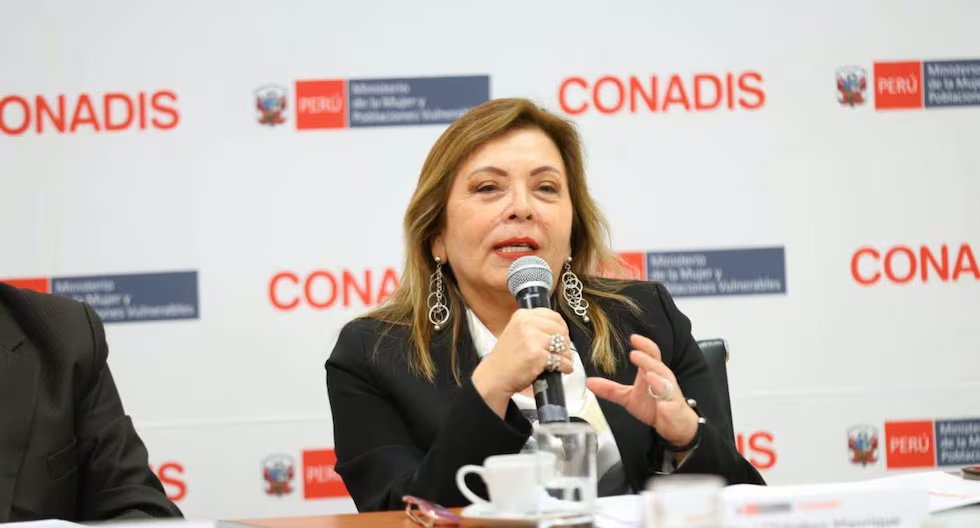
On October 16, the National Day of Persons with Disabilities is commemorated in the country, so The Commerce interviewed Olga Mercedes Villalobos, president of the National Council for the Integration of Persons with Disabilities (Conadis), to learn about the objectives of her management and the challenges faced by a citizen with disabilities in the country.
A notable point from the interview is that, according to Villalobos, regional governments and municipalities report that they allocate resources to supposedly serve people with disabilities, but he highlighted that it has been proven that there are offices that do not offer any type of service or the budget is allocated to other areas.
1. What is the role of Conadis towards a person with a disability?
The role of Conadis is to promote and guarantee the recognition and exercise of the rights of people with disabilities, promoting public policies, articulating actions with State entities at its three levels of government and supervising compliance with auditable obligations.
Likewise, it provides guidance to people with disabilities and their families, promotes the elimination of barriers that limit their participation in society and contributes to generating the necessary conditions so that they can exercise their rights on equal terms with other people.
2. What are the objectives of your management?
I am an educator specializing in disabilities and the most important thing at this moment is the issue of inclusive education, since, without it, a person with a disability will not be able to have opportunities at the level of productive technical studies and at the university level, therefore, they will continue to be in a circle of poverty.
3. What challenges does a person with disabilities face in Peru?
In Peru, people with disabilities face multiple barriers that make it difficult to fully exercise their rights and participate on equal terms in society. Among the main challenges are the persistence of prejudices, stereotypes and discriminatory practices, as well as accessibility barriers in public spaces, public transportation, information and communications. They also face difficulties in accessing inclusive education, quality health services and decent employment opportunities.
Added to this are territorial gaps, especially in rural areas, the limited availability of support services and the difficulties in exercising their autonomy.
Since 2012, an Enedis (Specialized National Survey on Disability) has not been carried out and we have repeatedly asked the MEF to assign us the budget of 16 million soles to carry out this specialized survey through the INEI. If the gap is not known, it is very difficult to generate public policies. We need to know where the disabled person is, what disability they have and what their need is.
4. How has the issue of rights for people with disabilities been evolving in recent decades?
Our legislation has experienced important changes in the way we understand disability, moving from the medical-rehabilitation model to the social and human rights model, which recognizes the importance of eliminating environmental barriers.

Mercedes Villalobos, as president of Conadis, has visited various Omaped locations in Lima.
5. How many people with disabilities does Conadis provide assistance to or how many people does it have registered?
Through the National Registry of Persons with Disabilities, Conadis has, as of October 15, 2026, 631,330 registrations. Likewise, through the Alivia Peru Network, one of our main guidance and support services, we have served 26,720 people so far this year, facilitating their access to information, public services and the exercise of the rights of people with disabilities and their families.
6. Does Conadis make unexpected visits to guarantee quality services to people with disabilities?
Conadis exercises its control and sanction powers through the Control and Sanctions Directorate. An Inspection Plan is approved annually and these are developed in accordance with an established program.
During the year 2026, 527 inspections were carried out nationwide. Of this total, 313 correspond to ordinary inspections, whose objective is to verify compliance with the regulations and, if non-compliance is detected, they may lead to the initiation of an administrative sanctioning procedure; and 214 correspond to indicative, preventive inspections. Unlike ordinary actions, these actions are not intended to impose sanctions, but rather to provide recommendations and technical assistance so that entities adapt their actions to current regulations.
Likewise, we are carrying out supervisions of the Omaped to verify their implementation and provision of services to people with disabilities. More than 40 Omaped have been visited in Lima.
7. What expectations do you have regarding President Keiko Fujimori’s announcement that next year the budget of the Contigo social program will be expanded to incorporate more than 100,000 people with disabilities?
In reality, it is a historic event that has been achieved by the management of President Keiko Fujimori in coordination with the Minister of Women and Vulnerable Populations, Mara Seminario. Since 2024, there were only 142,771 beneficiaries and the budget projection for 2027 did not contemplate an increase, a situation that as Conadis concerned us because there was an average of 116,200 people on the waiting list.
In previous government administrations, the priority was not given to expanding pension coverage, which is 300 soles per bimonthly to people with disabilities.
The requirements to access the pension are: being a person with severe disabilities and being in a situation of poverty.
8. Is the rule that establishes that public entities must hire a minimum of 5% of their staff with people with disabilities, while, in the private sector, companies with more than 50 workers must hire at least 3%?
The results obtained in the audits carried out by Conadis show that only one ministry, specifically the Ministry of Labor and Employment Promotion, complies with the 5% labor quota for people with disabilities. Likewise, at the regional government level, in the audits carried out in 2025, only 4 GOREs meet the quota: Pasco, Piura, Huánuco and Ucayali.
So far in 2026, Conadis has carried out 82 inspections regarding compliance with the employment quota, and it was verified that 14 entities complied with the legal quota of 5%, while 62 entities did not comply with said obligation. In the remaining 6 cases, it was not possible to determine compliance because the managed entities did not send the complete information required to carry out the corresponding evaluation.
On the other hand, we must specify that, in accordance with current regulations, the Ministry of Labor, through Sunafil, is responsible for oversight in the private sphere. According to information from Sunafil, 245 private companies meet the employment quota for people with disabilities in 2025.
9. Has progress been made in compliance with the norm that states that regional and local governments must allocate 1% of their annual budget to the population with disabilities?
Through Law No. 32139, it was established that regional and local governments have the obligation to include resources for activities in their annual budget, which is 0.5% of the Institutional Opening Budget for Oredis and Omaped, as well as 0.5% of the PIA in investments for projects and maintenance of accessibility.
Conadis has found that, of 24 audited/supervised regional governments, none has complied with allocating 0.5% of resources to finance activities and projects aimed at caring for people with disabilities. Likewise, of 60 audited or supervised local governments, only about 26 local governments have allocated more than 0.5% of resources for activities; while 5 have allocated more than 0.5% for projects.
The governing oversight body is the Comptroller’s Office. The norm was a hope for people with disabilities, since there is a budget allocated, which in some regional governments is quite a lot of money, since in certain cases there are more than 20 million soles to allocate to the Regional Offices for Attention to People with Disabilities (Oredis) or the Municipal Office for Attention to People with Disabilities (Omaped). However, no GORE has given 1% for disability issues. That is why the person with a disability is so dissatisfied and abandoned, since there is a budget, but it is not assigned to them.
Some five regional governments have closed their Oredis so that this budget no longer enters that office and is allocated to the Social Development Management in order to distribute it to their different social programs. They have turned the law around.
We have agreed with the head of the PCM, Luis Galarreta, and the Minister of Women and Vulnerable Populations, Mara Seminario, that as soon as the credentials are given to the new municipal and regional authorities, an induction will be carried out on the law that requires 1% to be allocated for accessibility and service issues, since it has a criminal sanction.
In the case of Omaped, it has been detected that in the friendly consultation of the MEF it is stated that they have allocated 0.5% of the budget, however, when you visit the Omaped premises there are no services, which leads to wondering where the money is going.