‘What we have is of great value’
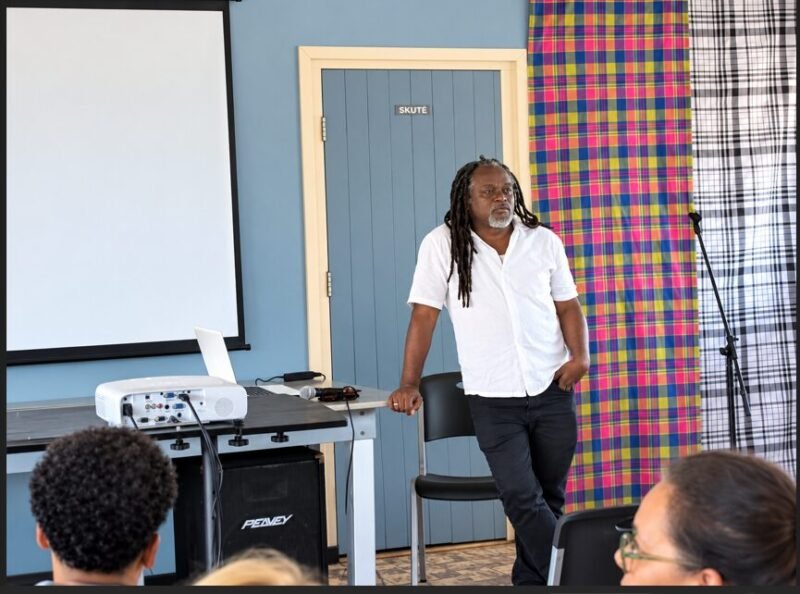
Artist Marcel Pinas walks up and down to welcome guests from his Kibii Foundation. The characteristic brick building where the Suralco hospital used to be located serves as a reminder of a bygone time in Moengo. When American capital dictated development in the famous bauxite town. The building is now used to drive community development through arts and cultural education. “What we as Maroons have is of great value. We must use that to shape our future,” Pinas explains his motto on Friday, on the eve of the Day of the Maroons.
Text and image Euritha Tjan A Way
What the policy center in Suriname does not have, artist Marcel Pinas does have. He has a vision of the future that should be realized in twenty to thirty years: The Kibii Wi Koni University based on traditional maroon knowledge. The greater goal is to bundle Maroon knowledge and to teach the Maroon themselves that their own knowledge is of great value and can contribute to solving problems in contemporary society. Pinas has taken consistent steps to this end until 2018. And after an interruption due to government interference at the time, Pinas has regained the motivation to continue for two years.
“I especially missed the support of the large companies that readily sponsor events in Paramaribo. It seems as if they do not want to support activities domestically”
After the Moengo Festival, which was organized again after eight years in September, the Kibii Wi Koni research center was reopened on Saturday. The preceding Friday, the Symposium on Maroon Knowledge: Heritage and Research in Motion was held. Representatives of national and international organizations that have a connection with Kibii were present at the symposium on Friday.
Own publishing house
Through these partners, Kibii learned to look differently at the work she does with the community. “For example, we have learned to see people who work with us in Moengo as artistic producers. They work with the community and they create things. That was a different way of looking at what we do here in Moengo and how we want to approach it further,” said Coco Duivenvoorde, who works with Pinas at Kibii.
Artist Tolin Alexander, who is from the area himself, was also a speaker on the first day. He shared what motivated him to set up his own publishing house, Kotika Publishing. “Some time ago I was asked to verify scientific information about the forest in Suriname. I found it remarkable that the client always preferred what was written down. While we as Maroons and connoisseurs of traditional medicinal knowledge base ourselves on oral stories. That was the reason for me to set up my own publishing company to write down our stories myself.”
On October 10, the publisher’s second book was also presented at the reopening of the research center. A special book with stories of five researchers who investigated various topics related to Maroon culture.
In the photo
During the question round on Friday, a visitor asked how the artists deal with the fact that people in Suriname apparently do not like to have their picture taken. The answer was multi-layered. Alexander shared the story of one of his relatives who is pictured in the Cobra Museum in the Netherlands. “I came there, saw it and reported it to the museum. I was told by a person that he was not responsible for the exhibition. He took my contact details and then I would be called. That never happened and in the meantime there is a story there that is not correct. So I will show you the other side of the coin.”
Pinas that with the True Time looked back on the Moengo festival and said that starting up after eight years is not easy. “I especially missed the support of the large companies that readily sponsor events in Paramaribo. It seems as if they do not want to support activities inland. Such companies do not understand that there is cohesion in the community. Help organize such an event and contribute to development in the area,” Pinas said.
He noted that Marowijne artists themselves also charged a lot of money for performances. “USD 5,000 while we do not want to make a profit, but set up an activity for the community. In the end, the event was successful, but we have to evaluate and adapt for a better course next year,” Pinas said. He looks forward to the follow-up process with the Ministry of Education, Science and Culture, which he believes is going well due to the bond that Kibii has with the schools. “Ultimately, the youth need to know what we are working on in order to continue it.”