In his briefing to the UN Security Council… UN Envoy De Mistura confirms:
“no “The future can be reduced to a political proposal on the negotiating table.”
issue Self-determination should be at the heart of any attempt to end the conflict
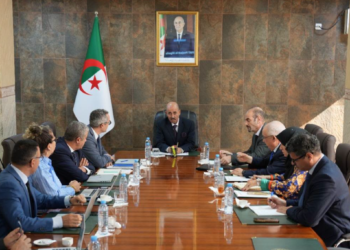
The future of Western Sahara cannot be decided apart from the will of the Sahrawi people, nor can it be reduced to a political proposal on the negotiating table, as a ready-made solution, before the right of the Sahrawis to freely determine their fate is guaranteed. This is the conclusion reached by the Personal Envoy of the Secretary-General of the United Nations, Staffan de Mistura, and reported to the UN Security Council during his briefing on October 8, reviewing the faltering negotiations, the impossibility of imposing autonomy, and the necessity of keeping the right of the Sahrawi people to self-determination at the heart of any political settlement.
After three negotiating rounds hosted by Washington and Madrid during the first months of the year, de Mistura said in his briefing, the international track was unable to overcome the fundamental differences that prevent reaching a final agreement. Despite the progress achieved by these rounds, according to what de Mistura reported, the divergence between the parties’ positions still exists, making the issue of self-determination at the heart of any attempt to end the conflict, far from readings that treat one of the proposed proposals as a predetermined outcome.
The most prominent part of the UN envoy’s briefing was his assertion that the autonomy proposal, whatever its form, “can never be simply imposed on the people of Western Sahara,” a statement that carries a fundamental significance in the ongoing debate about the future of the issue, as it distinguishes between putting a political initiative on the negotiating table and adopting it as a final solution without the approval of the Sahrawis themselves.
Discussing the Moroccan proposal does not mean accepting it in advance
Discussing the Moroccan proposal does not mean accepting it in advance, and including it in the settlement process does not give it the status of an agreed-upon solution, nor does it alone determine the nature of the final status of Western Sahara. Between the two matters, a fundamental role emerges: the first relates to a negotiating process in which the options remain subject to discussion, and the second assumes reaching a final result, which was not achieved according to the data contained in the briefing.
Inviting the Polisario Front to discuss the proposal, ask questions about it, request clarifications about its provisions, or submit proposals to improve it, does not mean, according to the same source, that the Front is required to abandon its political and legal positions or acknowledge autonomy as a final option. Engaging in discussing the proposals does not negate the right of the Sahrawi party to defend its position on the future of the region.
The briefing provided by the UN envoy indicates that the call for flexibility is not limited to one party, but rather the message concerns both parties to the conflict and that overcoming the stalemate requires the willingness of the Polisario Front and the Moroccan occupation to respond positively to the negotiations and search for common ground. Sustainable progress cannot be achieved if flexibility turns into one party demanding concessions, while treating the other party’s proposals as the only framework within which settlement should take place.
Self-determination goes beyond negotiating political formulas
The fundamental question in the Western Sahara issue is not only related to the formula in which the affairs of the region will be managed, but rather the right of the Sahrawi people to decide their future freely. Therefore, any discussion about the Moroccan proposal or other political proposals should not obscure the most important issue: How will the will of the people concerned be guaranteed, and what are the guarantees that prevent a result from being imposed on them?
De Mistura’s statements regarding the impossibility of imposing autonomy are important beyond the political formulation of the Moroccan proposal, because they set clear limits to any attempt to deal with the negotiating discussion as a prior approval of a specific solution. Negotiations may allow for the exchange of perceptions and modification of proposals, but they do not mean that the outcome becomes known before completing the process and reaching an agreement.
Not only that, de Mistura attaches great importance to a solution that takes into account international law and reaching a permanent settlement requires that international guarantees and relevant legal references be present in the political path, preventing the solution from being reduced to understandings that do not address the essence of the conflict. From this standpoint, the priority is not reaching an apparent agreement but rather a path that guarantees respect for the rights in question and addresses the issue of the future of the issue once and for all.
The path to agreement requires more negotiation and guarantees
The UN envoy’s briefing explicitly acknowledged the inability of the three negotiating rounds to overcome the fundamental differences, so that the challenge before the UN path remains to address the disputed issues, most notably ensuring that no solution is imposed on the Sahrawi people that they did not agree to.
These data do not mean that the international path has reached its end, or that the briefing announced the final failure of the negotiations, nor does it mean that the autonomy proposal has become an approved settlement. Rather, the continuing differences confirm that the path towards agreement still requires more negotiating work, reliable international guarantees, and a clear treatment of the legal and political issues related to the conflict.
Ultimately, the future of Western Sahara is not decided by the number of meetings held, nor by the mere advancement of a proposal in the diplomatic discussion, but by the extent to which the settlement is able to address the essence of the conflict and respect the will of the Sahrawi people.
theThe Humanitarian Initiative is not a political argument
The briefing also touched on an initiative that allows Sahrawi refugees to make individual and voluntary visits to the cities of Laayoune and Dakhla, to learn about the conditions and discuss the proposals put forward regarding its future.
According to the data contained in the briefing, the Polisario Front responded to the initiative on September 14, expressing its readiness to cooperate with the United Nations High Commissioner for Refugees to facilitate its implementation, stressing that the willingness to cooperate with the Commission regarding voluntary visits does not constitute acceptance of the Moroccan proposal, and cannot be interpreted as a waiver of the right of the Sahrawi people to self-determination.
The individual and voluntary nature of the visits also requires, according to what De Mistura concluded, respect for the freedom of the refugees concerned to make their decisions, away from any pressure or political exploitation of the refugee conditions. A humanitarian initiative should not be made a political argument that is not in line with the principles of the Polisario Front and cannot be treated as an alternative to addressing issues related to the future of the file.