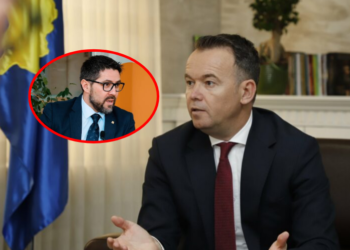
The debate on the administrative-territorial reform 2.0 continued even outside the Assembly hall, moving to the studio of the show “Opinion”.
Taulant Balla and analyst Artan Hoxha were involved in a tense debate regarding the number of employees in the public administration and the effects of the territorial reform.
Hoxha claimed that the number of employees in the central and local administration has increased compared to 2015, while Balla disputed the figures and accused the analyst of providing incorrect information.
Excerpts from the debate:
Artan Hoxha: In the total of the state, you have found this state with 163 thousand employees in total, central and local government. Today, together, central and local governments, you are 187 thousand. Now tell me, they have the local government with 41 thousand, administration and municipal enterprises, and the central government with the difference of 187 thousand.
Taulant Balla: I speak with letters, you speak from the air.
Artan Hoxha: Tell me, what does this government do with this state-owned enterprise? They say now we have reduced the number of personnel. They have now increased it by 20,000 in total, they have transferred some functions of the local government, for this reason their staff has increased, but it should have been reduced in the central government. Grow here, grow there. Where is the result of the 2015 reform?
Taulant Balla: I’ll say it. Let me explain to you, sir, because you are making a fool of yourself.
Artan Hoxha: State parasite.
Taulant Balla: No, it’s useless. It’s useless.
Artan Hoxha: What about in vain? You have it in the statistics.
Taulant Balla: Will you let me say two words? You’re lying, no, you’re lying.
Artan Hoxha: Yes, no, open the INSTAT page. Open up.
Taulant Balla: Lying, no, lying. Shut up and I’ll tell you now.
Artan Hoxha: Open now.
Taulant Balla: Then. To give you an example, in 2015, Lushnjë Municipality had private cleaning until three years ago. And it turned out, and I invite the people of Lushnja to call Fevziu now, it turned out that that cleaning with that private company did not provide the right quality of service. In 2023, Lushnjë Municipality decides to no longer provide this service to the private sector, but to provide it with its own company. So, the money is the same. It became a state enterprise, you can say that they are state employees. They were the same employees, but what happens? The municipality spent 1 million euros for this service. 20% went to VAT, 20% was taken by the company. From 1 million euros, I save at least 400 thousand euros and today Lushnja is cleaner, it is cleaned by a public company.