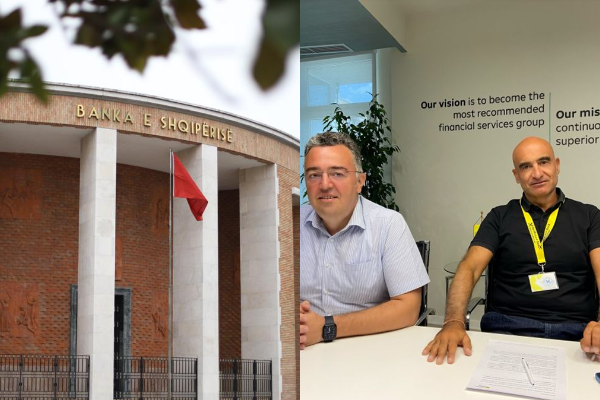
Immediately after the serious incident at the Raiffeisen bank, which affected the accounts of thousands of citizens, the Bank of Albania has landed for control. BSH inspectors are currently present in Raiffeisen investigating in detail what happened.
The first suspicions are of intervention, which came about due to human error, while it has not yet been determined whether the intervention was external or internal.
According to sources, what happened was an anomaly in the casting of Sunday’s daily batch. This is an automatic process that runs at night to process and update all transactions accumulated during the day.
Practically, the incident affected all the transactions that citizens made during Sunday, which were registered twice in the system. This means that those who had withdrawn received their money twice. Others who had paid by card, as well. A source told Kapital that it is about over 40,000 affected transactions.
The situation returned to normal and the anomalies were corrected a day later, but the incident caused quite a bit of concern among the citizens.
Read also:
Although Raiffeisen tried to minimize the incident through a blunt statement and an aggressive PR without clarifying what the cause was, sources told Kapital that the bank risks penalties, the severity of which will depend on the completion of the investigations. But it is not excluded that the event could eat heads at management levels at Raiffeisen.
A week before the incident, Raiffeisen announced the complete transition to the cloud, becoming the first bank in Albania to carry out this transformation.
“On September 17, 2026, we marked a historic moment for Raiffeisen Bank Albania. For 22 years, our technological infrastructure has supported the operation of the bank 24 hours a day, every day of the week, including nights and public holidays. Today, we have finished migrating our applications to the cloud. This is not a partial transition or a hybrid model, but a complete transformation. We have moved 100% to the cloud, achieving something that no other bank in Albania has achieved before,” declared Erion Serti, Member of the Board of Directors and IT director of Raiffeisen Bank Albania.
After the incident, Serti is the person who risks the most sanctions, which can go up to forced removal from BSH, if the investigations prove direct responsibility. But beyond punitive measures for individuals or financial penalties, the incident has also put Christian Canacaris, the executive director of Raiffeisen in Albania, in a difficult position.
He lobbied for the installation of the new system, a complex process that required months of work, significant funding, specialized expertise and close collaboration between the teams of Raiffeisen Bank Albania, Raiffeisen Bank International and the technology partners involved.
Now justifying the incident to the mother in Austria will not be so easy, especially after the huge expenses. Human responsibility is initially suspected. This is the most prevalent variant in the control groups.