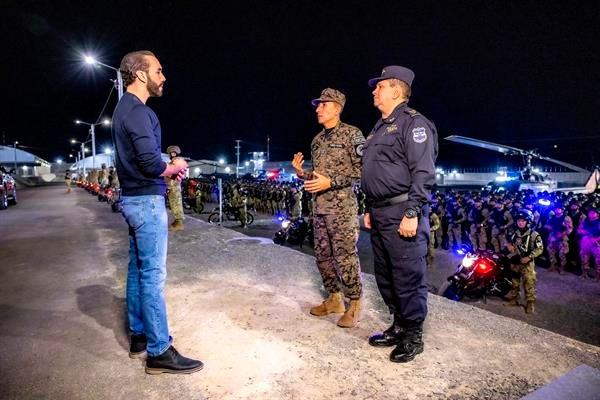
Something very serious is happening in El Salvador and the world has begun to notice it.
A Group of Independent Experts for El Salvador has concluded that, during the Exception Regime, state authorities have committed crimes against humanity; and they request the prosecutor of the International Criminal Court to investigate the reported crimes and therefore deduce responsibilities.
Crimes against humanity are defined in article 7 of the Rome Statute, which gave rise to and guides the International Criminal Court to which El Salvador has been a signatory since 2016. The Statute defines them as crimes committed under systematic attack on the civilian population, with knowledge (of those responsible) of the commission of these attacks. The statute lists the crimes that could constitute against humanity if they are committed in this way: murder, torture, extermination, sexual violence, persecution for political, ethnic, religious, gender reasons… forced disappearance of people, among others.
The Group of Experts, made up of international jurists with extensive experience and sufficient prestige to be considered an authority, presented a 300-page report that is the most complete, documented and forceful study on the crimes committed by the Salvadoran authorities during the Emergency Regime. The report says:
Serious deprivations of physical freedom in violation of international standards or imprisonment, torture, forced disappearances, rape and sexual violence, murders, as well as other documented inhuman acts, having been committed as part of a widespread and systematic attack against the civilian population, including children and adolescents, in the context of the security policy framed in the regime of exception, may constitute crimes against humanity, as provided for in article 7 of the Statute of Rome that creates the International Criminal Court.
Crimes against humanity are called that because they are of such magnitude and severity that they constitute an attack against all of humanity. That was what gave rise to the establishment of the International Criminal Court, so that criminals of this type of crime could be persecuted, tried and imprisoned by the international community. The latest guest of the Court’s prison in The Hague is the former Philippine president, Rodrigo Duterte, for the systematic campaign of extrajudicial executions of people suspected of drug trafficking. Also accused, and with an international arrest warrant, are Israeli Prime Minister Benjamin Netanyahu, his former Defense Minister Yoav Gallant and Russian President Vladimir Putin. Crimes against humanity do not prescribe.
The report of the Group of Experts does not name any individual as allegedly responsible for the crimes committed in El Salvador, it limits itself to arguing and evidencing the crimes. It establishes that the human rights violations committed under the emergency regime are massive and systematic in nature, “not only because of their volume—more than 89,000 people detained without minimum guarantees or due process—but also because of the widespread repetition of patterns of abuse, the participation of multiple State agencies and the existence of an official policy that tolerates, encourages and justifies these practices as part of the so-called ‘war against gangs’. The scale of the abuses, their persistence over time, their vertical coordination and the state narrative that supports them allows us to maintain that it is a state policy deliberately established and executed.”
The word “systematic” is not gratuitous. It means that a planned, controlled and guided system has been put in place, or at least tolerated, by state authorities or armed groups. The seriousness of the crimes committed under this system makes it corrosive and perverse, because ordinary individuals – prison guards, police officers, prosecutors, judges, bureaucrats – end up committing atrocities to comply with the demands of the system (quotas, submissions, complicities, etc.).
The cost for El Salvador will be very high: the system, that is, the State authorities, have normalized the commission of massive crimes and are training a generation of security forces and justice operators in a culture of crime and impunity.
The accusations are of such seriousness that they require clear accountability from the authorities not only in response to the allegations of crimes against humanity, but also in terms of perspectives on the Exception Regime and correction of the system.
Unfortunately, the response of the government and its spokespersons has been not very serious. They accused the experts of having remained silent in the face of abuses in other countries (which, even if true, does nothing to mitigate the facts attributed to the Bukele regime); They lied and, in the crudest of cases, high-level officials said that the gang members were the ones who had committed crimes against humanity (Vice President Ulloa, probably assuming that he could be among those accused of crimes against humanity, ventured to say that the gang members had committed genocide, which is a legal aberration).
The latter deserves a separate reflection, because it is a recurring reaction from Nayib Bukele and his officials. When they are accused of human rights violations, they respond in one way or another that the gang members were worse, as if it were a competition or as if the horror of the gangs justified, by mere comparison, systematic torture, forced disappearances, deaths in prison, rapes, political persecution, arbitrary detentions, police extortion. It is deplorable to see the administrators of a State voluntarily comparing themselves to a criminal group.
A few months ago in the White House, alongside a delighted Donald Trump, Bukele said: “They accuse us of having imprisoned thousands, I prefer to say that we have freed millions.” No, he has not released them. He cannot free them because his is not a policy of freedoms but one of intimidation and domination. He has not released them. The executioner has simply changed them.
The ones he did release were gang leaders, like crook; and imprisoned thousands of innocent people.
It is increasingly difficult for Nayib Bukele’s propagandists to disguise, hide or divert attention from the serious crimes committed by the dictatorship. Despite the closure of public information, despite the neutralization of the institutions in charge of ensuring human rights and due justice; despite the restrictions on knowing even the most banal issues of public administration; despite the millions invested in propaganda and dissemination of fake news, the delegitimization of journalism and human rights defenders.
Recently, regarding the debate in Spain over the assisted death of a woman who was raped by a group of men, Nayib Bukele said on the social network
There has not yet existed, in the history of humanity, a good person who opposes respect for human rights. On the contrary, it is the violators of these rights who tend to oppose their defense. Conflict is probably inevitable: some establish fundamental rights for all human beings, without any distinction. The others propose a set of rights at the service of the leader and his group.
Given the magnitude of the accusations made by the Group of Experts, and taking into account that crimes against humanity do not prescribe, it was to be expected that the Salvadoran dictatorship would react by distorting everything and attacking everyone. It is their own legitimacy, and the future of the dictator, that is at stake for them. We, on the other hand, believe that what is at stake is the future of the country, whose government has become a producer of victims on a large scale.
The evidence continues to accumulate and is robust: The Salvadoran dictatorship is committing crimes against humanity.
The crimes are so serious that they are already visible to the world. There are thousands of direct victims of these events. The State, El Salvador, and all its inhabitants, are victims of this dictatorship.
The GIPES report concludes:
The true tragedy of El Salvador is not only the suffering of the victims, but the use of law as a tool of repression. Under a façade of legality, a machinery of massive persecution, political repression and social silencing has been erected. The emergency regime was not a simple extraordinary and temporary measure, but rather the structural mechanism that allowed repression to be normalized under the appearance of legality. In other words, the horrendous legal legality that the German jurist Gustav Radbruch referred to when analyzing the Nazi legal system.
*This article was originally published in The Lighthouse.