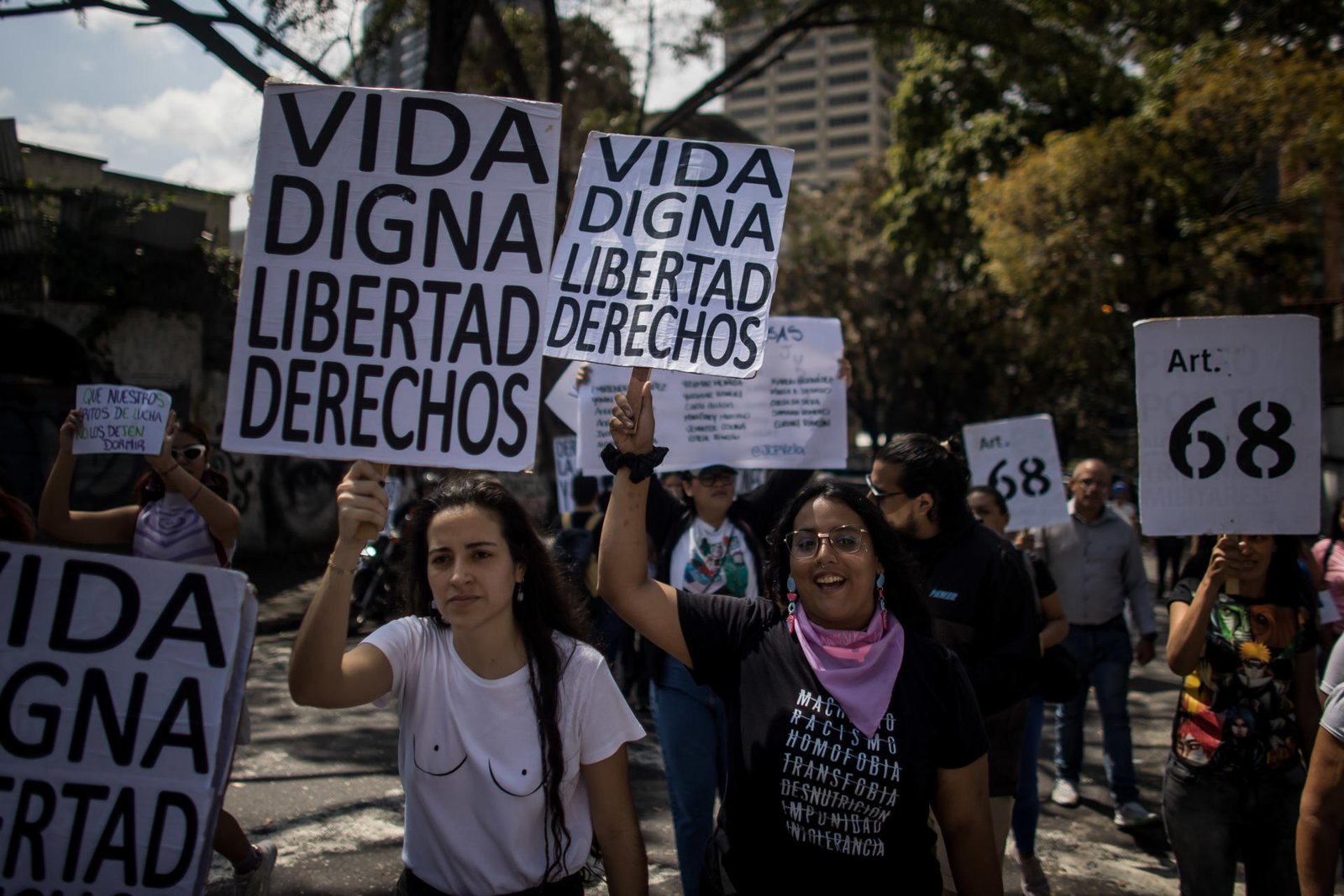
The Peace Laboratory organization presented in Caracas the 162-page study titled Unbreakable: Violence against women in Venezuelan politics, in which he documents with 23 testimonies from militants and leaders how the Exclusion, attacks and systematic discrimination limit the exercise effective of the political rights of female citizens.
This research reconstructs the different types of attacks that Venezuelan women suffer linked to political groups and measures the impact of these attacks on their public, family and personal spheres. The goal of the project is not to offer a global statistical sample of the female population in the sector, but to point out repeated behaviors and structural mechanisms that distance the leaders of the leadership and leadership positions.
The publication coincides with a situation characterized by the restablishment of digital portals, discussions on safeguards for the return of María Corina Machado and the start of negotiations. The public debate reincorporates topics related to pluralism, freedom of the press and free movement. However, the authors of the text maintain that democratic flexibilities lack effectiveness if the population does not exercise such powers on equal terms.
Leadership structure and segregation of duties
The work demonstrates that political action covers multiple fields in addition to electoral processes. Over the last decades, women citizens have promoted unions, coordinated grassroots platforms, directed party organizations, assisted victims, recorded human rights violations and supported community assistance tasks.
Despite this constant presence, the document of the civil entity emphasizes that Mobilization does not guarantee real leadership quotas. Factors such as the humanitarian emergency, institutional harassment, the reduction of civic space and the deterioration of the framework of law deepens gender asymmetries in the country.
Much of the previous research They focused their attention on the crisis of institutions and the elections. This new file examines the usual attacks within the parties, recognizing that the work of the leaders exceeds the limits of said organizations.
The main result of the analysis presents a compelling reality: Mobilizing bases is not equivalent to exercising command. The activists manage daily logistics, move groups and organize activities; However, men retain determinations of a strategic nature are excessive.
Party structures usually cite the public appearance of personalities such as Delcy Rodríguez and María Corina Machado as proof of equity. However, the research clarifies that the visibility of these two female political figures does not prove, by itself, that there is equal access to power.
The data collected reflects this disparity. Although 52.2% of those consulted stated that they were part of management spaces, 87% assured that men control the determining agreements. Likewise, 69.6% identified previous pacts designed in informal circles with no female presence, and only 13% indicated that the leadership adopts their proposals regularly.
There is a differentiated assignment of roles in the party ranks: representation, debate and resolution remain on the masculine side, while logistics, administration, coordination and support fall to the female side.
In parallel, 9% perceive the existence of higher merit requirements for female applicants. The lack of financing, the lack of transparency in appointments and the inclination towards male profiles ensure isolation.
Assimilation of harassment and personal scrutiny
The control exercised over the members is not limited to the distribution of positions. According to the report of Peace Laboratory100% of the participants confirmed that the private sphere of female leaders suffers more severe supervision than that of male leaders. In turn, 73.9% declared they received questions focused on their family lifer, personal conduct or physical image above their professional contributions.
The 23 sources consulted reported discrimination, blockades and intimidation that cross generations, political organizations and trajectories of militancy. The investigation indicates that These are not isolated events, but rather a continuous scheme.
The social assimilation of these behaviors sustains the validity of the described pattern. The dynamics of exclusion usually occur in the form of jokes; Episodes of harassment are assumed to be common practices, and invisibility is accepted as part of the internal functioning. Before the absence of objections or institutional responsessubordination loses its extraordinary character and becomes integrated into the routine of organizations.